
Training Modules for Crisis Responders
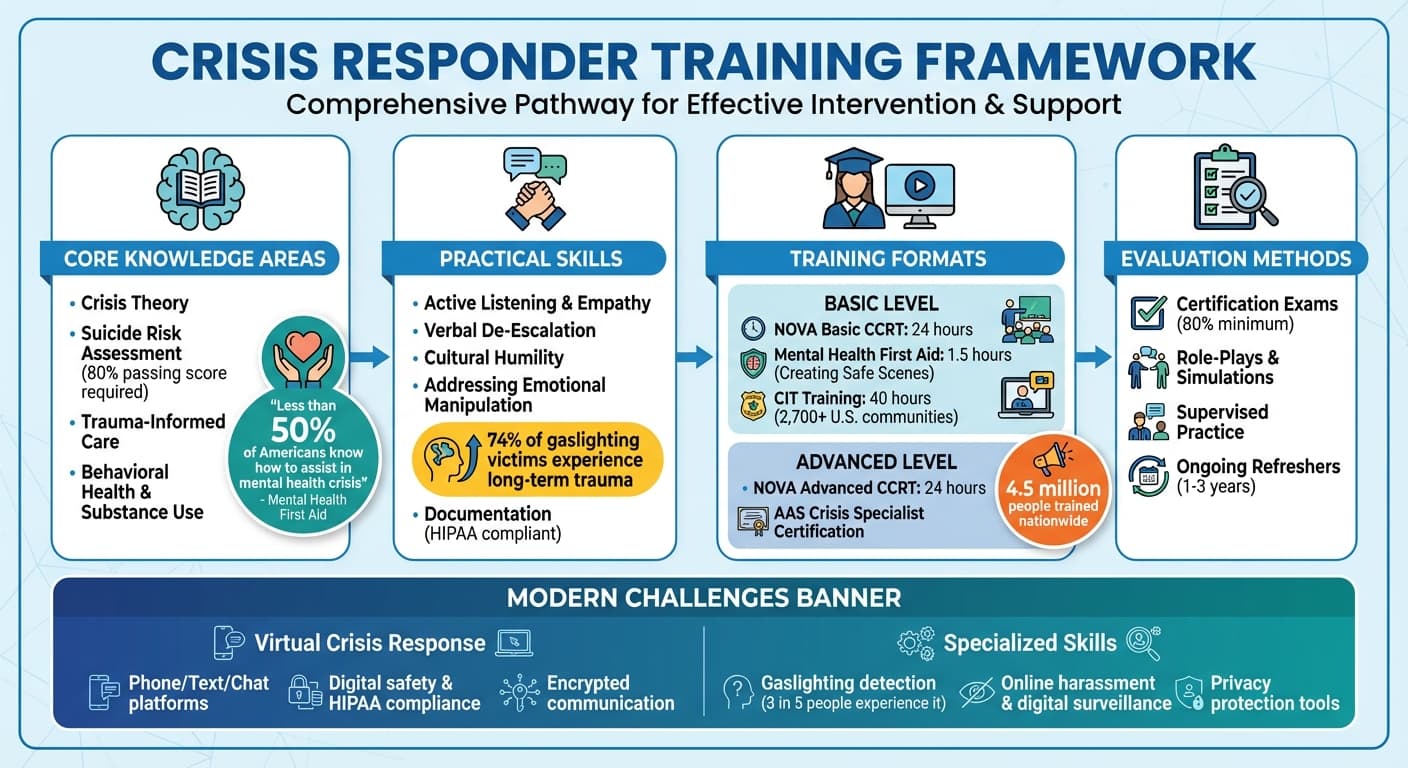
Crisis responders save lives by managing high-pressure situations like suicidal ideation, trauma, or severe anxiety. To perform effectively, they need structured training in risk assessment, trauma care, and de-escalation techniques. Programs like Crisis Intervention Team (CIT) training have shown success in connecting individuals to care rather than incarceration, reducing arrests while improving outcomes.
Key components of crisis responder training include:
- Core Knowledge: Crisis theory, suicide risk assessment, trauma-informed care, and behavioral health basics.
- Practical Skills: Active listening, verbal de-escalation, cultural awareness, and documentation.
- Training Formats: In-person, online, and hybrid models to balance flexibility and hands-on practice.
- Skill Evaluation: Certification exams, role-playing, supervised practice, and ongoing refreshers.
Modern challenges, like virtual crisis response and recognizing emotional manipulation (e.g., gaslighting), require specialized skills. Tools like Gaslighting Check help identify manipulation patterns, while training emphasizes privacy, digital safety, and ethical intervention.
Crisis response training ensures responders are prepared to stabilize individuals, prevent harm, and guide them toward recovery.
::: @figure
A Trauma-Informed Approach to De-escalation and Crisis Response
Core Skills for Crisis Response
To handle high-pressure situations effectively, crisis responders need a mix of theoretical knowledge and practical skills. These abilities help them assess risks accurately, communicate effectively, and connect individuals to appropriate care. Below, we’ll explore the key knowledge areas, hands-on skills, and evaluation methods that are essential for successful crisis response.
Required Knowledge Areas
Crisis responders need expertise in four main areas:
-
Crisis Theory: Understanding how acute stress affects perception and why brief, focused interventions work is crucial. For instance, the American Association of Suicidology (AAS) Crisis Specialist Training emphasizes assessing suicide and self-harm risks, including recognizing warning signs and differentiating between static factors (like past attempts) and dynamic ones (such as access to lethal means). The certification exam for this program requires an 80% passing score [1].
-
Trauma-Informed Care: Responders must recognize how traumatic stress can show up during crises - through dissociation, extreme emotional states, or distorted perceptions. Programs like NOVA's Community Crisis Response Team Training, which has been in use since 1986, teach techniques such as grounding, validation, and identifying immediate needs to avoid re-traumatizing individuals [2].
-
Behavioral Health and Substance Use: Training in this area enables responders to identify signs of mental health conditions, evaluate risks related to intoxication or withdrawal, and assess potential harm to self or others. According to Mental Health First Aid, less than half of Americans know how to assist someone in a mental health crisis, highlighting the importance of structured training [6].
Practical Skills for Responders
Theory alone isn’t enough - crisis responders also need practical skills to navigate real-world situations. These include:
-
Active Listening and Empathy: Techniques like open-ended questions, reflective summaries, and normalization help build trust and validate the individual’s feelings.
-
Verbal De-Escalation: Programs like CPI’s Nonviolent Crisis Intervention train responders to manage agitation by using a calm tone, setting boundaries, and avoiding confrontations [7]. For phone or chat-based interactions, where visual cues are missing, responders rely on vocal pacing and frequent verbal check-ins.
-
Cultural Humility: Responders must consider how factors like race, gender, ethnicity, and sexual orientation influence a person’s crisis and preferred support systems. This involves self-reflection and centering the individual’s perspective rather than assuming expertise.
-
Addressing Emotional Manipulation: When gaslighting or manipulation is involved, responders focus on validating experiences and supporting autonomy. Tools like Gaslighting Check (https://gaslightingcheck.com) can later help individuals identify manipulation patterns, such as blame-shifting or reality distortion. Research shows that 74% of gaslighting victims experience long-term emotional trauma [8].
-
Documentation: Accurate and concise records are essential. Responders must document behaviors, assessments, interventions, and safety plans while complying with U.S. privacy laws like HIPAA. For digital interactions, encryption and controlled access are critical to maintaining confidentiality.
Skill Assessment Methods
Ensuring that responders are well-prepared requires structured evaluation methods:
-
Certification Exams: The AAS Crisis Specialist Certification uses a written exam with an 80% passing requirement, offering two attempts to meet this standard [1].
-
Role-Plays and Simulations: Many programs include observed practice scenarios, such as handling a suicide risk call or managing a crisis involving intoxication. NOVA’s Basic and Advanced CCRT trainings provide 24 hours of instruction each, with embedded skills practice [2].
-
Supervised Practice: New responders often work under supervision in real or simulated situations before gaining independence. For example, SAMHSA offers a free 1.5-hour online course called "Creating Safe Scenes", which introduces first responders to safe crisis approaches.
-
Ongoing Training: Regular refreshers and recertification - typically required every one to three years - help responders stay updated on best practices in areas like suicide prevention, trauma response, and de-escalation [1].
Basic Training Modules
Crisis responders need a solid foundation to handle the challenges they face. Key training modules - covering crisis theory, suicide risk assessment, and trauma care - are central to nearly every crisis intervention program in the U.S. [1].
Crisis Theory Basics
This module introduces the underlying principles behind crisis situations, helping responders differentiate urgent crises from everyday challenges. A crisis is defined as a short-term state where a person’s usual coping mechanisms fail after an overwhelming event, such as losing a job, experiencing a sudden death, or surviving an assault [1]. Training emphasizes the stages of a crisis: the triggering event, rapid escalation, stabilization, and eventual recovery. By recognizing these phases, responders can intervene effectively - early support during the acute phase can significantly reduce long-term harm.
The module also focuses on resilience and recovery. Most individuals, when provided with safety, support, and connection, either return to their baseline or grow stronger after adversity. Trainees practice identifying personal strengths, such as supportive relationships, community ties, faith, cultural practices, or past experiences of overcoming hardship. They also learn to frame crisis reactions as natural responses to difficult circumstances rather than signs of weakness. Real-life scenarios - like a teenager struggling after online bullying or an adult facing suicidal thoughts after losing a job - demonstrate how crisis theory guides decisions about offering phone support, dispatching mobile teams, or involving law enforcement.
Suicide and Self-Harm Risk Assessment
Addressing suicide risk directly can save lives. Trainees are taught to recognize warning signs, such as verbal expressions of wanting to die, preoccupation with methods, hopelessness, giving away possessions, or behavioral changes like increased substance use, social withdrawal, reckless actions, or sudden mood swings [1].
Validated tools like the Columbia-Suicide Severity Rating Scale (C-SSRS) guide responders in assessing critical factors: current thoughts of death, intent, specific plans, access to lethal means, history of attempts, and the level of support available in the next 24 to 72 hours. In the U.S., particular attention is given to assessing access to common lethal means, including firearms, medications, heights, and vehicles. Trainees also learn how to adapt their communication styles for different settings, whether they’re responding to phone calls (like those to the 988 hotline), text messages, or in-person crisis visits.
A vital part of this training involves creating collaborative safety plans. Using evidence-based models like Stanley-Brown, responders work with individuals to identify warning signs, develop coping strategies, and compile a list of supportive contacts and resources, such as crisis lines or mobile teams. These plans are personalized, written in the individual’s own words, and evaluated for practicality using a numerical rating scale. To ensure trainees are proficient, the American Association of Suicidology requires them to pass an exam with a minimum score of 80% [1].
In cases where suicidal thoughts are accompanied by emotional manipulation or gaslighting, responders are trained to validate the individual’s experiences and document patterns safely. Techniques include establishing code words with trusted contacts or, when appropriate, using tools like Gaslighting Check (https://gaslightingcheck.com). These tools analyze conversations for manipulation while ensuring privacy through encryption and automatic data deletion, with a focus on protecting device security.
By mastering these skills, responders are prepared to act quickly and collaboratively to ensure immediate safety.
Trauma and Psychological First Aid
After assessing risks, responders must address trauma with immediate, supportive care. While not every crisis involves trauma, many do, and responders need to recognize trauma reactions without requiring individuals to relive painful events. This module introduces Psychological First Aid (PFA), a set of techniques designed to stabilize and support individuals using six trauma-informed principles: safety; trustworthiness and transparency; peer support; collaboration and mutuality; empowerment, voice, and choice; and sensitivity to cultural, historical, and gender issues [2].
PFA is distinct from traditional therapy because it doesn’t involve revisiting traumatic events. Instead, it focuses on meeting immediate needs and offering practical support. Trainees practice asking permission before physical contact, explaining next steps clearly, providing choices, and using non-coercive de-escalation techniques. Common trauma responses - like dissociation, heightened emotions, distorted perceptions, or hypervigilance - are framed as normal reactions to distressing situations.
Programs like NOVA's Basic Community Crisis Response Team Training, which has been in use since 1986, incorporate these principles into a 24-hour curriculum. This training includes grounding techniques and validation practices. Through role-playing and simulations, such as responding to calls from individuals in acute distress or assisting survivors at an accident scene, trainees gain hands-on experience in applying PFA to stabilize individuals and connect them to the right ongoing support.
Detect Manipulation in Conversations
Use AI-powered tools to analyze text and audio for gaslighting and manipulation patterns. Gain clarity, actionable insights, and support to navigate challenging relationships.
Start Analyzing NowTraining for Virtual and Community Crisis Response
Crisis intervention training has expanded beyond traditional in-person methods to include virtual and community-based approaches. These new contexts require responders to develop specific skills tailored to remote communication and on-site interactions in diverse environments like schools, workplaces, shelters, and neighborhoods.
Virtual Communication Skills
In virtual settings, the absence of visual cues changes how responders assess situations and build trust. On phone or text platforms, they rely on tone, word choice, typing speed, and response timing to gauge emotional intensity. Training focuses on using direct, structured questions to address critical topics like suicidal thoughts, plans, means, and timelines. Without body language, verbal precision becomes essential. Responders are also trained to detect warning signs such as sudden silences, phrases like "goodbye" or "you'll be better off", and abrupt changes in tone.
- Chat and text responders learn to interpret emotional cues from punctuation, spelling shifts, and delays in replies. They practice using clear, concise language and regularly check for understanding.
- Video responders are trained to spot visible injuries, unsafe environments, or signs of intoxication while ensuring privacy for the caller.
- Social media crisis responders focus on identifying red flags in posts, comments, and live streams, then transitioning discussions to safer, private channels in line with organizational policies.
Role-playing exercises, mock calls, and timed simulations help trainees build confidence in managing high-stakes situations remotely. Programs like Mental Health First Aid USA, which has trained over 4.5 million people nationwide, now offer blended and virtual formats to meet the growing demand for these skills [6]. However, effective communication must go hand-in-hand with strong digital security practices.
Digital Safety and Privacy
Maintaining confidentiality and secure communication is critical in virtual crisis work. Training covers HIPAA regulations, duty-to-warn requirements, and data protection strategies, such as using encrypted platforms, strong authentication, secure Wi-Fi, and locked devices [1][4]. Responders are taught how to manage chat logs, screenshots, and recordings responsibly, with clear policies on retention and deletion. Transparency with callers about what is recorded and under what circumstances emergency services may be contacted is emphasized.
Boundary management is another key focus. Trainees learn to separate personal and professional accounts, avoid sharing their location or personal contact information, and handle social media friend or follow requests appropriately. Practical scenarios, such as inadvertently accessing a client’s public profile, help responders apply privacy rules effectively. They also learn incident response protocols, including how to document breaches, notify the appropriate parties, and take corrective action if security is compromised. These measures also help identify subtler risks, such as emotional manipulation.
Identifying Emotional Manipulation and Gaslighting
Crisis responders frequently encounter individuals dealing with emotional manipulation and gaslighting, tactics that distort reality and undermine confidence. Research reveals that 74% of gaslighting victims report long-term emotional trauma, and three in five people have experienced gaslighting without recognizing it [8]. Training modules break down common manipulation patterns, including:
- Reality distortion: "You're imagining things again."
- Blame shifting: "If you were more organized, I wouldn’t have to..."
- Memory manipulation: "I never said that; you must be confused."
- Emotional invalidation: "You're overreacting again."
- Truth denial: "Stop making things up."
Responders practice techniques to affirm survivors’ experiences while avoiding self-blame. For example, they might say, "Based on what you’ve described, it’s understandable to feel confused; many people in emotionally abusive situations feel this way." They also learn to assess safety and connect survivors with resources like domestic violence shelters, legal assistance, and counseling services. Tools like Gaslighting Check (https://gaslightingcheck.com) enhance detection through AI-powered analysis, offering encrypted reports with strict privacy protections.
Dr. Stephanie A. Sarkis, a leading expert on gaslighting, explains: "Identifying gaslighting patterns is crucial for recovery. When you can recognize manipulation tactics in real-time, you regain your power and can begin to trust your own experiences again" [8].
Role-playing exercises simulate both virtual and in-person scenarios. For example, responders might assist a caller questioning their memory due to a partner’s behavior or support a survivor in a shelter who doubts whether their abuse "really happened." Training also addresses modern threats like digital surveillance, doxxing, and online harassment, ensuring comprehensive safety plans that consider both digital and physical risks.
Creating and Evaluating Training Programs
Curriculum Design and Learning Pathways
An effective training program builds on core skills by gradually introducing more advanced concepts and practical applications. For instance, NOVA's Community Crisis Response Team Training has refined this approach over three decades. It begins with a 24-hour Basic CCRT course that covers crisis fundamentals, trauma, and psychological first aid. Once participants complete this, they can move on to the 24-hour Advanced CCRT, which delves into leadership, special population needs, and media coordination [2].
A well-structured curriculum sets clear prerequisites for every level. Introductory training often requires minimal qualifications, like background checks and an understanding of organizational policies. In contrast, intermediate courses might demand prior completion of foundational modules, a specific number of supervised practice hours (e.g., documented call shifts or field experiences), and passing basic skills assessments. Advanced training typically requires participants to demonstrate field experience and secure supervisory approval [1][2][7].
To ensure participants meet competency standards, many programs set benchmarks, such as achieving an 80% pass rate [1]. Training modules should align with specific role requirements. For example, volunteers working on crisis lines need strong communication skills and expertise in suicide risk assessment, while law enforcement officers in Crisis Intervention Team programs require training on safety protocols, legal considerations, and diversion strategies [3][7].
Teaching Methods and Simulation Exercises
The most effective training programs blend concise lectures with hands-on exercises that replicate real-life scenarios. For example, Crisis Intervention Team training for law enforcement, which is implemented in over 2,700 U.S. communities, typically spans 40 hours. It combines classroom instruction with practical skills training and panels featuring individuals with lived experience of mental illness or crisis [3]. Similarly, Mental Health First Aid, which has trained more than 4.5 million people nationwide, incorporates role-playing scenarios followed by immediate feedback [6].
Presentations by individuals with lived experience play a crucial role in fostering empathy and reducing stigma. These sessions often include personal stories from individuals and families who have navigated mental health crises. For maximum impact, these presentations should be scheduled early in the day, followed by small-group discussions to process the material. Speakers should be coached to focus on key learning points and avoid overly graphic details [3].
Simulation exercises are another cornerstone of effective training. These exercises should start with common, high-impact scenarios like handling suicidal ideation calls, domestic disputes, public psychosis incidents, intoxication, or online crisis chats. As participants progress, they can tackle more complex situations, such as co-occurring substance use, multi-party crises, or interactions involving manipulative behaviors. For scenarios involving gaslighting or emotional manipulation, trainers can create anonymized cases that highlight tactics like denial, blame-shifting, and minimization. Each simulation should conclude with a guided debrief, focusing on what went well, missed risks, and areas for improvement in teamwork and documentation [1][2][5][7]. These exercises not only enhance skills but also provide valuable data for refining training programs.
Program Evaluation and Improvement
Evaluating a training program's effectiveness involves tracking both short-term learning outcomes and long-term real-world performance. Pre- and post-tests are commonly used to measure knowledge gains, while self-assessment tools help participants gauge their confidence in areas like suicide risk assessment or de-escalation techniques. Observed skills ratings during simulations and probationary shifts also provide actionable insights [1][6][7]. Operational metrics such as diversion rates, use-of-force incidents, resolution times, and repeat contact rates further highlight program impact [3][7].
Advanced tools like Gaslighting Check (https://gaslightingcheck.com) offer additional layers of analysis. These platforms use AI to identify manipulation patterns in anonymized conversations, generating reports that highlight tactics like reality distortion and emotional invalidation. When properly secured and de-identified, these insights can inform curriculum updates. For example, trainers can use this data to create realistic role-play scripts or decision trees, then measure whether targeted training improves responders' ability to set boundaries, validate experiences, and make appropriate referrals.
Continuous improvement relies on combining routine evaluation data with regular feedback. Organizations should gather input from learners and supervisors about the program's relevance and gaps, review incident reports for emerging trends (e.g., an increase in virtual crisis contacts), and host annual curriculum review sessions. These sessions should include trainers, frontline staff, individuals with lived experience, and partner agencies to ensure the content remains aligned with current U.S. guidelines and best practices [2][3][4][6]. Testing updates with small pilot groups before full implementation can confirm whether changes enhance confidence and intervention success rates, making it easier to scale improvements effectively.
Conclusion
Effective crisis response starts with structured training. When responders are trained in areas like crisis theory, risk assessment, trauma care, de-escalation, and ethical practices, they’re better prepared to identify distress, minimize harm, and guide individuals toward mental health support instead of incarceration. Programs that emphasize this approach have consistently shown success in reducing arrests and improving connections to treatment [2][3].
As crisis systems increasingly rely on modern communication methods - phone, text, chat, and mobile community teams - responders must expand their skill sets. Virtual communication, digital safety, and the ability to recognize emotional manipulation, such as gaslighting, are becoming essential. These skills are particularly important in cases of domestic violence, stalking, or coercive control, where survivors may struggle to articulate their experiences. Training that addresses these scenarios enables responders to validate survivors’ experiences, avoid inadvertently siding with abusers, and document patterns accurately.
One tool making strides in this area is Gaslighting Check (https://gaslightingcheck.com), which uses AI to detect manipulation. By offering encrypted storage and automatic deletion, the platform provides objective insights that help responders validate survivors’ realities, develop tailored safety plans, and support informed decision-making. This technology complements hands-on techniques, as Dr. Stephanie A. Sarkis emphasizes:
"Identifying gaslighting patterns is crucial for recovery. When you can recognize manipulation tactics in real-time, you regain your power and can begin to trust your own experiences again" [8].
However, tools like this should enhance - not replace - the clinical judgment and trauma-informed care that responders provide.
FAQs
What essential skills do mental health crisis responders need?
Mental health crisis responders need a mix of practical skills and emotional awareness to provide meaningful support to individuals in distress. These skills are essential for navigating complex and often high-pressure situations effectively:
- Active listening: This ensures responders fully grasp the needs and emotions of the person they’re assisting, creating a foundation for understanding.
- Empathy: By genuinely connecting with others, responders can build trust and offer compassionate care.
- Emotional regulation: Staying calm and collected during intense moments is vital for maintaining clarity and control.
- Clear communication: Responders must convey information in a way that’s easy to understand, helping to de-escalate potentially volatile situations.
- Problem-solving: Analyzing situations quickly and crafting effective action plans is key to addressing immediate concerns.
- Cultural competence: Respecting and understanding diverse backgrounds fosters a more inclusive and supportive approach.
Another critical aspect is being able to recognize manipulation tactics, such as gaslighting. This awareness helps responders identify emotional abuse and support individuals in reclaiming their confidence and sense of control.
What makes virtual crisis response training different from in-person training?
Virtual crisis response training leverages online tools and platforms to provide responders with a flexible way to hone their skills. Through interactive simulations and virtual role-playing scenarios, participants can experience realistic situations that help them build confidence and sharpen their ability to adapt under pressure.
A key focus of this training is mastering remote communication tools, which are crucial for managing crises in digital spaces. By concentrating on these elements, virtual training equips responders to tackle challenges effectively, whether they're working in an online environment or face-to-face.
How can technology help identify emotional manipulation during a crisis?
Technology has become a powerful ally in spotting emotional manipulation, thanks to tools like AI that can analyze conversations with incredible precision. These systems are designed to pick up on subtle manipulation tactics - like gaslighting - right as they happen, giving people the insights they need to identify and confront harmful behaviors.
During crises, technology also proves invaluable for gathering evidence. It can deliver detailed analyses and validation, helping victims make sense of the manipulation they’re facing. This not only aids in making better decisions but also plays a key role in supporting their journey toward recovery.