
Social Support Strategies for Gaslighting Recovery
Gaslighting can leave you doubting your reality, but building a strong support system is key to recovery. Here's how social connections help:
- Gaslighting Explained: A form of emotional abuse where someone manipulates you into questioning your perceptions.
- Why Social Support Matters: Isolation fuels gaslighting, while trusted individuals validate your experiences and rebuild confidence.
- Steps to Take:
- Identify and reconnect with people you trust.
- Join support groups for shared understanding.
- Set boundaries with unsupportive individuals.
- Document your experiences to affirm your reality.
- Tools for Recovery: Use resources like Gaslighting Check to analyze interactions and complement support from others.
::: @figure
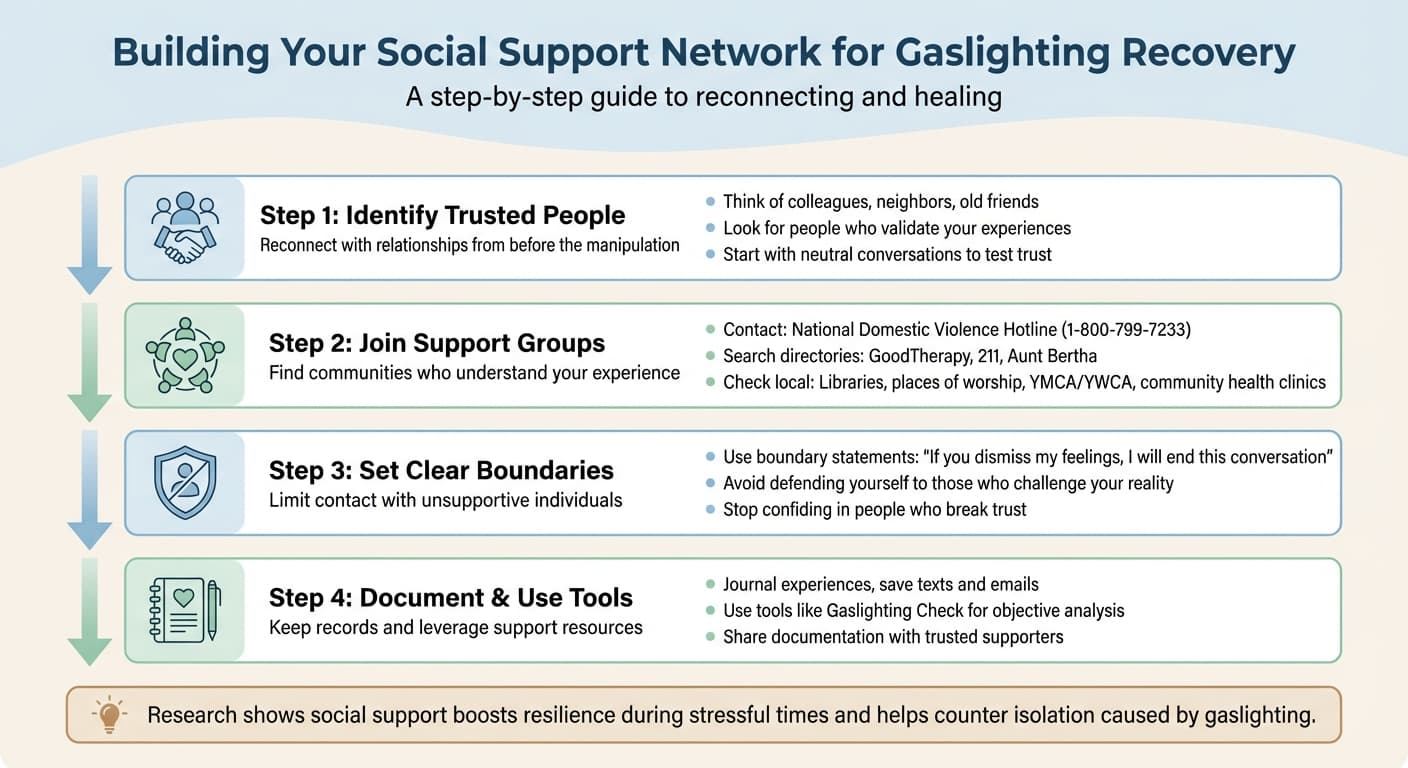
Building Your Social Support Network
Finding People You Can Trust
Recovering from gaslighting starts with identifying people who genuinely validate your experiences and abilities. Think back to relationships you had before the manipulation began - those connections can often provide a sense of stability because they reflect who you were before the abuse.
Expand your circle of support. Different people can fulfill different needs: a colleague might help you navigate work stress, while a neighbor could lend a hand with daily tasks. Focus on those who won’t dismiss your experiences or side with the person who hurt you.
Start small when rebuilding trust. Test the waters by discussing neutral topics like recent news or a movie you enjoyed. This approach allows you to gauge their reactions without immediate vulnerability. When you’re ready to open up, be clear about your needs. For instance, you might say, “I need someone to just listen without offering advice,” or “Please don’t share this conversation with anyone.”
"Keep a record of things that happened, so that when they're challenged later, you can go back to your journal and rest assured from your own words that, yes, in fact, this did happen."
– Kate Balestrieri, Psy.D., Licensed Psychologist [6]
Documenting your experiences - whether through journaling, saving texts, or keeping emails - can be incredibly grounding. These records not only help you affirm your reality but also offer something tangible to share with trusted individuals when seeking support.
Joining Support Groups
Once you’ve identified trustworthy people, support groups can offer an even broader sense of understanding and connection. These groups bring together individuals who’ve experienced gaslighting and can provide empathy and shared perspectives. Domestic violence programs, social service organizations, and community health clinics often host such groups [7][3]. If you’re unsure where to start, the National Domestic Violence Hotline (1-800-799-7233) can connect you to vetted local resources [7]. Online directories like GoodTherapy, 211, and Aunt Bertha are also excellent tools for finding specialized support options.
"Support groups are located at domestic violence and social service organizations. You can locate support groups near you by reaching out to our advocates, or by reviewing online directories such as GoodTherapy, 211 and Aunt Bertha."
– The National Domestic Violence Hotline [7]
Community spaces such as libraries, places of worship, YMCA/YWCA branches, and senior centers often host or can refer you to peer support groups [4]. In-person groups provide face-to-face interaction and access to local resources, while online groups offer anonymity and convenience, especially for those unable to attend in person. Both formats serve the same essential purpose: helping you reclaim your narrative and recognize that the abuse wasn’t your fault [3].
If you’re still in an abusive situation, be cautious when searching for support groups. Use a safe device or browser, as your internet activity might be monitored [7]. The greatest benefit of these groups is the validation they provide from people who’ve walked a similar path - something your personal network might not fully understand.
Setting Boundaries with Unsupportive People
Not everyone in your life will support your healing journey, and that’s okay. Setting firm boundaries allows you to focus on those who uplift and validate you. Some individuals may downplay your feelings, spread rumors, or disguise hurtful remarks as humor. Learning to limit or cut off contact with these people is essential for your recovery [5][2].
Develop clear boundary statements. For instance, if someone minimizes your experience, you might say, “If you keep dismissing my feelings, I will end this conversation” [5]. When someone challenges your version of events, resist the urge to defend yourself. Instead, calmly state, “It seems we remember things differently, but I don’t want to argue about it,” and then redirect the conversation or step away [2].
"As soon as you understand that it doesn't matter how right you are, the closer you will be to freedom."
– Robin Stern, Ph.D., Co-founder and Associate Director of the Yale Center for Emotional Intelligence [1]
You can’t control how others perceive your story, even when you know you’re right. Accepting this truth is a critical step toward emotional liberation [1]. Protect your narrative by ending conversations that leave you feeling attacked or invalidated [1]. Stop confiding in people who break your trust or gossip about your situation [8]. If direct confrontation might escalate into physical danger, prioritize creating distance over verbal boundary-setting [5].
Communicating Effectively Within Your Support Network
Sharing Your Story in a Safe Way
Talking about gaslighting can feel overwhelming, but preparation can make a big difference. Start by clearly stating your needs. For example, you could say: "My partner is gaslighting me, and I need you to listen and validate my experience" [3]. This simple statement helps set expectations and ensures the listener understands how to support you.
When you share your story, focus on your emotions - whether that's confusion, hurt, or feeling attacked - rather than debating specific incidents [1]. This approach avoids the exhausting back-and-forth arguments that gaslighters often exploit. If speaking feels too difficult, consider writing your thoughts down instead [7].
"Gaslighting is a way that abusive partners minimize and/or dismiss what they did, so talking it out with others will validate your experience and recognize that what the abuser did is not ok."
– The National Domestic Violence Hotline [3]
Bring in supporting records when necessary. If you have documentation that backs up your story, share it selectively to reinforce your account [3][2]. However, if you're still in the abusive relationship, ensure these records are stored securely - send copies to a trusted friend and delete them from your own devices to avoid discovery [3].
Once you’ve shared your story, follow up by clearly outlining what you need from the person you’re speaking to. This helps them understand how best to support you.
Stating Your Needs Directly
Recovery is strengthened when you combine storytelling with direct, specific requests. Vague requests can lead to frustration or unmet expectations, so be clear about what you need. For instance, you might say: "I need you to hold onto these important documents for safekeeping," or "I just need someone to be here with me while I sort this out" [8][7].
Relying on multiple people for support can be helpful. Each person may bring something different to the table. For example, a colleague might help you navigate workplace challenges, while a neighbor could assist with family-related concerns [4]. Spreading out your support network this way prevents any single person from feeling overwhelmed and gives you a broader base of strength.
"Research shows though that expressing vulnerability, the feeling of being emotionally exposed, can bring you closer to others, and strengthen connections."
– Eric, Hotline Advocate, The National Domestic Violence Hotline [7]
Be upfront about confidentiality. If privacy is critical, make it clear: "Please don’t share this with anyone - breaking that trust could put me in danger" [8]. Being direct about these boundaries not only protects your safety but also ensures the relationship remains intact.
Using Tools for Additional Support
How Gaslighting Check Can Help

Recovering from manipulation can cloud your judgment, making it tough to trust your instincts. Tools like Gaslighting Check provide a way to objectively analyze conversations and detect manipulation tactics that might otherwise go unnoticed. This tool uses both text and voice analysis to uncover patterns of manipulation in interactions [2][3].
It generates detailed reports highlighting recurring behaviors and includes emotion logging to help you track how specific interactions impact your mental well-being. With features like end-to-end encryption and automatic data deletion, it ensures your privacy - especially critical if you're in a vulnerable situation.
However, before using voice recordings for legal purposes, make sure you’re familiar with your state's recording laws [2][3]. Understanding these legal boundaries is essential if you plan to present evidence later. By offering a clear, unbiased perspective, tools like this enhance your ability to navigate recovery while complementing other forms of support.
Combining Tools with Personal Support
While digital tools provide valuable insights, they’re most effective when paired with support from trusted individuals. For example, detailed reports from tools like Gaslighting Check can help you present a well-documented case to legal or medical professionals, offering a timeline of behavior that’s harder to dismiss.
When confronting a gaslighter, consider involving a neutral third party from your support network and use digital tools to monitor the interaction [2]. To protect yourself, clear your browser history after using these tools [3]. Save important files - like screenshots, voice memos, or text transcripts - in a secure email account or share them with a trusted friend. Once stored safely, delete these files from your device to minimize the risk of being monitored [3].
Detect Manipulation in Conversations
Use AI-powered tools to analyze text and audio for gaslighting and manipulation patterns. Gain clarity, actionable insights, and support to navigate challenging relationships.
Start Analyzing Now7 Keys to Recover From Gaslighting | OC Relationship Therapist
Conclusion: Strengthening Recovery Through Social Support
Recovering from gaslighting hinges on connection. Building a network of trusted friends, family members, support groups, and professionals provides fresh perspectives to challenge the gaslighter's distortions. In fact, a 2022 study highlighted that social support plays a key role in boosting resilience during stressful times [4]. These relationships act as a foundation, helping to counteract feelings of isolation and warped perceptions.
Combining personal connections with digital tools can further reinforce recovery. While your support network provides emotional reassurance and reality checks, AI-driven tools can help document and clarify manipulation patterns. This combination - emotional support paired with objective evidence - helps you distinguish between reality and the gaslighter’s narrative.
Each type of relationship contributes something different. A therapist can guide you through trauma, support groups offer shared experiences, and digital tools provide tangible proof of events. Together, these resources form a safety net that helps rebuild self-trust and counters the isolating effects of gaslighting.
Interestingly, offering support to others can also aid your own healing. Sharing your journey in moderated support groups or with individuals facing similar struggles can create a sense of purpose and connection. This reciprocal exchange not only strengthens your progress but also helps dismantle the isolation that enables gaslighting to persist.
Your path to recovery is personal, and finding the right mix of supportive relationships and practical tools will empower you to reclaim your reality and trust in yourself once again.
FAQs
How can I tell if someone is gaslighting me?
Gaslighting happens when someone manipulates you in ways that make you doubt your own reality, memories, or emotions. Some common tactics include denying events or facts, dismissing your feelings as irrational, and shifting blame onto you. They might also twist your words or claim conversations never happened, leaving you confused and questioning yourself.
If you think you're experiencing gaslighting, start by observing these patterns and how they affect you. Writing down specific incidents can help you keep track of what’s happening. Talk to trusted friends, family, or a mental health professional to share your experiences and get validation. A solid support system is key to protecting your emotional health and regaining confidence in your perspective.
What are the advantages of joining a support group during gaslighting recovery?
Joining a support group during gaslighting recovery can be incredibly helpful. It creates a safe, understanding environment where you can openly share your experiences and emotions without judgment. Connecting with others who have faced similar challenges can ease feelings of isolation and provide comfort through shared understanding.
These groups also offer practical tools and techniques to help rebuild your confidence, trust your instincts again, and develop healthier ways to cope. Listening to others’ stories and perspectives can inspire new ways of thinking and strengthen your ability to navigate the recovery process with greater ease and confidence.
How do I set boundaries with people who aren't supportive during gaslighting recovery?
Setting boundaries with individuals who undermine your emotional well-being is a key step in recovering from gaslighting. Start by identifying behaviors that harm your mental health, such as dismissing your emotions or disregarding your needs. Once these patterns are clear, outline specific boundaries to protect yourself. This might include avoiding certain topics, spending less time with them, or prioritizing activities that nurture your well-being.
When communicating these boundaries, be calm yet firm. Consistency is crucial - stick to your limits even if it feels challenging. Surround yourself with people who respect your boundaries and affirm your experiences. Building this kind of support system fosters a safer space for your healing journey. Setting boundaries isn’t an overnight fix, but with patience and persistence, it’s a vital step toward reclaiming your emotional health.