
5 Signs of Manipulation AI Can Spot in Texts
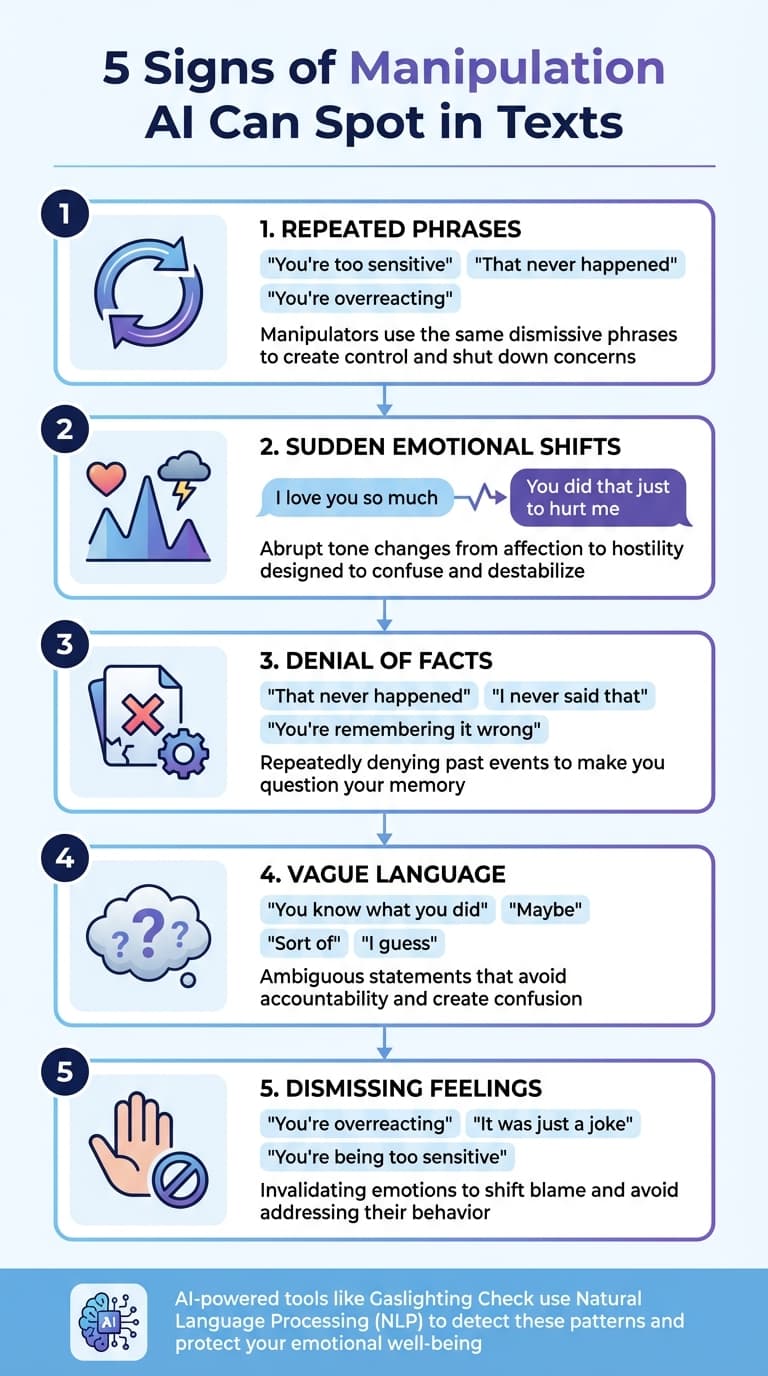
Manipulation in text messages can be subtle but harmful. Here are 5 key signs that tools like Gaslighting Check can detect to protect your emotional well-being:
- Repeated Phrases: Manipulators often use the same dismissive phrases like "You're too sensitive" to create control and shut down concerns. AI tools track these patterns over time.
- Sudden Emotional Shifts: Abrupt changes in tone, like switching from affection to hostility, are flagged as deliberate attempts to confuse and destabilize.
- Denial of Facts: Repeatedly denying past events or statements can make you question your memory. AI identifies contradictions across conversations.
- Vague Language: Phrases like "You know what you did" avoid accountability. AI highlights evasive language and patterns of deflection.
- Dismissing Feelings: Comments like "You're overreacting" invalidate emotions. Tools detect frequent use of such language to identify manipulation.
Gaslighting Check uses Natural Language Processing (NLP) to analyze texts, flag manipulative patterns, and provide reports for clarity. It helps you set boundaries and maintain healthier communication.
::: @figure
1. Repeated Use of the Same Phrases
Manipulators often rely on a small set of phrases to create a sense of control and predictability. Phrases like "You're too sensitive" or "That never happened" are frequently used to dismiss concerns and shut down meaningful conversations [6][7].
This repetitive language can create a false sense of authority, making it easier to gain someone’s trust without question [5]. Tools such as Gaslighting Check analyze the frequency of these phrases, helping to detect patterns during conflicts or situations where clear answers are needed. By identifying these repeated patterns, the tool can uncover deeper manipulative strategies at play.
Experts refer to this tactic as "steamrolling", where repeated arguments wear down the other person over time. Natural Language Processing (NLP) technology scans for phrases like "You're overreacting", "It was just a joke", or "You're being too sensitive" - all of which are common indicators of manipulation.
Pay attention to absolute language, such as "you always" or "you never." These statements are major red flags, often signaling the rigid, black-and-white thinking typical of manipulative behavior. Gaslighting Check focuses on identifying such patterns, as they disrupt healthy communication. If you notice the same dismissive phrases surfacing every time you express hurt or concern, it’s a sign worth examining.
Gaslighting Check’s free text analysis tool documents these recurring phrases, helping to establish a communication baseline. This makes it easier to spot when certain language exceeds the boundaries of healthy interaction.
2. Sudden Changes in Emotional Tone
Abrupt shifts in emotional tone can be a strong sign of manipulation, often leaving you feeling confused and off-balance.
Manipulators tend to swing between extremes. One moment, they might shower you with warmth and affection, saying things like, "I love you so much." Hours later, you could receive a drastically different message, such as, "I guess I don't matter to you anymore" or "You did that just to hurt me." This emotional rollercoaster isn't accidental - it's designed to keep you unsettled.
These sudden changes make it hard to find emotional footing. For instance, someone might go from self-pitying statements like, "I guess I'm just a terrible person", to outright accusations. The goal? To create enough confusion that you focus on the chaos rather than the manipulation behind it. This tactic becomes even more effective in text communication, where the absence of facial expressions and tone of voice amplifies the uncertainty.
Be mindful of signs like abrupt tone changes - messages in ALL CAPS, long silences followed by urgent demands like "Answer me now", or cruel comments later brushed off as "just a joke." These behaviors aren't random; they're calculated to destabilize.
Tools like Gaslighting Check analyze text patterns to detect these emotional swings. By tracking changes in language, punctuation, and intensity, it flags shifts that could indicate manipulation. This documentation helps separate normal mood changes from deliberate attempts to control.
If you notice someone frequently cycling between affection and hostility - especially when you assert boundaries or make independent choices - it's worth paying closer attention. Consistent patterns like this often point to a deeper issue that shouldn't be ignored.
3. Denying Facts or Past Events
Denying past events or facts can seriously disrupt clear communication. Among the most harmful tactics is when someone outright denies previous statements or actions. You might hear things like, "That never happened", "I never said that", or "You're remembering it wrong." These phrases are often used intentionally to make you question your memory.
AI tools tackle this behavior by analyzing conversations over time. Through Natural Language Processing (NLP), these systems can pick out phrases linked to truth denial and memory manipulation. They compare statements across different messages to find contradictions. For instance, if someone says, "I always supported your decision" in one conversation but earlier messages show them saying, "You're making a huge mistake", the AI flags the inconsistency. By examining the context and spotting repeated contradictions, the system can identify deliberate attempts to distort reality.
The real red flag isn’t just a one-off instance of "forgetting." It’s the repeated pattern of denial, especially when documentation proves otherwise. Manipulators often exploit the fact that human memory can be unreliable. That’s why storing texts and emails can be crucial - they provide solid evidence for AI systems to analyze.
Pay attention to phrases that challenge your sense of reality, like "You must be confused", "You're imagining things", or "It was just a joke" when it clearly wasn’t. These types of statements are often flagged by AI detection systems because they’re crafted to make you second-guess yourself. When such patterns appear frequently, they point to something more concerning than a simple misunderstanding.
4. Using Vague or Generic Language
Manipulators often rely on vague language to sidestep accountability. Statements like "You know what you did" or "You always do this" put you on the defensive without offering any concrete details to address. It's a tactic designed to keep you guessing and off balance.
This kind of ambiguity also clouds conversations, creating a "fog" that makes it harder to pin down the truth. Words and phrases like "maybe", "sort of", or "I guess" allow manipulators to avoid committing to a clear stance. Later, they can twist their words, claiming, "That's not what I meant", because they never gave a definitive answer in the first place. If you push for clarification, they might deflect by saying things like, "Why are you always so negative?" or "You're making a big deal out of nothing", steering the conversation away from the original issue.
AI tools can pick up on this behavior by analyzing the flow of conversations. Using Natural Language Processing (NLP), these systems detect patterns of evasive language, especially during moments of tension or conflict. For instance, if someone repeatedly avoids giving direct yes-or-no answers when you set boundaries or ask clear questions, the AI flags this as a potential red flag. It can also highlight frequent use of phrases like "I don't remember saying that", which often signals an attempt to dodge responsibility.
The best way to counter vague language is to demand specifics. Ask questions like, "What exactly are you referring to?" or "Can you point to a specific instance?" Manipulators thrive on your acceptance of ambiguity, so pressing for details either forces them to clarify or exposes their evasiveness. To protect yourself further, follow up on important conversations with written summaries. This creates a record that’s hard to misinterpret or rewrite later.
Interestingly, AI analysis shows that spikes in vague language often occur right after direct questions or boundary-setting. This isn’t a coincidence - it’s a deliberate effort to create confusion. If you notice this pattern, trust your instincts. That uneasy feeling you get? It’s your cue that something’s not adding up.
Detect Manipulation in Conversations
Use AI-powered tools to analyze text and audio for gaslighting and manipulation patterns. Gain clarity, actionable insights, and support to navigate challenging relationships.
Start Analyzing Now5. Dismissing Your Feelings
Dismissing your feelings is one of the most harmful manipulation tactics out there. It’s a way for someone to invalidate your emotions, making you question your right to feel hurt or upset. You’ve probably heard phrases like, “You’re being too sensitive,” “You’re overreacting,” or “It was just a joke.” These kinds of comments are designed to downplay your feelings and shift the blame onto you.
Here’s how it works: instead of addressing their own behavior, the manipulator turns the attention to you, making it seem like you’re the problem. If you express frustration or hurt, they might respond with, “Why are you always so negative?” or even deny your experience entirely by saying, “That never happened.” This tactic not only avoids accountability but also leaves you doubting your own reality. It’s a subtle but powerful way to maintain control.
AI tools like Gaslighting Check are built to detect emotional invalidation by analyzing conversations for dismissive language. For example, phrases like “You’re overreacting” or “You’re misremembering” are red flags. These tools also look out for absolute language - words like “always” or “never” - which manipulators often use to make you feel unreasonable or impossible to deal with.
If you notice someone frequently using dismissive language in texts, save those messages. Keeping a record can provide clear evidence of patterns that are harder to deny later. Pay close attention to repeated phrases like “That never happened” or “You’re imagining things.” These recurring patterns often point to deliberate manipulation. Trust your gut - if you’re consistently feeling confused or doubting yourself, it’s a sign something’s wrong.
The best response? Set clear boundaries. If the dismissive behavior doesn’t stop, it’s a strong indicator of a deeper lack of respect. Protecting your emotional well-being is non-negotiable.
How Gaslighting Check Detects These Signs

Gaslighting Check analyzes your conversations for manipulative phrases like "You're overreacting", "I never said that", or "After everything I've done for you." Using advanced NLP algorithms, it flags these phrases instantly. When you paste a text thread into the system, it highlights patterns such as repeated guilt-tripping or dismissive language that might otherwise go unnoticed.
Once problematic language is identified, the tool notifies you immediately. For instance, during a live conversation, if a message like "Answer me now" or "Everyone else agrees with me" is sent, you'll receive a real-time alert explaining the tactic - whether it’s an attempt at urgency-based control or creating a false sense of consensus. If a phrase like "I guess I'm just a terrible person then" appears repeatedly (say, three times), the system flags it as a pity-play guilt trip and notifies you on the third instance[1][3].
With the conversation history tracking feature (available in the Premium Plan for $9.99/month), the system archives text threads along with timestamps. This allows the AI to cross-reference statements across conversations. For example, if someone claims, "I never said that", the system can immediately contradict it by referencing earlier messages[1][2][4]. This feature helps identify patterns of escalating evasiveness or repeated denials over time.
The platform also generates detailed reports that compile all the data into actionable insights. These reports include charts showing how often invalidating phrases appear, tone graphs tracking emotional changes, and frequency breakdowns (e.g., 5 denials in 10 messages). They even suggest next steps, like "Pause the conversation and start documenting", helping you better understand manipulation patterns[1]. You can export these reports to share with a therapist or use them as evidence if needed.
To ensure privacy, the platform uses end-to-end encryption and automatically deletes data after 30 days. By turning vague feelings of confusion into clear, actionable data, Gaslighting Check empowers you to set boundaries and protect yourself effectively.
Conclusion
Manipulative texts often rely on repeated phrases, sudden shifts in tone, denial of facts, vague statements, and outright dismissal of emotions. These tactics are designed to confuse you and make you second-guess your own perceptions.
Gaslighting Check steps in to address this by analyzing conversations in real time. It flags phrases like “I never said that” and identifies recurring patterns of invalidation or contradiction. With detailed reports, it highlights manipulative language and behaviors, giving you concrete evidence to better understand the dynamics at play.
This technology isn’t about creating distrust - it’s about providing clarity. By recognizing patterns of denial or guilt-tripping, you’re empowered to set boundaries and protect your well-being. In a world where so much communication happens via text, tools like this help you build relationships rooted in trust and mutual respect. With objective insights, you can regain control and ensure your conversations are healthier and more respectful.
FAQs
How does Gaslighting Check identify manipulation in text conversations?
Gaslighting Check uses Natural Language Processing (NLP) to dig deep into text and spot signs of emotional manipulation. It examines everything from word choices and sentence flow to the overall context, uncovering tactics like gaslighting, blame-shifting, and dismissive language. The system is trained to catch subtle red flags - things like guilt-tripping phrases, contradictions, or responses that invalidate emotions.
On top of that, the platform uses sentiment analysis to track emotional tone, detect shifts in mood, and identify urgency in conversations. This makes it easier to separate genuine communication from manipulative patterns. By blending these technologies, Gaslighting Check gives users clear insights and real-time alerts, empowering them to spot and address manipulation as it happens.
What should I do if Gaslighting Check detects manipulative language in my conversations?
If Gaslighting Check flags manipulative language, it’s crucial to focus on protecting your emotional well-being. Start by carefully reviewing the AI’s findings to understand the tactics identified, like guilt-tripping or emotional invalidation. This information can help you evaluate the situation and determine your next steps.
You might want to document these interactions for your records, especially if you think you’ll need support or plan to take further action. It’s also wise to connect with trusted friends, family members, or a mental health professional for advice and perspective. If the manipulation continues, consider setting firm boundaries or stepping away from the conversation to safeguard your emotional health.
By taking these actions, you can approach the situation with more confidence and maintain your mental and emotional balance.
Can Gaslighting Check analyze emotional shifts in text messages?
Gaslighting Check is built to examine emotional changes in text messages. It uses AI-driven tools like sentiment analysis and natural language processing (NLP) to spot shifts in tone, subtle emotional changes, and patterns like guilt-tripping, gaslighting, or emotional invalidation.
By identifying these patterns, Gaslighting Check empowers users to recognize possible manipulation tactics and gain a clearer understanding of the emotional dynamics in their conversations.