
Narcissism and Gaslighting: The Connection
Gaslighting is a manipulation tactic often used by narcissists to control others. It involves distorting reality, making victims doubt their perceptions, and fostering dependency. Narcissists use this to protect their fragile egos and maintain dominance in relationships. Victims typically experience three stages: disbelief, defense, and depression, often leading to emotional exhaustion and loss of self-trust.
Key insights:
- Narcissistic traits like entitlement and lack of empathy fuel gaslighting.
- Common tactics include countering, trivializing, and withholding.
- Gaslighting Check, an AI tool, helps identify manipulation in real time by analyzing text and audio interactions.
Understanding these behaviors can empower victims to regain clarity and take steps toward recovery.
The narcissist’s most deceptive gaslighting moves
Narcissistic Personality Traits and Gaslighting Explained
This section sheds light on how narcissistic traits fuel the manipulative tactics of gaslighting.
Narcissistic Personality Disorder (NPD) is characterized by traits such as an inflated sense of self-importance, fixation on fantasies of boundless success or power, excessive need for admiration, entitlement, and a lack of empathy [2][4]. A clinical diagnosis requires an individual to exhibit at least five out of nine specific traits [2]. These tendencies often turn relationships into tools for control and self-validation [3].
Gaslighting is one of the most effective tools in a narcissist's arsenal. It involves deliberate, ongoing manipulation designed to erode a victim's confidence and create emotional dependency [4][6]. Unlike simple disagreements, gaslighting is calculated and persistent, aimed at making the victim doubt their own reality to the point where they rely on the narcissist for validation [4][6].
Narcissists often protect their fragile egos by deflecting blame and projecting their faults onto others [3][5]. Tairesha "Sunflower" Flemister, LMSW, from Charlie Health, explains:
"Narcissistic gaslighting occurs when a narcissistic individual manipulates someone into questioning their own reality, memory, or perception" [5].
This manipulation typically surfaces during the devaluation phase of the narcissistic abuse cycle. Initially, the narcissist engages in love-bombing and idealization, but this soon gives way to criticism and gaslighting, which gradually dismantles the victim’s self-esteem. Eventually, the cycle ends with abrupt abandonment, also known as "discarding" [6][8]. Gaslighting creates a power imbalance where the victim is left confused, submissive, and dependent [4][5][6]. These dynamics provide insight into how narcissistic traits shape the use and acceptance of gaslighting.
A 2023 study involving 315 participants revealed that men with high levels of vulnerable narcissism - marked by hypersensitivity to rejection and fragile egos - were significantly more likely to accept gaslighting tactics than women [1]. Vulnerable narcissism, in particular, shows a strong connection to a greater acceptance of such manipulative behaviors [1].
1. Narcissistic Personality Traits
Purpose
Narcissists often use gaslighting as a tool to shield their fragile ego and maintain control in relationships. While they may appear confident, beneath the surface lies a deep-seated insecurity that makes them hypersensitive to criticism - commonly referred to as "narcissistic injury." By distorting their victims' sense of reality, narcissists create an environment where they hold all the power, leaving others reliant on them for validation and decision-making. In some cases, they even find satisfaction in their victims' confusion, using manipulation as a way to assert dominance. These tendencies are reflected in the specific strategies they use, which are explored below.
Mechanisms/Methods
Narcissists rely on various tactics to manipulate and control. One common method is projection, where they accuse others of the very behaviors they exhibit. For example, a narcissist who lies frequently might accuse their partner of being untrustworthy. They also trivialize others' emotions, dismissing valid feelings as "too sensitive" or unimportant. Another tactic is stonewalling - abruptly cutting off conversations when confronted, effectively dodging accountability.
What fuels these behaviors is a profound lack of empathy. Narcissists see their perspective as the only one that matters, often dismissing opposing views as irrational or a sign of instability. This mindset allows them to perpetuate their manipulation without remorse. A 2023 study involving 315 participants identified primary psychopathy, Machiavellianism, and sadism as the strongest predictors of gaslighting tendencies, with these traits explaining 57.2% of the variance in gaslighting acceptance [1]. These manipulative strategies take a heavy psychological toll on those targeted.
Impact on Victims
The effects of narcissistic gaslighting can be devastating. In a survey of 2,875 individuals who experienced intimate partner violence, 85.7% reported being labeled "crazy" by their partner, and 73.8% believed their partner intentionally tried to make them feel insane. Alarmingly, 50.2% said their partner had threatened to report them as "crazy" to authorities, discouraging them from seeking help [10].
Victims often go through a cycle of disbelief, attempts to defend themselves, and eventually, emotional exhaustion. This can lead to depression and a loss of trust in their own perceptions. Over time, they may find themselves constantly apologizing, doubting even the smallest decisions, and withdrawing from loved ones. As the narcissist's fabricated reality takes over, victims lose their sense of self and become increasingly isolated, trapped in a web of manipulation.
Detect Manipulation in Conversations
Use AI-powered tools to analyze text and audio for gaslighting and manipulation patterns. Gain clarity, actionable insights, and support to navigate challenging relationships.
Start Analyzing Now2. Gaslighting Check

Purpose
Gaslighting Check provides a tool to help you regain clarity in situations clouded by narcissistic manipulation. When dealing with a narcissist, it’s often hard to trust your own perceptions. This platform aims to bridge that gap by objectively analyzing conversations and validating your experiences. Research indicates that 3 out of 5 people unknowingly endure gaslighting, with many remaining in manipulative relationships for more than two years[11].
Using advanced machine learning, Gaslighting Check identifies common manipulation tactics like blame shifting, memory distortion, denying reality, and emotional invalidation. Instead of leaving you to second-guess yourself, it offers an evidence-based breakdown of your interactions.
Mechanisms/Methods
The platform analyzes both text and audio conversations through multi-modal detection techniques[11][12]. Whether it’s a chat transcript or an audio file, the AI scans for patterns that are often hallmarks of gaslighting, such as:
- Countering: Statements like, "Your memory is always terrible; I never said that."
- Withholding: Phrases such as, "I don’t want to talk about this again."
- Trivializing: Comments like, "It was just a joke, don’t be so sensitive."
It doesn’t just stop at identifying these patterns. The system provides real-time insights along with actionable recommendations to help you respond effectively. Stephanie A. Sarkis, Ph.D., author of Healing from Toxic Relationships, highlights the importance of recognizing these tactics:
"Identifying gaslighting patterns is crucial for recovery. When you can recognize manipulation tactics in real-time, you regain your power and can begin to trust your own experiences again"[11].
For those seeking deeper insights, premium features like conversation history tracking allow users to identify recurring patterns over time.
Impact on Victims
The effects of gaslighting can be profound, with 74% of victims reporting long-term emotional trauma[11]. For many, tools like Gaslighting Check provide a much-needed sense of validation and clarity. David W., who endured manipulation since childhood, shared his experience:
"The AI analysis confirmed what I suspected but couldn’t prove. It gave me the clarity I needed to make important decisions"[11].
Pros and Cons
::: @figure
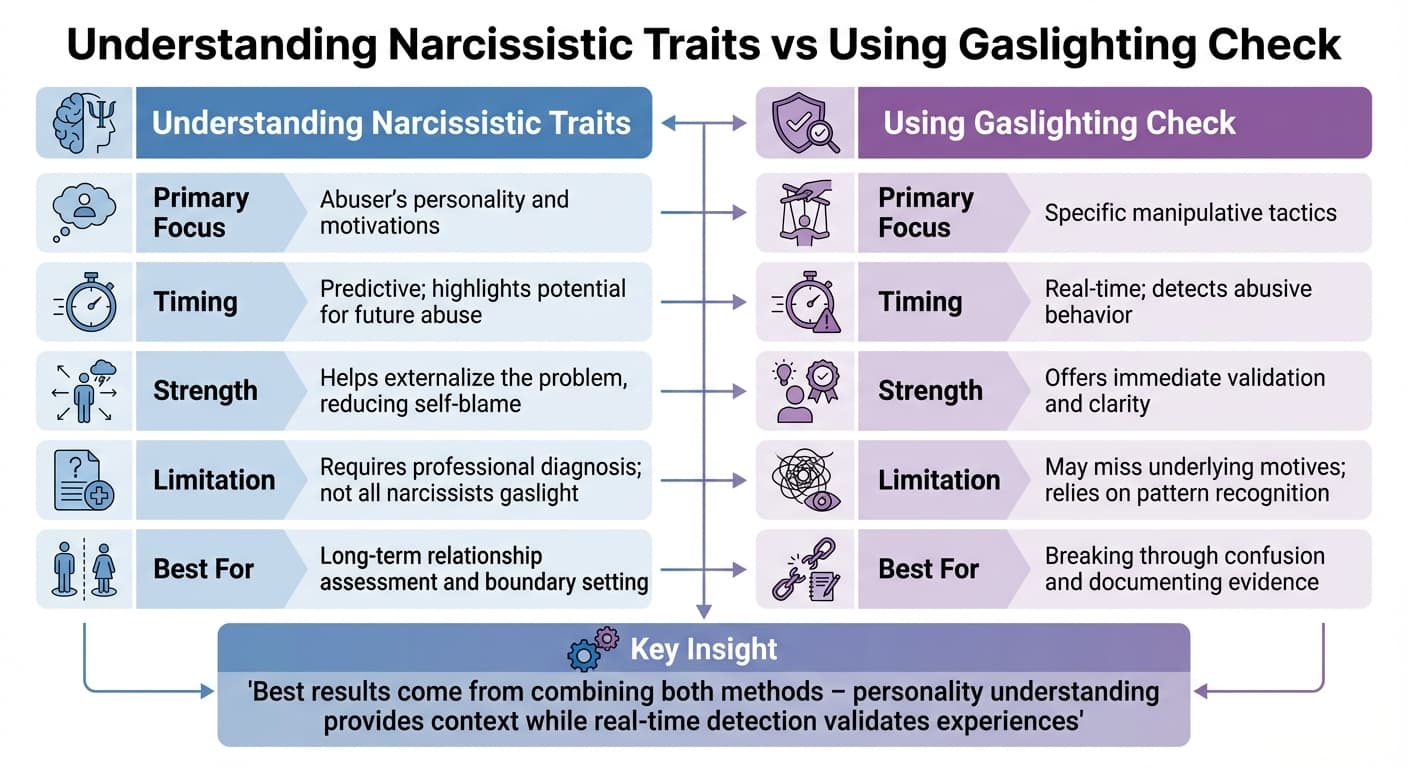
This section dives into the comparison between long-term personality insights and immediate behavioral detection when dealing with narcissistic manipulation. By examining these two approaches side by side, we can better grasp their individual strengths and limitations.
Understanding narcissistic personality traits sheds light on the root motivations behind manipulative behaviors. For example, recognizing patterns like the "Idealize, Devalue, Discard" cycle can help predict future actions before they escalate [5][9]. Studies show that traits from the Dark Tetrad significantly influence the likelihood of someone engaging in gaslighting [7]. However, there are challenges with this approach: diagnosing Narcissistic Personality Disorder (NPD) requires a trained professional, and individuals with NPD rarely seek help [9]. Additionally, not all gaslighters are narcissists - traits like primary psychopathy and sadism often play a larger role in gaslighting behaviors than narcissism alone [7].
Using Gaslighting Check, on the other hand, offers instant feedback by identifying manipulative behaviors as they occur. It detects tactics like countering, withholding, and trivializing, helping to clear the confusion often caused by gaslighting. This method provides tangible evidence, especially when self-doubt creeps in. However, its focus is on identifying what is happening rather than why. It also works best when spotting repeated, intentional patterns of abuse, rather than one-off disagreements.
| Aspect | Understanding Narcissistic Traits | Using Gaslighting Check |
|---|---|---|
| Primary Focus | Abuser's personality and motivations | Specific manipulative tactics |
| Timing | Predictive; highlights potential for future abuse | Real-time; detects abusive behavior |
| Strength | Helps externalize the problem, reducing self-blame | Offers immediate validation and clarity |
| Limitation | Requires professional diagnosis; not all narcissists gaslight | May miss underlying motives; relies on pattern recognition |
| Best For | Long-term relationship assessment and boundary setting | Breaking through confusion and documenting evidence |
The best results often come from combining these two methods. Understanding personality traits provides a clearer picture of an abuser's tendencies, while real-time detection validates your experiences and supplies actionable evidence. Together, these tools can help you make more informed decisions about your relationships and set the foundation for exploring intervention strategies in future discussions.
Conclusion
Narcissistic gaslighting can dismantle your sense of reality, self-esteem, and independence. The link between narcissistic tendencies and gaslighting is intentional - meant to assert control while deflecting accountability to protect a fragile ego. As Tairesha "Sunflower" Flemister, LMSW, explains:
"Learning to identify gaslighting behaviors is the first step to breaking free." [5]
This type of manipulation leaves deep and lasting effects. Victims often find themselves trapped in the stages of the Gaslight Effect - starting with disbelief, moving to constant self-defense, and eventually succumbing to depression and emotional fatigue [6]. Over time, gaslighting can cause serious psychological and even physical harm [8]. Isolation tactics, frequently used by gaslighters, only deepen dependency and make it harder to see the truth.
Recognizing these behaviors is the first step toward breaking free. Tools like Gaslighting Check can help by validating your experiences through real-time text and voice analysis, offering concrete evidence to counter the manipulator’s denials.
Understanding why narcissists gaslight and learning to spot it as it happens can help you reclaim your sense of reality. You are not alone in this struggle. With the right support - whether from professional therapy, trusted allies, or tools designed to expose manipulation - you can escape the cycle and rebuild trust in your own perceptions. Armed with awareness and actionable resources, you can stand firm against gaslighting and regain control of your life.
FAQs
How can I tell if a narcissist is gaslighting me?
Gaslighting by a narcissist is a manipulative tactic where they twist reality to make you question your own thoughts, memories, and experiences. For instance, they might tell you you're "too sensitive" or accuse you of "imagining things." Your feelings may be dismissed outright, or worse, you might find yourself blamed for their actions. They often contradict themselves, brush off hurtful remarks as jokes, or accuse you of the very behaviors they engage in.
This kind of behavior can leave you feeling isolated, especially if they discourage you from seeking advice or perspectives from others. You might also notice you're apologizing constantly - even when you’ve done nothing wrong. If this resonates, tools like Gaslighting Check can analyze conversations and provide insights to help you spot manipulation. Recognizing these patterns is a key step in rebuilding your confidence and establishing healthy boundaries.
What impact does narcissistic gaslighting have on a person’s mental health?
Narcissistic gaslighting can have a profound impact on mental health, chipping away at a person’s confidence and sense of reality. Those subjected to this form of manipulation often struggle with persistent self-doubt, diminished self-esteem, and a fractured sense of identity. The constant invalidation can leave individuals feeling lost, unsure of their own thoughts and experiences.
Over time, these effects can spiral into deeper emotional challenges, such as confusion, heightened anxiety, and even dissociation - a state where someone feels disconnected from themselves or their surroundings. The mental strain doesn’t stop there. Gaslighting can trigger symptoms akin to anxiety disorders, depression, and even post-traumatic stress, making it increasingly hard for victims to trust their instincts or build healthy relationships.
Resources like Gaslighting Check offer a lifeline, helping individuals recognize manipulation patterns early. By identifying these tactics, people can begin to regain control and take steps to escape the damaging cycle of emotional abuse.
How does Gaslighting Check help detect emotional manipulation?
Gaslighting Check leverages cutting-edge text and voice analysis to detect emotional manipulation during live conversations. It provides detailed reports and maintains a searchable history of past interactions, ensuring your privacy through encrypted data and automatic deletion protocols. This tool aims to help users recognize subtle manipulation tactics and offers practical insights to address them effectively.