
How to Manage Emotional Dysregulation After Gaslighting
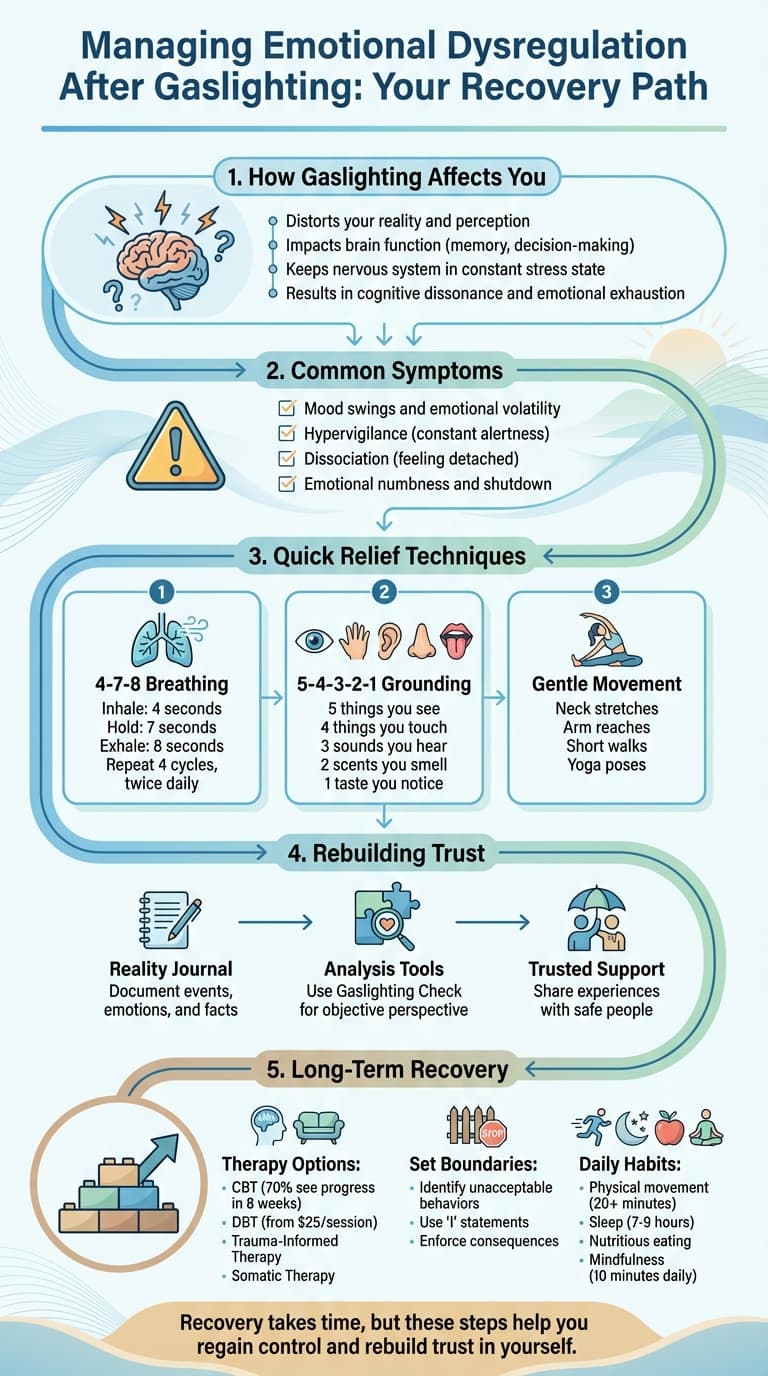
Gaslighting can leave you feeling emotionally overwhelmed, doubting your own reality, and struggling to regain control. This guide offers practical tools to help you manage emotional dysregulation, rebuild trust in your instincts, and find long-term balance. Here’s a quick summary:
- How Gaslighting Affects You: It distorts your reality, impacts brain function (like memory and decision-making), and keeps your nervous system in a constant state of stress.
- Common Symptoms: Mood swings, hypervigilance, dissociation, and emotional numbness are frequent responses.
- Quick Relief Techniques:
- 4-7-8 Breathing: Helps calm your nervous system.
- 5-4-3-2-1 Grounding: Uses your senses to bring focus back to the present.
- Gentle Movement: Reduces physical tension and redirects your thoughts.
- Rebuilding Trust:
- Keep a reality journal to document events and emotions.
- Use tools like Gaslighting Check for analyzing manipulative conversations.
- Share your experiences with trusted individuals for perspective.
- Long-Term Recovery:
- Consider therapy options like CBT or DBT to address emotional trauma.
- Set clear boundaries to protect yourself from manipulation.
- Build daily habits like physical movement, mindfulness, and proper sleep to restore emotional stability.
Recovery takes time, but these steps can help you regain control of your emotions and rebuild trust in yourself.
::: @figure
How Can You Heal the Effects of Gaslighting with Dr. Kate Truitt
Detect Manipulation in Conversations
Use AI-powered tools to analyze text and audio for gaslighting and manipulation patterns. Gain clarity, actionable insights, and support to navigate challenging relationships.
Start Analyzing NowHow Gaslighting Affects Your Emotional Health
Gaslighting can fundamentally alter how your brain processes reality. When someone repeatedly denies or twists facts, your brain faces a tough choice: trust the other person or doubt your own perceptions. Many people end up questioning themselves, training their minds to lean into uncertainty. This internal conflict often shows up as noticeable emotional patterns.
"The areas responsible for threat assessment become both hyperactive and unreliable. Victims become simultaneously hypervigilant and unable to trust their hypervigilance." - Joni E. Johnston, Psy.D., Clinical/Forensic Psychologist [3]
This leads to cognitive dissonance, where your logical understanding clashes with gaslighting vs. manipulation tactics. The constant mental effort to reconcile these contradictions can leave you emotionally drained, sometimes to the point of feeling numb. Over time, the gaslighter's criticism seeps in, making you question and dismiss your own valid emotional responses.
The effects aren't just emotional - they're physical, too. Long-term gaslighting can actually impact your brain's structure. The hippocampus, crucial for memory, can shrink. The prefrontal cortex, which helps with decision-making, becomes less effective. Even the temporal lobe, which plays a role in regulating emotions, can be affected. Meanwhile, your nervous system stays stuck in a "high alert" state, reacting to threats that may not even exist.
Common Signs of Emotional Dysregulation
Gaslighting often triggers a range of emotional symptoms that can feel overwhelming. For instance, you might notice sudden mood swings - calm one moment, completely overwhelmed the next.
Hypervigilance is another common response. You might find yourself constantly scanning your environment for signs of danger, which can be exhausting. Dissociation, or feeling detached from reality, is also frequent - you might zone out or feel disconnected during conversations. Even simple decisions can start to feel impossible because you no longer trust your own judgment.
| Emotional Symptom | Manifestation | Impact on Daily Life |
|---|---|---|
| Hypervigilance | Always feeling on edge or overly alert | Increased stress and constant exhaustion |
| Dissociation | Feeling detached, "blank", or zoning out | Trouble staying present or engaged |
| Emotional Volatility | Unpredictable mood swings | Challenges in maintaining personal balance |
| Numbness | Emotional shutdown during stress | Withdrawal from social and personal activities |
How Your Nervous System Responds to Gaslighting
Gaslighting isn't just emotionally taxing - it feels like a physical threat to your body. Chronic manipulation keeps your nervous system locked in fight-or-flight mode, flooding you with stress hormones even when there's no immediate danger. This can show up as muscle tension, a racing heart, headaches, sleep problems, and even digestive issues.
Over time, this stress reshapes your brain. The prefrontal cortex, responsible for logic and decision-making, becomes less effective. Your hippocampus struggles with memory, making it harder to trust your recollection of events. Meanwhile, the temporal lobe's impaired function can result in unpredictable emotional reactions. These changes directly fuel the mood swings and dissociative symptoms that many victims of gaslighting experience.
"Over time, you start to question your self-worth, self-esteem and mental capacity." - Dr. Chivonna Childs, Psychologist [2]
Eventually, your body stops trusting its own signals. The natural alarm system meant to protect you becomes unreliable, leaving you feeling both anxious and unable to trust that anxiety. Breaking free from this cycle requires retraining your mind and body to recognize what’s real and what isn’t.
Quick Grounding Techniques to Calm Overwhelming Emotions
When emotions feel overpowering, grounding techniques can help interrupt your body's stress response and bring your focus back to the present. These simple strategies can be used anywhere - whether you're in the middle of a tense conversation, dealing with a triggering situation, which you can identify using a gaslighting triggers checklist, or experiencing a sudden wave of anxiety. They’re designed to help you regain a sense of control.
Breathing Exercises to Soothe Your Nervous System
The 4-7-8 breathing method is a powerful way to activate your body's relaxation response. Here’s how it works: inhale deeply through your nose for 4 seconds, hold your breath for 7 seconds, and then slowly exhale through pursed lips for 8 seconds. This specific ratio encourages your lungs to fully empty, stimulating the vagus nerve, which helps calm your system [4].
"The durations of these breaths aren't as important as the ratio of the inhalation breath, breath-hold, and the exhalation breath, which is twice as long as the inhalation breath." - Ni-Cheng Liang, Pulmonologist and Mindfulness Teacher [4]
Start with just four cycles, twice a day. If you feel dizzy or lightheaded, scale back the number of cycles and work your way up gradually. Many people underestimate just how impactful proper breathing can be [4].
The 5-4-3-2-1 Sensory Grounding Technique
This exercise is perfect for shifting your focus from overwhelming emotions to the safety of the present moment. It’s especially helpful if you’re feeling disconnected or overstimulated, as it directs your attention to the physical world around you [7].
Here’s how it works:
- 5 things you see: Observe their colors, shapes, and textures.
- 4 things you can touch: Notice sensations like the fabric of your clothes or the texture beneath your feet.
- 3 distinct sounds: Maybe it’s the hum of a fan, birds chirping, or distant traffic.
- 2 scents: Keep a small bottle of lotion or mint gum handy as a "scent anchor."
- 1 taste: Sip water or notice the lingering flavor of toothpaste.
Name each observation aloud or in your mind, focusing on neutral details like “The wall is brown” rather than forming opinions [6]. Research has shown that grounding exercises like this can improve mood in people with anxiety and depression more effectively than relaxation techniques alone [6].
Physical Movement to Ease Tension
Gentle movement can redirect your focus from distressing thoughts to body sensations, helping to calm the fight-or-flight response [5][8]. You don’t need an intense workout - simple, mindful movements are enough to help you feel more regulated [7].
Try stretching your neck, reaching your arms overhead, or bringing one knee to your chest while standing. You can also clench your fists or grip a surface to release pent-up energy, then relax your muscles [5]. If you're mid-conversation and emotions run high, stepping away for a short walk or using expert-backed response tactics can clear your head [9].
"Stretching your body helps you get outside your mind and back into your body." - Melissa Young, MD, Functional Medicine Specialist, Cleveland Clinic [5]
Adding yoga poses like Child’s Pose or Cat-Cow stretches can enhance your sense of stability by increasing your body’s connection with the floor. If possible, spend a few minutes outside - walking barefoot on grass or dirt can create a grounding effect. Even running cool or warm water over your hands provides sensory input that can disrupt racing thoughts [5][7].
Rebuilding Trust in Your Own Perceptions
Gaslighting can deeply affect your ability to trust your memories, partly due to its impact on the hippocampus, which can shrink as a result of prolonged emotional trauma [12]. Here are some practical ways to rebuild confidence in your perceptions.
Keep a Reality Journal
Jotting down events as they happen creates a factual record you can revisit whenever self-doubt sets in. Record details like the date, time, the exact words spoken, your emotional responses, and any physical sensations you noticed during the interaction. For example, if someone said, "You're imagining things", note how it made you feel and what you observed in that moment. Whether you prefer a physical notebook or a secure digital document, keeping these notes private and consistent can help you identify patterns of manipulation. Over time, reviewing your entries often reveals discrepancies between what was said and what actually occurred, giving you solid evidence to counter any doubts about your reality.
Use Gaslighting Check to Analyze Conversations

Sometimes, an outside perspective can cut through the confusion. Gaslighting Check (https://gaslightingcheck.com) is a tool designed to analyze both text and voice conversations for manipulation tactics. It identifies behaviors like deflection, blame-shifting, and reality distortion in written messages, while its voice analysis detects tone and verbal cues that may signal emotional manipulation.
You can upload a conversation or record audio in real time to receive a detailed breakdown of possible manipulation tactics. For $9.99 per month, the Premium Plan also tracks your conversation history, helping you spot recurring patterns. Plus, your data is kept secure with encryption and automatic deletion. This tool complements your personal records, offering an objective resource to confirm and validate your experiences.
Share Your Experiences with Trusted People
Isolation can make self-doubt worse. Talking to trusted friends, family members, or a therapist can provide the external perspective you need to challenge your uncertainty [13]. Make sure to choose individuals who genuinely care about your well-being and aren’t connected to the gaslighter.
Find a safe, private space to discuss your experiences. Use "I" statements, like "I feel unsure when they say I made up that conversation", to express your feelings without assigning blame. If someone witnessed the situation, ask for their neutral account of what happened. Hearing trusted feedback can validate your experiences and help you see the manipulation for what it is [10][11].
Long-Term Methods for Managing Your Emotions
Recovering from gaslighting is a process that requires steady, long-term effort. It involves addressing the underlying causes of emotional instability and creating habits that promote resilience. By incorporating these practices into your daily routine, you can build a solid foundation for emotional well-being and reduce the risk of falling victim to manipulation in the future. Starting with professional support and clearly defined boundaries is key.
Therapy Options for Gaslighting Recovery
Therapy plays a crucial role in challenging the distorted beliefs caused by gaslighting. Different approaches offer unique benefits:
- Cognitive Behavioral Therapy (CBT): Helps identify and replace false beliefs with healthier thought patterns.
- Trauma-Informed Therapy: Focuses on processing and healing deep emotional wounds.
- Somatic Therapy: Aids in releasing trauma stored in the body.
- Dialectical Behavior Therapy (DBT): Teaches practical skills for managing intense emotions.
Studies show that 70% of participants in CBT groups led by therapists noticed significant progress within just eight weeks [14]. For those seeking affordability, online DBT therapy is available starting at $25 per session [14]. These therapeutic methods not only help manage emotional distress but also rebuild trust in your own perceptions and decisions.
Set and Maintain Clear Boundaries
Establishing boundaries is essential for protecting yourself from further manipulation. Start by identifying behaviors that are unacceptable - such as being interrupted, dismissed, or unfairly blamed. Use effective communication to set these limits using "I" statements, like: "I feel disrespected when my words are twisted, and I will end the conversation if it continues."
The key, however, lies in enforcing these boundaries. As Jillian Williams, LISW-S, explains:
"Choosing not to engage is one of the most powerful things you can do" [1].
This means resisting the urge to argue or justify yourself when someone crosses a line. Instead, follow through with your stated consequence - whether that’s leaving the room, ending the call, or reducing future interactions. Reflect on whether certain unhealthy behaviors, such as yelling or constant criticism, were normalized in your past. Familiar patterns aren’t always healthy, and recognizing this is a critical step toward change [1].
Develop Daily Habits That Support Emotional Health
Building emotional resilience happens through small, consistent actions. Here are a few habits to integrate into your routine:
- Physical movement: Activities like a 20-minute walk, yoga, or dancing can help regulate your nervous system and reduce stress.
- Adequate sleep: Aim for 7–9 hours per night to allow your brain to process emotions and strengthen memory, especially if chronic stress has impacted areas like the hippocampus.
- Nutritious eating: Opt for whole foods to maintain stable blood sugar levels and avoid mood swings caused by energy crashes from processed foods.
- Mindfulness practices: Spend 10 minutes daily meditating or sitting quietly to reconnect with your thoughts and emotions.
Additionally, create a personal "psychological first-aid kit" filled with comforting or uplifting actions. This could include calling a supportive friend, taking a warm shower, or listening to a favorite song. Rebuilding confidence in your judgment is also vital - try making small independent choices each day, like picking a new route to work or deciding what to eat without seeking advice. Over time, these habits strengthen your emotional stability and help you regain trust in yourself. [15]
Conclusion
This guide offers practical tools and strategies to support recovery, combining grounding techniques, trust-rebuilding practices, and self-care habits. When intense emotions feel overwhelming, grounding exercises like the 5-4-3-2-1 sensory method or 4-7-8 breathing can help you reconnect with the present moment and calm your stress response.
Restoring trust in your own perceptions is just as important. Keeping a reality journal can help you track patterns and clarify your thoughts. Tools like Gaslighting Check can also be helpful. Their free plan provides basic text analysis, while a premium subscription ($9.99/month) includes voice analysis and conversation history tracking - useful for identifying manipulation.
For long-term healing, consider therapy options like CBT, DBT, or trauma-informed counseling. These approaches offer structured ways to manage emotions and rebuild confidence. Protect your emotional energy by setting clear boundaries using "I" statements and following through. Small, consistent actions - such as getting enough sleep, moving your body for at least 20 minutes daily, and making decisions independently - can gradually restore your emotional balance.
Recovery takes time and effort, but combining these tools with daily self-compassion will help you regain control and rebuild your emotional well-being.
FAQs
How do I know if I’m being gaslit?
Gaslighting is a form of manipulation designed to distort your sense of reality. It often leaves you feeling confused or questioning your own judgment. Some common signs include repeated denial of your experiences, brushing off your emotions, or hearing phrases like, "You're just imagining it." Over time, this behavior can chip away at your confidence and emotional well-being. Keeping a record of specific incidents and identifying these patterns early can help you validate your experiences and take steps to safeguard your mental health.
What should I do if grounding techniques don’t help?
If grounding techniques aren’t cutting it, there are other ways to tackle emotional dysregulation caused by gaslighting. One option is seeking help from a therapist or counselor who can provide personalized tools to help you cope. You might also try mindfulness practices, which can sometimes bring relief. But if these approaches don’t seem to be enough, a mental health professional can help you work through the deeper emotional wounds. Often, a mix of strategies is necessary to rebuild and maintain emotional balance over time.
How can I set boundaries without escalating conflict?
To establish boundaries without creating unnecessary conflict, it's important to be firm, consistent, and respectful. Use clear "I" statements to convey your needs and emotions - for example, "I feel overwhelmed when..." or "I need some time to focus on...". This approach keeps the conversation focused on your perspective rather than sounding accusatory.
If someone crosses your boundaries, calmly follow through with appropriate consequences. Staying composed, maintaining a neutral tone, and using clear communication can help you assert yourself without escalating tensions. Pairing these strategies with neutral body language can also go a long way in keeping interactions constructive and balanced.