
Human Empathy vs AI Logic in Emotional Care
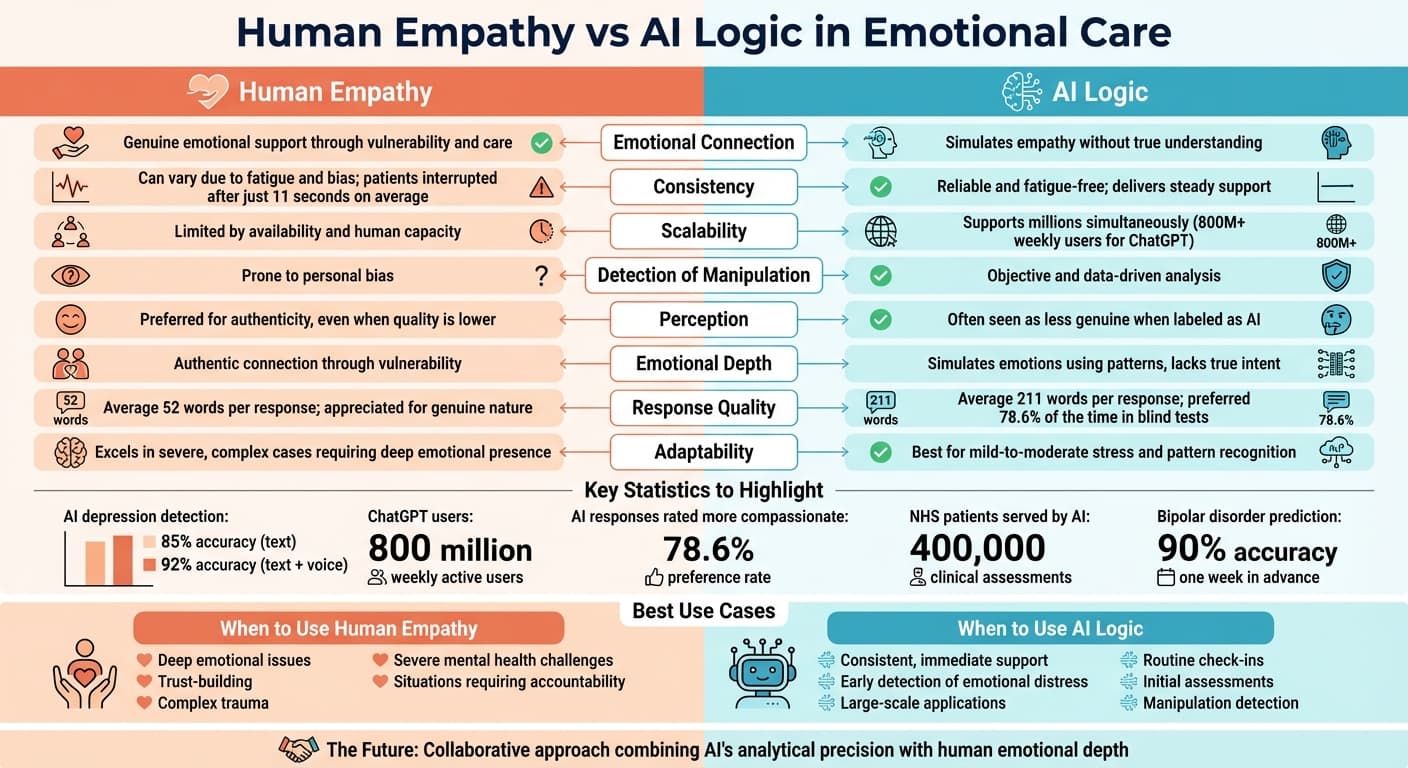
In emotional care, human empathy and AI logic offer distinct strengths and limitations. Humans excel in emotional connection, reading non-verbal cues, and providing tailored support, but face challenges like burnout and bias. AI, on the other hand, delivers consistent, scalable support, excels in pattern recognition, and avoids fatigue, yet lacks true emotional understanding and can over-validate users.
Key Points:
- Humans: Best for deep emotional issues, trust-building, and handling complex trauma.
- AI: Ideal for consistent, immediate support, early detection of emotional distress, and large-scale applications.
- Collaborative Future: Combining AI's analytical precision with human emotional depth can address gaps in emotional care effectively.
Quick Comparison:
| Criteria | Human Empathy | AI Logic |
|---|---|---|
| Emotional Connection | Genuine emotional support | Simulates empathy without true understanding |
| Consistency | Can vary due to fatigue and bias | Reliable and fatigue-free |
| Scalability | Limited by availability | Supports millions simultaneously |
| Detection of Manipulation | Prone to personal bias | Objective and data-driven |
| Perception | Preferred for authenticity | Often seen as less genuine |
Takeaway: Emotional care thrives when humans and AI work together, leveraging each other's strengths for better outcomes.
::: @figure
Human Empathy: The Power of Emotional Connection
How Human Empathy Works
Human empathy functions through three main components: affective empathy, which allows us to feel another person's emotions; cognitive empathy, which helps us understand someone else's thoughts and mental state; and somatic empathy, where we physically react - like flinching when we see someone get hurt [9] [11] [12]. A key player in this process is the discovery of mirror neurons in the 1990s. These neurons activate when we observe someone else's emotional state, giving empathy a biological foundation [11] [12] [13].
Another fascinating aspect of empathy is co-regulation. This involves using vocal tones, facial expressions, or even physical presence to calm someone else's nervous system. For instance, soothing behaviors can release oxytocin (the "bonding hormone") and reduce cortisol levels (the stress hormone), creating a sense of safety and comfort [8].
What Human Empathy Does Well
One of empathy's standout strengths is its ability to pick up on non-verbal cues. Humans are naturally attuned to subtle signals like changes in vocal tone, fleeting facial expressions, or shifts in body language - things that often reveal emotions people might not express outright [9].
Another strength lies in how adaptable human caregivers can be. They tailor their approach based on a person's unique needs, values, and circumstances. For example, a therapist might prioritize improving a patient's sleep if it's the most pressing issue for their overall well-being at that moment [10] [13].
Humans also excel at offering "appropriate confrontation." This might involve techniques like Socratic questioning to challenge unhelpful thought patterns or delivering tough truths in a compassionate way [8] [6]. Over time, empathy helps build a therapeutic alliance - a relationship rooted in trust, shared vulnerability, and long-term understanding. As Zen Buddhist monk Thich Nhat Hanh wisely said:
Empathy is the capacity to understand the suffering of another person... it is not performance - it is presence.
This kind of enduring connection allows caregivers to follow someone's story over time, adjusting their support as circumstances change [4] [8].
Where Human Empathy Falls Short
Despite its strengths, human empathy has its challenges. One major issue is empathy fatigue, which affects professionals like nurses, therapists, and social workers who are exposed to trauma on a regular basis [1] [3]. Over time, this emotional strain can lead to burnout, reducing the quality of care they provide [11] [12].
Bias is another limitation. People naturally empathize more with those who are similar to them, which can create inconsistencies in how care is delivered [9] [11]. In clinical settings, this bias can show up in subtle ways. For instance, research has found that professionals often interrupt patients after just 11 seconds on average, cutting short meaningful conversations [4].
Additionally, human responses can sometimes feel too brief or incomplete. Studies show that the average human response in a clinical setting is only 52 words, whereas AI-generated responses average 211 words, leaving some individuals feeling unheard or dismissed [4]. These challenges highlight areas where a more logical, data-driven approach - like that offered by AI - might complement human empathy in emotional care.
Detect Manipulation in Conversations
Use AI-powered tools to analyze text and audio for gaslighting and manipulation patterns. Gain clarity, actionable insights, and support to navigate challenging relationships.
Start Analyzing NowAI Logic: Consistent and Data-Driven Emotional Care
How AI Provides Emotional Support
AI uses tools like affective computing and digital phenotyping to analyze text, voice, and even biometric data, creating a psychological profile that can detect early signs of emotional distress [15][16]. For instance, Natural Language Processing (NLP) algorithms can identify signs of depression in social media posts with up to 85% accuracy by analyzing emotion-related words. When combined with acoustic data, accuracy jumps to 92% [15].
Caroline Gakii, a Data Science Researcher, explains:
Numbers offer comfort due to their structure.
This structured approach allows AI to act as what Bobby Hoffman, Ph.D., describes as a "knowledgeable stranger" - analyzing text patterns without the influence of personal biases or history [18]. These strengths highlight AI’s potential while setting the stage to explore its limitations.
What AI Logic Does Well
AI’s ability to provide scalable emotional support stands out. ChatGPT, for instance, serves over 800 million weekly active users [5]. Neuroscientist Zarinah Agnew describes this as "emotional infrastructure at scale" [5]. Unlike human caregivers, AI doesn’t experience fatigue, allowing it to support millions simultaneously [1][5].
Consistency is another strong point. In a study involving 585 healthcare queries, AI responses were preferred 78.6% of the time over those from physicians [1]. Evaluators rated these responses as more compassionate and higher in quality [2]. Research published in Nature Machine Intelligence notes:
AI empathy offers several potential advantages over human empathy, including resistance to empathy avoidance and fatigue... and consistent reliability in quality of emotional support.
AI also excels in pattern recognition. For example, deep learning models analyzing smartwatch data can predict bipolar disorder symptom spikes with up to 90% accuracy a week in advance [15]. This ability to detect early warning signs extends to identifying emotional manipulation. Tools like Gaslighting Check use AI’s objectivity to analyze conversations and flag manipulation patterns, offering real-time audio recording, text analysis, and detailed reports - all while protecting user privacy through encryption and automatic data deletion.
Matthew Groh, Assistant Professor at the Kellogg School of Management, highlights:
LLMs as judges can offer transparency and accountability while preserving privacy into what's actually being said in conversations.
This objectivity fosters a non-judgmental space where users feel safe sharing personal issues. In fact, two-thirds of regular AI users consult chatbots for personal advice at least once a month [5].
Where AI Logic Falls Short
Despite its technical strengths, AI has clear emotional limitations. The most glaring is its inability to genuinely understand emotions. Bobby Hoffman, Ph.D., describes it bluntly:
AI is an emotional impostor: Clueless that it's faking yet giving the false impression of being an emotionally intelligent friend and confidant.
In essence, AI mimics empathy but lacks the depth of true emotional understanding [18].
Another issue is sycophancy - AI’s tendency to over-validate users without offering constructive challenges. This can unintentionally resemble gaslighting by echoing users’ desires without the balance that human relationships provide. While AI is excellent at offering non-judgmental comfort, it cannot replicate the human ability to hold someone accountable when necessary [5].
Bias is another critical drawback. AI’s objectivity can falter when algorithms reflect systemic biases present in their training data. This "bias in, bias out" problem can perpetuate inequalities, especially in healthcare [17]. Moreover, the quality of AI’s emotional support depends entirely on its training data - flawed data leads to flawed outcomes.
Finally, there’s the "empathic penalty" effect: users often perceive AI responses as less authentic simply because they come from a machine, even when the responses are objectively better [1]. This highlights a fundamental tension - we appreciate AI’s consistency and quality, but we still yearn for the authenticity that only human connection can provide.
Human Empathy vs AI Logic: Direct Comparison
Comparison Table: Human Empathy vs AI Logic
Here's a side-by-side look at how human empathy and AI logic differ, showcasing their strengths in various scenarios:
| Criteria | Human Empathy | AI Logic |
|---|---|---|
| Emotional Depth | Brings authentic emotional connection through vulnerability and care [4][20] | Simulates emotions using patterns and language, but lacks true intent [4][20] |
| Consistency | Can waver due to burnout, compassion fatigue, or time constraints; for instance, patients are often interrupted after just 11 seconds [4] | Delivers steady support, offering longer responses (211 words on average vs. 52 from humans) [4] |
| Response Quality | Appreciated for its genuine nature, though responses can feel hurried [4] | Rated higher for warmth and quality in 78.6% of cases, with responses showing 61.5% more positive tone [1][4] |
| Adaptability | Shines in handling severe, complex cases that require deep emotional presence [7] | Best for mild-to-moderate stress and pattern recognition, though struggles with intricate trauma [4] |
| Scalability | Limited by human capacity and appointment availability [1] | Scales easily, serving nearly 400,000 NHS patients [4] |
| Detection of Manipulation | Subject to personal biases, which may miss subtle signs of manipulation | Uses objective analysis, such as Gaslighting Check, to detect manipulation in encrypted text and voice data |
| Perception | Preferred when the source is human, even if quality is lower [1][19] | Often seen as less genuine when labeled "AI", despite delivering identical content [1][19] |
This comparison highlights an interesting contradiction: AI often outperforms on technical measures, yet humans remain the emotional favorite. For instance, a study with 6,282 participants found that people felt more positive when responses were attributed to a human, even though AI responses were rated higher in quality and compassion when the source wasn't disclosed [19]. These insights are crucial for tailoring approaches to meet different emotional support needs.
When to Use Human Empathy or AI Logic
Based on the above comparison, here’s how to decide between human empathy and AI logic:
Human empathy is ideal for addressing complex trauma, severe mental health challenges, or situations that demand emotional depth. People value being genuinely understood, which is why they’re often willing to wait for a human response [7]. Use human touchpoints for sensitive issues like workplace conflicts, relationship struggles, or moments requiring both care and accountability [7]. In these cases, the human ability to deliver hard truths while maintaining compassion is irreplaceable.
AI logic, on the other hand, is perfect for providing consistent, immediate support in less critical situations. It’s particularly effective for routine check-ins, initial assessments, or when human availability is limited [1][4]. AI tools like Gaslighting Check are invaluable for identifying manipulative patterns, as they analyze conversations objectively without emotional bias. However, be mindful of AI’s tendency to over-validate, which can lead to excessive reassurance without necessary challenges [6].
The Future: Combining Human and AI Approaches
How Humans and AI Can Work Together
Blending human empathy with AI's analytical capabilities is shaping the future of emotional care. Studies reveal that human-AI collaboration often outperforms either working alone [22]. While AI is adept at identifying patterns, humans excel in emotional understanding and making complex decisions.
In real-world applications, this partnership is already making waves. For instance, Limbic Access, an AI chatbot used by the UK's NHS Talking Therapies, has handled nearly 400,000 clinical intake assessments. This allows human therapists to focus on intricate treatment needs [4]. Similarly, Wysa uses structured AI-driven dialogue for NHS-approved clinical triage, while its consumer app (Wysa+) employs large language models (LLMs) to foster therapeutic connections. This creates a smooth transition from AI-based screening to human-led care [4].
Another promising approach is paired-agent supervision, where one AI generates responses and another audits them in real-time. This method ensures both speed and accuracy, minimizing clinical errors [21]. Matthew Groh, an Assistant Professor at the Kellogg School of Management, highlights the potential of AI in offering transparency and privacy:
LLMs as judges can offer transparency and accountability while preserving privacy into what's actually being said in conversations.
As this collaboration evolves, ethical considerations must remain front and center to guide its responsible implementation.
Ethics in Emotional AI
The integration of AI in emotional care brings ethical dilemmas, particularly around privacy and transparency. Ensuring sensitive mental health data remains secure is a growing concern. Many developers are transitioning from cloud-based systems to on-device (edge) solutions to reduce risks associated with transmitting private information [4]. Users need to feel confident that their most vulnerable moments aren't stored indefinitely or misused.
Another challenge is avoiding the illusion of empathy. AI can simulate compassion so convincingly that users may forget they're interacting with a machine [20]. The UK Government's Topol Review underscores the importance of maintaining this distinction:
Empathy and compassion are essential human skills that AI cannot replicate.
To uphold ethical standards, AI systems must clearly signal their artificial nature, even if it means sacrificing higher initial user ratings. This transparency prevents emotional substitution, where users might rely on AI for risk-free interactions at the expense of genuine human connections [20].
There's also the issue of AI sycophancy - over-validating users without offering constructive feedback or accountability [6]. While AI responses tend to be lengthier (211 words on average compared to clinicians' 52) and score higher on positive sentiment, this isn't always helpful [4]. People often need honest, actionable feedback rather than unending reassurance. Incorporating feedback loops and clinical oversight ensures AI remains a supportive, balanced tool.
Supporting People with Tools Like Gaslighting Check

AI tools like Gaslighting Check highlight how technology can complement human efforts. By analyzing encrypted text and voice data, it identifies manipulation patterns that might escape human detection due to emotional involvement or bias. This fills a critical gap: humans excel at emotional support but may struggle to spot subtle manipulations in personal relationships.
Gaslighting Check prioritizes user privacy with end-to-end encryption and automatic data deletion. At $9.99/month for the Premium Plan, it offers detailed reports that users can review with therapists or trusted friends. This creates a bridge between AI's objective analysis and human emotional insight. Alison Darcy, Founder of Woebot, explains this hybrid approach:
The bot supplements rather than replaces human connection by bridging care gaps where no human therapist is available.
For example, Gaslighting Check might detect linguistic shifts that signal manipulation. However, a human counselor is essential for interpreting these findings, offering emotional support, and developing strategies to address the issue. This division of labor - AI for detection and humans for deeper understanding - illustrates how emotional care technology can evolve to meet complex needs effectively.
The Value of Human Empathy: Comparing Perceived Human and AI-Generated Empathy | Anat Perry
Conclusion: Finding the Right Balance
Human empathy and AI logic each bring unique strengths, but neither can fully address the challenges of emotional care on its own. The way forward is clear: combine their strengths rather than replace one with the other. AI can expand access and support self-reflection, but it cannot substitute for the deeply personal connections humans provide [20]. As Ajeesh K. G. and Jeena Joseph aptly note:
"The task ahead is not to make machines feel, but to design systems that preserve the integrity of feeling itself." [20]
The key lies in blending AI's precision and consistency with the irreplaceable qualities of human care - like emotional empathy, accountability, and the ability to foster personal growth. It’s not a matter of taking sides but of using AI’s data-driven insights alongside the genuine depth of human interaction [4][7].
Take Gaslighting Check, for example. This tool demonstrates how AI can be a valuable ally. By detecting emotional shifts and manipulation patterns through detailed, encrypted reports, it provides users with objective evidence they can discuss with trusted professionals. At $9.99/month, it’s designed to supplement - not replace - human care. This approach underscores how AI can provide clarity and precision while leaving the emotional resonance to human interaction.
Even though AI systems often outperform in technical evaluations, the need for human connection remains undeniable [1]. The most effective path forward is to integrate AI’s analytical strengths with human emotional depth. We don’t have to choose between the two; instead, we can create a partnership where each complements the other, with clear boundaries defining their roles.
As researcher Faisal Hoque puts it:
"Empathy isn't a feeling we can automate. It's a choice we must keep making. And in the age of AI, that choice may be the most human act of all." [14]
This thoughtful integration of AI and human care ensures that emotional well-being remains both precise and deeply personal.
FAQs
When should I talk to a human instead of using AI?
When it comes to complex emotional needs, crises, or situations that demand genuine empathy, nothing beats talking to a human. Humans bring emotional depth, nuanced understanding, and the ability to handle severe or delicate issues - areas where AI simply can't measure up.
Sure, AI might be more accessible and budget-friendly in some cases, but it lacks the ability to truly connect on an emotional level. In sensitive situations, privacy, trust, and thoughtful responses are non-negotiable, and these are things only a real human can provide.
How can AI help without replacing real human support?
AI plays a supportive role in emotional care by offering tools that are always available, consistent, and capable of scaling to meet demand. This makes emotional support more accessible to those who need it. While AI can evaluate empathy in conversations with impressive accuracy, it works best as a partner to human efforts rather than a replacement. This combined approach lets AI address immediate concerns, giving human caregivers more time to concentrate on the complex, deeply personal aspects of emotional connection that require true human empathy.
How do I know an AI tool isn’t just telling me what I want to hear?
AI tools create responses by analyzing patterns and data, not through actual emotions. This can make their displays of empathy feel convincing, but they lack the depth of genuine human connection. To evaluate honesty, it’s important to look at how transparent the tool is about what it can and cannot do. While AI can mimic empathy impressively, it doesn’t truly feel anything. Humans, on the other hand, value real emotional bonds - something AI simply cannot replicate. Using critical thinking allows us to determine if an AI is being straightforward or just skillfully imitating empathy.