
How Culture Impacts Online Communication Styles
Online communication reflects cultural norms through word choices, emoji use, and response timing. With over half the global population online, cultural differences shape how people interact digitally. For example:
- Emoji preferences: South Koreans often use vertical emoticons (^^), while Western users prefer horizontal ones (:-)).
- Communication styles: Individualistic cultures (e.g., the U.S.) favor direct messaging, while collectivist cultures (e.g., China) emphasize group harmony and indirect language.
- Response timing: Monochronic cultures (e.g., the U.S.) value prompt replies, while polychronic cultures (e.g., Latin America) are more flexible.
- Platform choices: High-uncertainty-avoidance cultures (e.g., Japan) prefer structured platforms like LINE, while low-uncertainty-avoidance cultures embrace dynamic spaces like Twitter.
Understanding these patterns helps reduce miscommunication and build stronger connections in digital spaces. Tools like Gaslighting Check analyze communication while accounting for cultural norms, enabling healthier online interactions.
Understanding cultural differences in communication styles
Cultural Frameworks That Shape Online Communication
::: @figure
Researchers often turn to Hofstede's Cultural Dimensions and Hall's Context Theory to explain how cultural differences influence digital communication.
Hofstede's Cultural Dimensions in Digital Spaces
Hofstede's framework identifies several cultural dimensions that shape online interactions. For example, power distance influences how individuals engage with authority figures in digital forums. In cultures with high power distance, people may hesitate to challenge or question authority figures in online discussions. On the other hand, in low power distance cultures, users are more likely to ask questions and voice disagreements openly [4].
"In a large power distance society, parents teach children obedience, while in a small power distance society parents treat children as equals" [4].
This dynamic often carries into workplace communication, affecting how employees interact on digital platforms.
Individualism versus collectivism also plays a key role in shaping communication styles. In individualistic cultures like the United States, online messages are typically direct, explicit, and focused on the content itself [7]. In contrast, collectivist cultures, such as those in China or Guatemala, favor indirect communication that emphasizes group harmony over bluntness [7]. A study of Hong Kong Chinese negotiators found that they made more aggressive opening offers via email than their U.S. counterparts, suggesting a "reactance effect" where collectivist communicators compensate for the lack of nonverbal cues in digital spaces by being more assertive [6].
Another dimension, uncertainty avoidance, affects how people approach online platforms. Cultures with high uncertainty avoidance prefer clear guidelines, timelines, and structured communication, while those with low uncertainty avoidance are more comfortable navigating ambiguity [4]. This dimension also ties into the indulgence versus restraint spectrum - users from indulgent cultures often feel more in control of their online interactions, whereas those from restrained cultures may perceive stricter social norms influencing their digital behavior [4].
Hofstede's dimensions provide a foundation for understanding implicit communication styles, which are further explored through Hall's high-context and low-context framework.
High-Context vs. Low-Context Communication Online
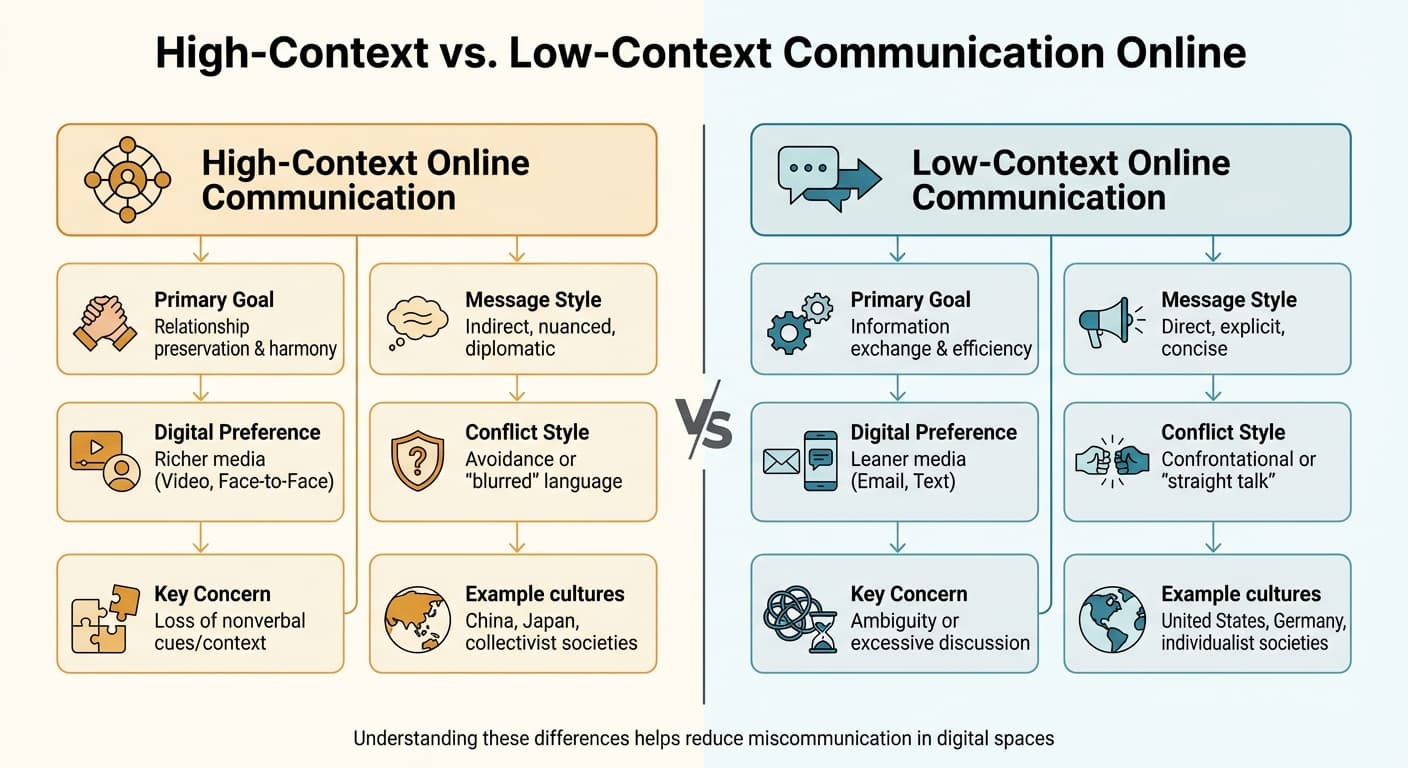
Edward Hall's theory divides cultures into high-context (HC) and low-context (LC) communicators, a distinction that becomes particularly relevant in digital environments. High-context cultures rely on implicit cues, nonverbal signals, and shared understanding to convey meaning. In contrast, low-context cultures prioritize direct and explicit communication, where meaning is embedded in the words themselves rather than the surrounding context.
Digital platforms strip away many social cues - such as tone, facial expressions, and pauses - making it harder for high-context communicators to rely on implied meanings [9]. As researchers Pablo Lamino and John Diaz explain:
"High-context cultures are typically collectivist, strongly emphasizing group harmony and indirect communication, where much of the meaning is conveyed through nonverbal cues and the surrounding context" [7].
To adapt, HC communicators often use diplomatic or vague language to maintain harmony and avoid conflict [9].
A 2022 study involving participants from China and the U.S. highlighted these differences. While China remains a high-context culture, the U.S. leans toward low-context communication, directly influencing how individuals from these cultures use digital media [5]. Low-context users, like those in the U.S., prefer digital communication for its clarity and efficiency, favoring concise instructions and direct feedback in emails. Meanwhile, high-context cultures, such as Japan, often prefer richer forms of communication - like face-to-face meetings - because they provide the contextual and nonverbal cues that digital platforms lack [8].
| Feature | High-Context Online | Low-Context Online |
|---|---|---|
| Primary Goal | Relationship preservation & harmony | Information exchange & efficiency |
| Message Style | Indirect, nuanced, diplomatic | Direct, explicit, concise |
| Digital Preference | Richer media (Video, Face-to-Face) | Leaner media (Email, Text) |
| Conflict Style | Avoidance or "blurred" language | Confrontational or "straight talk" |
| Key Concern | Loss of nonverbal cues/context | Ambiguity or excessive discussion |
The way cultures perceive the "richness" of communication media also varies significantly [5]. For instance, what might seem like an appropriately concise email to someone in New York could come across as cold or incomplete to someone in Tokyo. With 46.2 million immigrants living in the U.S. as of 2022 - making up 13.9% of the population [7] - understanding these cultural differences is no longer optional. It’s crucial for fostering trust, avoiding miscommunication, and building strong relationships across digital platforms.
These frameworks offer valuable insights for developing digital tools tailored to diverse communication preferences.
How Culture Affects Online Self-Presentation
The way people present themselves online is deeply influenced by cultural values, which shape digital communication styles and patterns. These cultural differences lead to unique behaviors and interactions in online spaces.
Individualism vs. Collectivism in Online Behavior
In individualistic cultures, people often highlight their personal achievements and opinions through text-based posts. In contrast, collectivistic cultures lean toward modesty, using non-verbal cues like photos and emojis to maintain social harmony. For example, research shows that collectivism is strongly linked to higher emoji usage, with East Asians frequently relying on these cues to soften potentially uncomfortable interactions [2].
Social networks also reflect these cultural differences. Individualists tend to build large, loosely connected networks, while collectivists focus on forming smaller, more enduring relationships. A global study found that about 82% of internet users over the age of 15 log into social networking sites, but the way they engage varies significantly depending on cultural norms [12]. These differences create distinct regional patterns in how people behave online.
Examples of Online Self-Presentation Across Cultures
Empirical studies highlight how cultural values shape online self-presentation. For instance, U.S. users spend more time on social media, consider it more important, and have larger online friend networks compared to users in China [12]. Americans tend to favor text-based posts, while Singaporeans share more photos, a strategy that aligns with collectivist values by maintaining connections without overt self-promotion [10].
Singaporeans also take extra steps to manage their online image, such as untagging themselves from unflattering photos to ensure a polished public persona [10]. In South Korea, users demonstrate a balance of independence and connectedness, a behavior researchers describe as an "Autonomous-Related" self-construal. South Koreans actively use social media to engage with friends rather than passively browse [13].
"East Asians used significantly more CMC [Computer-Mediated Communication] cues overall, and displayed greater situational sensitivity (i.e., used more situationally-congruent CMC cues)."
– Togans, L. J., et al. [2]
Privacy concerns also play a significant role in online behavior. In China, where uncertainty avoidance is high, people are particularly cautious about privacy risks and social pressures, which can discourage them from sharing political or civic opinions online [11]. Meanwhile, in the U.S., 59% of social media users report feeling stressed when encountering opposing political views during online interactions [11].
Detect Manipulation in Conversations
Use AI-powered tools to analyze text and audio for gaslighting and manipulation patterns. Gain clarity, actionable insights, and support to navigate challenging relationships.
Start Analyzing NowCultural Preferences in Platform Choice and Response Patterns
Cultural values don't just influence how people present themselves online - they also shape which platforms they gravitate toward and how quickly they expect responses. These preferences are deeply tied to attitudes about structure, time, and social interaction, creating a strong connection between cultural norms and digital behavior.
Uncertainty Avoidance in Platform Usage
Different cultures have varying levels of comfort with ambiguity, and this directly impacts their choice of communication platforms. In cultures with high uncertainty avoidance, where structure and clear rules are highly valued, people tend to favor platforms with established etiquette and reduced social risks. For example, LINE is widely used in Japan because of its structured and orderly nature [12].
On the other hand, cultures with low uncertainty avoidance are more open to dynamic and spontaneous interactions. Platforms like Twitter, known for its less formal and fast-paced environment, thrive in these settings [12]. Similarly, Renren in China reflects collectivist values by emphasizing in-group sharing, while Facebook in the U.S. leans toward individualistic self-expression [12].
Time Orientation and Response Expectations Online
Cultural attitudes toward time also play a key role in shaping digital communication styles. In monochronic cultures - such as the U.S., Germany, and Switzerland - time is treated as linear and finite. These societies often expect prompt and organized responses, and delays can be seen as a lack of reliability [15].
In contrast, polychronic cultures, including those in Latin America, the Middle East, and Africa, view time as more fluid and relationship-focused. Here, response times are more flexible, and multitasking is a common norm [15]. A fascinating study published in PLOS One in March 2024 analyzed over 1.5 million English Twitter sentences and nearly 100,000 Chinese Weibo sentences. The study revealed that 91.9% of Weibo posts emphasized the "temporal present" (focusing on the immediate moment), while 77.9% of English tweets reflected the "atemporal present" (centered on logic and facts) [14]. This suggests that Chinese users often prioritize immediate experiences in their digital interactions, while English-speaking users lean toward abstract reasoning and planning.
A real-world example of these cultural differences played out during Kia Motors' plant construction in Mexico between 2015 and 2016. South Korean managers, accustomed to quick decision-making and immediate responses, faced challenges working with Mexican staff, who preferred a slower, trust-building approach. After seven months of targeted workshops involving 21 teams, Kia successfully bridged this gap, improving trust and earning recognition for internal innovation [16]. This case highlights just how crucial it is to understand cultural attitudes toward time for effective digital communication across borders.
Applications for Digital Coaching and Communication Tools
Adapting Tools for Cross-Culture Communication
Digital coaching tools need to differentiate between culturally appropriate behaviors and manipulative actions. For example, in Chinese culture, indirect communication is often used to maintain harmony and protect relationships. A tool designed around Western-style directness might mistakenly interpret this indirectness as evasiveness, leading to misjudgments [3].
This challenge requires more than just translating languages. As highlighted in Nature Communications Medicine:
"Cultural adaptations [are] the systematic modification of an existing intervention so that it aligns with a target audience's cultural norms, beliefs, and values" [17].
To address this, AI tools can incorporate frameworks like Hofstede's Cultural Dimensions Theory. This helps assess communication styles and identify potential risks based on cultural backgrounds [1].
A practical example of this is the adaptation of the WHO's E-Mental Health Program in 2019 for overseas Filipino workers. Recognizing the stigma surrounding mental health in Filipino culture, researchers removed images of doctors from the interface to avoid reinforcing negative perceptions. They also relied on iterative user feedback to ensure the program aligned with cultural expectations [17]. This kind of sensitivity is a cornerstone for tools like Gaslighting Check.
Gaslighting Check: Supporting Healthy Communication Across Cultures

Building on these principles, Gaslighting Check integrates cultural awareness into its functionality. The platform uses multimodal analysis to detect manipulation while accounting for cultural communication norms. For instance, in the U.S., ambiguity in communication might suggest manipulation, but in many Asian cultures, indirectness is often a way to maintain relationships [3].
Gaslighting Check’s detailed reports help distinguish between cultural norms and manipulative behaviors. In languages like Korean, frequent omissions are a normal part of communication but can also be exploited by manipulators. The platform is designed to flag such patterns while recognizing when they are simply part of the language’s natural use [18].
At $9.99/month for the Premium Plan, the tool offers features like text and voice analysis, detailed communication reports, and conversation history tracking. These capabilities support users navigating multicultural relationships and digital interactions, promoting healthier communication by fostering cultural awareness in diverse environments.
Conclusion: Building Cultural Awareness in Online Communication
Cultural differences shape every aspect of online communication, from how emojis are used to the timing of responses and the platforms people prefer. Research highlights some striking patterns: East Asians, for instance, use far more emojis than Americans to maintain social harmony, while Chinese individuals often lean toward indirect communication styles, contrasting with the more direct approach of European Americans [2] [3]. These observations highlight the growing need for digital tools that can recognize and adapt to cultural nuances.
Understanding these patterns helps reduce misunderstandings. Monica Mutheu from the Catholic University of Eastern Africa puts it well:
"By doing so, we can foster more meaningful and harmonious cross-cultural online interactions, ultimately contributing to a more interconnected and culturally aware global society" [1].
This kind of awareness is becoming increasingly important as digital platforms bring people from different cultures together every day.
However, a challenge lies in distinguishing cultural behaviors from manipulation. Tools like Gaslighting Check analyze communication patterns while taking cultural norms into account, helping to separate genuine cultural differences from manipulative tactics in digital conversations.
Both organizations and individuals need to prioritize digital literacy and refine their communication strategies to align with cultural contexts. This includes selecting the right communication channels - research shows that text-based platforms like email can provoke more aggressive responses in some cultures compared to face-to-face interactions [1] [6].
As the digital world continues to evolve, even traditionally high-context cultures like Japan are beginning to adopt more direct Western communication styles, reflecting broader changes in how people connect online [19].
FAQs
How do cultural differences affect how people use emojis online?
Cultural background heavily influences how people use emojis - everything from their frequency to their meaning. For instance, in Western countries like the U.S. and U.K., people often use positive emojis such as 😊 or ❤️ to express emotions openly. On the other hand, in Eastern countries like Japan and China, emojis are typically chosen to suit the context and convey more subtle feelings. Research even suggests that East Asian users include more emojis in conversations about politeness or sensitive topics, reflecting the importance of group harmony in their collectivist cultures.
The types of emojis people prefer also differ. Western users tend to favor emojis that highlight personal expression, while Eastern users often choose symbols that represent family or community. Even how emojis are interpreted varies - Western users focus more on the mouth in smiley faces, while Eastern users pay closer attention to the eyes. These differences reveal how cultural norms shape digital interactions and offer valuable insights for designing tools and platforms that cater to diverse audiences.
Why do people from high-context cultures face challenges with digital communication?
High-context cultures rely heavily on non-verbal signals, shared experiences, and unspoken understandings to communicate effectively. But when conversations move to digital platforms - especially text-based ones like emails or messaging apps - these subtle cues often disappear. This loss of context can make it challenging for people from high-context cultures to interpret messages accurately, sometimes leading to confusion or miscommunication.
Because high-context communicators are accustomed to relying on others to "read between the lines", the straightforward and explicit nature of digital communication can feel awkward or inadequate. They may need to exert extra effort to either provide more context or decipher limited cues, which can slow down conversations and create uncertainty in online interactions. Features like emojis, video calls, or references to shared experiences can help fill in these gaps, making digital communication feel more natural and intuitive for high-context communicators.
How do digital tools like Gaslighting Check adapt to cultural differences in communication?
Digital tools like Gaslighting Check can fine-tune their functionality to align with various cultural communication styles by leveraging research on how people interact across different societies. For instance, in high-context cultures - common in many East Asian societies - communication often relies on indirect language, subtle cues, and the use of emojis to convey emotion. On the other hand, low-context cultures, such as the United States, typically favor more direct communication with fewer emotional symbols. By training its analysis models to identify these distinct patterns, Gaslighting Check can more accurately distinguish between culturally appropriate communication and manipulative behaviors.
The platform can also tailor its feedback and reports to suit cultural preferences regarding privacy and communication style. For example, users from individualistic cultures might appreciate detailed reports that can be shared publicly, while those from collectivist cultures may prefer concise, private summaries. By offering customizable settings for tone, level of detail, and type of guidance, the tool can ensure it remains effective and respectful across diverse cultural norms, providing meaningful support to users around the globe.