
How AI Detects Implicit Hate Speech
Implicit hate speech is subtle, coded language that conveys prejudice without using overtly offensive words. It often relies on sarcasm, metaphors, or context to mask its intent. Detecting it is challenging because it can evade both human moderators and basic content filters. Here's how AI tackles this problem:
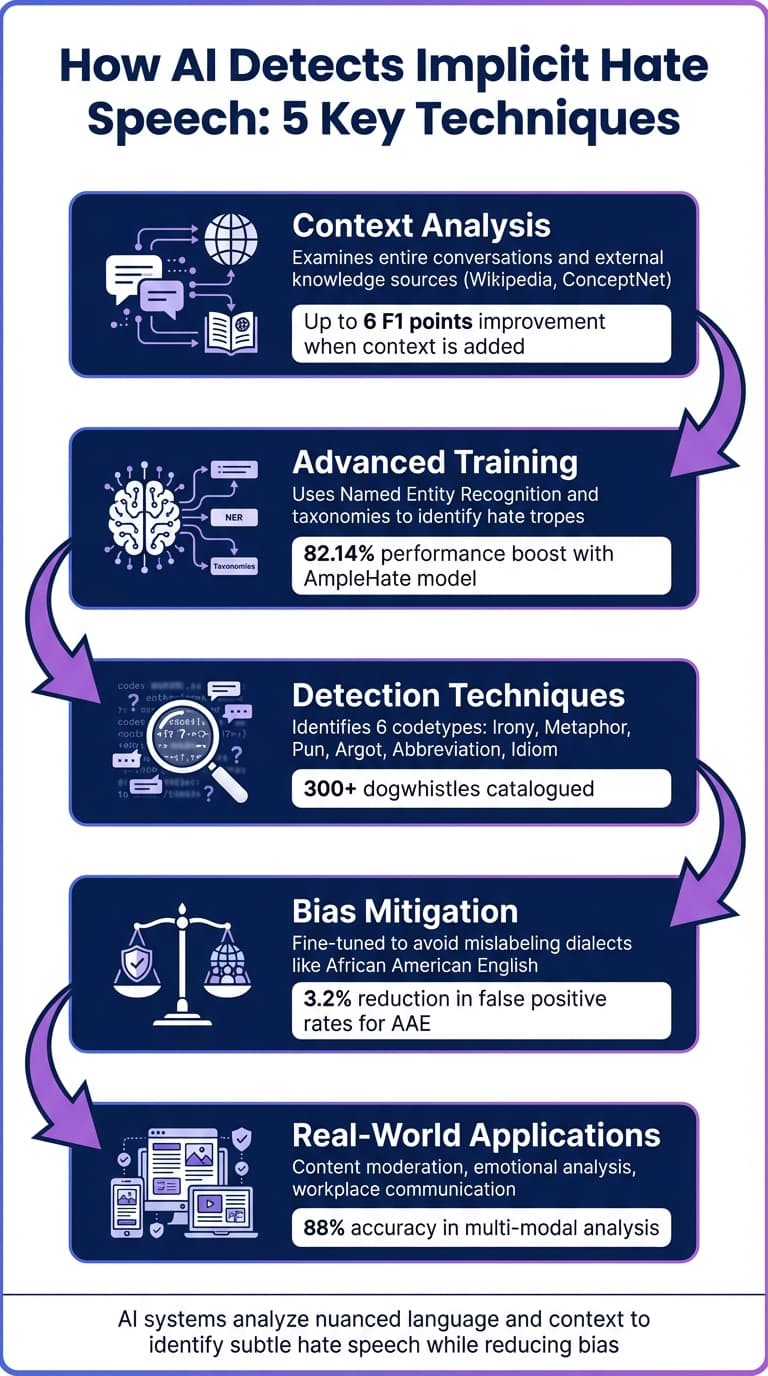
- Context Analysis: AI examines entire conversations and external knowledge (e.g., Wikipedia) to understand the intent behind words.
- Advanced Training: Models like AmpleHate use Named Entity Recognition and taxonomies to identify specific hate tropes, such as stereotypes or coded language.
- Detection Techniques: AI identifies hidden patterns like irony, abbreviations, and "dogwhistles" (phrases with double meanings).
- Bias Mitigation: Systems are fine-tuned to avoid mislabeling non-offensive language, especially in dialects like African American English (AAE).
- Applications: Beyond moderation, these tools are used in emotional manipulation analysis (e.g., detecting gaslighting) and workplace communication.
AI's ability to analyze nuanced language and context is reshaping how implicit hate speech is identified and addressed, ensuring safer online spaces while reducing bias.
::: @figure
How AI Analyzes Language Context
The Role of Context in Detection
AI systems don’t just look at individual words when identifying implicit hate speech. A phrase that might seem harmless in one situation could carry hateful undertones in another, depending on factors like the speaker, the audience, and the broader conversation. That’s why modern detection tools analyze entire conversations rather than isolating single posts.
As Joshua Wolfe Brook and Ilia Markov explain [6]:
"Robustly detecting hate speech is a complex and context-dependent task, as such speech is often obfuscated through irony, euphemism, or coded language."
AI models rely on two types of context to make sense of conversations. Conversational context involves analyzing parent posts, replies, and thread history to grasp the flow of discussion. On the other hand, background context pulls from external knowledge sources like Wikipedia, ConceptNet, or Wikidata to gather historical or social facts about groups or individuals mentioned [6]. When AI incorporates this background information, its performance improves significantly - by up to 3 F1 points for text analysis and 6 F1 points for memes combining text and images [6].
Interestingly, when human moderators review posts with full context, the percentage of messages labeled as abusive drops from 18% to 10%. This shows how understanding context can clarify intent and help distinguish genuine hate speech from misinterpreted language by comparing AI and human analysis [6]. It also highlights the importance of embedding a broader social and cultural understanding into AI training.
Training AI with Social and Cultural Knowledge
To effectively identify implicit hate, AI systems must be trained with knowledge about cultural and demographic nuances. Modern systems leverage Large Language Models (LLMs) as dynamic knowledge bases, generating background insights about entities mentioned in posts instead of just flagging keywords [6]. Using Named Entity Recognition, the AI links identified groups to relevant historical and social data [6].
Advanced models, such as AmpleHate, mimic human reasoning by first identifying explicit or implicit targets in the text. They then use attention mechanisms to examine how these targets relate to the surrounding cultural context [4]. This method has proven highly effective, outperforming older approaches by an average of 82.14% [4]. Additionally, the AI is trained on detailed taxonomies that categorize implicit hate into specific tropes, such as "white grievance", "inferiority language", and "stereotyping" [6]. This allows the system to go beyond simple keyword detection and perform a deep semantic analysis [3].
The way AI processes context also plays a crucial role in its accuracy. Research suggests that separating context from the original post using an "Embed & Concat" method is more effective than merging them into a single representation [6]. This modular approach ensures the original message remains intact while still incorporating the cultural awareness needed to detect subtle forms of hate speech.
Detect Manipulation in Conversations
Use AI-powered tools to analyze text and audio for gaslighting and manipulation patterns. Gain clarity, actionable insights, and support to navigate challenging relationships.
Start Analyzing NowAI Techniques for Detecting Implicit Hate Speech
Identifying Coded Language and Hidden Patterns
AI systems rely on six specific codetypes to identify rhetorical strategies that mask hateful intent. These include Irony, Metaphor, Pun, Argot (slang tied to specific groups), Abbreviation, and Idiom [5]. For instance, abbreviations like "txl" can function as slurs, while metaphors such as "big fat pigs" may dehumanize certain groups [5]. Some systems are also designed to detect "dogwhistles" - phrases that seem neutral but carry hateful meanings for specific audiences [7].
"Dogwhistles are coded expressions that simultaneously convey one meaning to a broad audience and a second one, often hateful or provocative, to a narrow in-group; they are deployed to evade both political repercussions and algorithmic content moderation."
- Julia Mendelsohn, Researcher [7]
One example of this involves the word "cosmopolitan." While it generally means "worldly", researchers from the Association for Computational Linguistics found that it has been used in political contexts as a coded term with anti-Semitic undertones [7]. To help AI systems identify such terms, a glossary of over 300 dogwhistles has been compiled [7].
Embedding Models for Language Understanding
Embedding models take language analysis a step further by creating vectors that capture both the semantic meaning and hidden intent behind words [8]. These systems can link explicit and implicit hate speech by identifying shared targets, which helps improve accuracy in ambiguous cases [8]. A notable technique in this field is the use of "HatePrototypes", which are class-level vector representations that allow AI to transfer knowledge across various hate speech detection tasks [3].
In November 2025, researchers Irina Proskurina and Julien Velcin introduced HatePrototypes, demonstrating that these models could effectively detect both explicit and implicit hate speech using as few as 50 labeled examples per class, without requiring extensive fine-tuning [3]. Just a month earlier, in September 2025, Yejin Lee and her team developed "AmpleHate", a model that uses Named Entity Recognition to identify targets and injects relational vectors into sentence representations. This approach delivered an 82.14% performance boost compared to standard contrastive learning techniques and showed attention patterns closely aligned with human evaluations [4].
"While explicit hate can often be captured through surface features, implicit hate requires deeper, full-model semantic processing."
- Irina Proskurina, Researcher [3]
These embedding models are further supported by graph-based approaches, which analyze the broader context of conversations.
Graph-Based Community Detection
To refine detection capabilities, some AI systems focus on the structure of conversations. By modeling social media discussions as directed graphs, where nodes represent comments and edges signify reply relationships, these systems can uncover contextual hate patterns [9]. Two key techniques - Centrality Encoding and Spatial Encoding - help assess a comment's influence based on its replies and map the hierarchical relationships among users in a thread [9]. This structural analysis is a cornerstone of real-time emotional manipulation detection in digital spaces.
For instance, the CoSyn neural network incorporates both conversational and user context. This approach led to a 1.24 percentage point improvement in implicit hate speech detection accuracy, achieving 57.8% across six datasets [10]. Researchers trained these models using "HatefulDiscussions", a dataset comprising 8,266 Reddit discussions and 18,359 human-labeled comments from 850 communities [9]. This method reveals how seemingly harmless statements, like "That's gross!" can take on hateful undertones when placed within conversations about immigration or minority groups [9].
Ensuring Accuracy and Reducing Bias in AI Systems
Balancing Accuracy Across Demographics
Sometimes, overall accuracy scores can hide serious biases. For example, harmless language is often flagged as hate speech, especially when it comes to African American English (AAE). Studies show false positive rates for AAE can climb as high as 46%, with some datasets mislabeling 97% of AAE instances as toxic [11]. However, researchers Xia, Field, and Tsvetkov tackled this issue in May 2020 using adversarial training. Their method reduced the false positive rate for AAE text by up to 3.2% while slightly improving the F1 score [11].
"Classifiers trained on biased annotations are more likely to incorrectly label AAE text as abusive than non-AAE text... which risks further suppressing an already marginalized community."
- Mengzhou Xia, Anjalie Field, and Yulia Tsvetkov, Carnegie Mellon University [11]
Their approach involves a secondary model that helps the main AI system ignore demographic markers like race or dialect while still identifying genuine toxicity and emotional abuse. This process starts with pre-training for general language understanding, followed by fine-tuning with an adversary model. The goal? To make the encoder "blind" to protected attributes without compromising its ability to detect actual hate speech [11]. By improving fairness, the system not only protects marginalized communities but also becomes better at catching nuanced hate speech. Fixing these biases, however, means taking a hard look at the data used to train these systems.
Addressing Bias in Training Data
A big part of the problem lies in the training data itself. Annotators who lack familiarity with certain dialects or social nuances often mislabel non-abusive language as offensive [11]. This issue gets even trickier when Large Language Models, like GPT-4o or Llama-3.1, are used to label data. These models can unintentionally introduce biases related to gender, race, religion, or disability [14].
Diagnostic tools like HateCheck help uncover these hidden issues that overall metrics might miss. A 2025 study by Fasching and Lelkes compared seven moderation systems across 125 demographic groups, revealing that identical content could be classified very differently depending on the system [12] [15].
"Moderation system choice fundamentally determines hate speech classification outcomes."
- Neil Fasching and Yphtach Lelkes [15]
To address these challenges, developers can use causal analysis to identify and fix spurious correlations in training data, ensuring models focus on hateful intent rather than demographic traits [13]. Regular audits with specialized benchmarks like "Latent Hatred" or "HateBiasNet" are also crucial. These tools help ensure that AI systems can handle coded language and protect against vulnerabilities tied to specific demographics [1] [14].
Applications of AI in Emotional and Social Contexts
Gaslighting Check: A Tool for Emotional Analysis

AI isn't just about crunching numbers or recognizing images - it’s also diving into the complexities of human emotions. One fascinating example is Gaslighting Check, a platform designed to detect emotional manipulation in personal communications. Using techniques originally developed for identifying implicit hate speech, this tool analyzes both text and voice patterns to spot gaslighting and other manipulative behaviors.
What sets this system apart is its ability to go beyond single phrases. Instead, it examines how tone, contradictions, and patterns evolve over time in a conversation. This approach allows it to generate detailed, explainable reports showing why certain interactions might be flagged [16]. For U.S. users, the service offers subscription plans that include comprehensive analyses of both text and voice, with privacy safeguarded through end-to-end encryption and automatic data deletion.
Broader Applications of AI-Powered Analysis
The power of AI to interpret subtle communication patterns extends far beyond personal relationships. These same techniques are making waves in workplace communication and social media moderation. A standout example is the Multi-Modal Discussion Transformer (mDT), developed by Liam Hebert, a PhD student at the University of Waterloo. This tool integrates text, images, and contextual cues to analyze online discussions. Trained on over 8,000 Reddit threads containing more than 18,000 labeled comments from 850 communities, the system achieved an impressive 88% accuracy rate - well above the 74% average of earlier models [18][20].
"We really hope this technology can help reduce the emotional cost of having humans sift through hate speech manually."
- Liam Hebert, PhD student, University of Waterloo [18]
The need for such tools is clear: about 67% of social media users report encountering hate speech regularly [17]. AI-driven systems, like those employing LSTM models, are now achieving accuracy rates as high as 97.6% while remaining interpretable [19]. These solutions are particularly vital for protecting marginalized groups - such as LGBTIQ individuals, ethnic minorities, and women - who are often subjected to subtle and context-dependent hostility [17]. By analyzing the flow of conversations and how context shifts meaning, these systems can detect nuanced changes in intent that might go unnoticed in isolated statements [16].
An In-depth Analysis of Implicit and Subtle Hate Speech Messages
Conclusion
AI is reshaping how we identify implicit hate speech online. The transition from basic keyword detection to deep semantic understanding marks a major step forward in recognizing coded language, subtle stereotypes, and hidden discrimination and manipulative behavior across contexts that older methods often overlook. For example, in December 2025, researchers from the University of Central Florida leveraged advanced language models to reannotate datasets, leading to a 12.9-point boost in F1 score[2]. This progress enables systems to grasp nuances that even human moderators might struggle to detect.
Tools like HatePrototypes highlight how effective detection can be achieved with limited labeled data. This approach reduces the barriers to developing sophisticated tools, making them more accessible and practical for broader use[3].
"Implicit hate speech detection is challenging due to its subtlety and reliance on contextual interpretation rather than explicit offensive words." - Yejin Lee, Joonghyuk Hahn, Hyeseon Ahn, and Yo-Sub Han[4]
These developments emphasize AI's expanding role in creating safer online environments while respecting free speech. By addressing disguised hate speech - such as harmful comparisons, exclusionary rhetoric, and discriminatory language - these advancements help protect marginalized communities[1][3]. Importantly, the focus is shifting toward interpretable, human-centered systems that support moderators rather than replace them, ensuring that digital spaces can balance safety with freedom of expression.
FAQs
What makes hate speech “implicit”?
Hate speech is labeled as "implicit" when it’s conveyed indirectly through coded or context-dependent language. This might involve the use of metaphors, irony, stereotypes, or references that require inference and background knowledge to grasp the intended meaning. Unlike explicit slurs or openly offensive terms, these subtle expressions often rely heavily on context, making them much harder to identify without a deeper understanding of the situation.
How does AI use context to spot coded hate?
AI identifies coded hate speech by digging into the context and relationships within the language. Modern models are trained to pick up on subtle hints like irony, euphemisms, or coded phrases. They combine this with background knowledge and contextual clues to uncover hate speech that might appear innocent at first glance. Essentially, it works much like how humans can detect hidden meanings in conversations, even when they aren't immediately obvious.
How do models avoid bias against dialects like AAE?
Models are being refined to address bias against African American English (AAE) through techniques like adversarial training and data relabeling. Adversarial training, for instance, works to reduce false positives by distinguishing toxic language indicators from features unique to AAE. Additionally, educating annotators about dialects such as AAE helps minimize racial bias during the data labeling process. These approaches aim to improve how models interpret dialectal differences, ensuring a fairer approach to hate speech detection.