
Cultural Gaslighting: Impact on Mental Health
Cultural gaslighting is a systemic form of manipulation where institutions, like healthcare or education, dismiss the experiences of marginalized groups based on identity markers such as race, gender, or sexuality. This practice perpetuates inequality and damages mental health by invalidating personal knowledge and experiences. Key findings include:
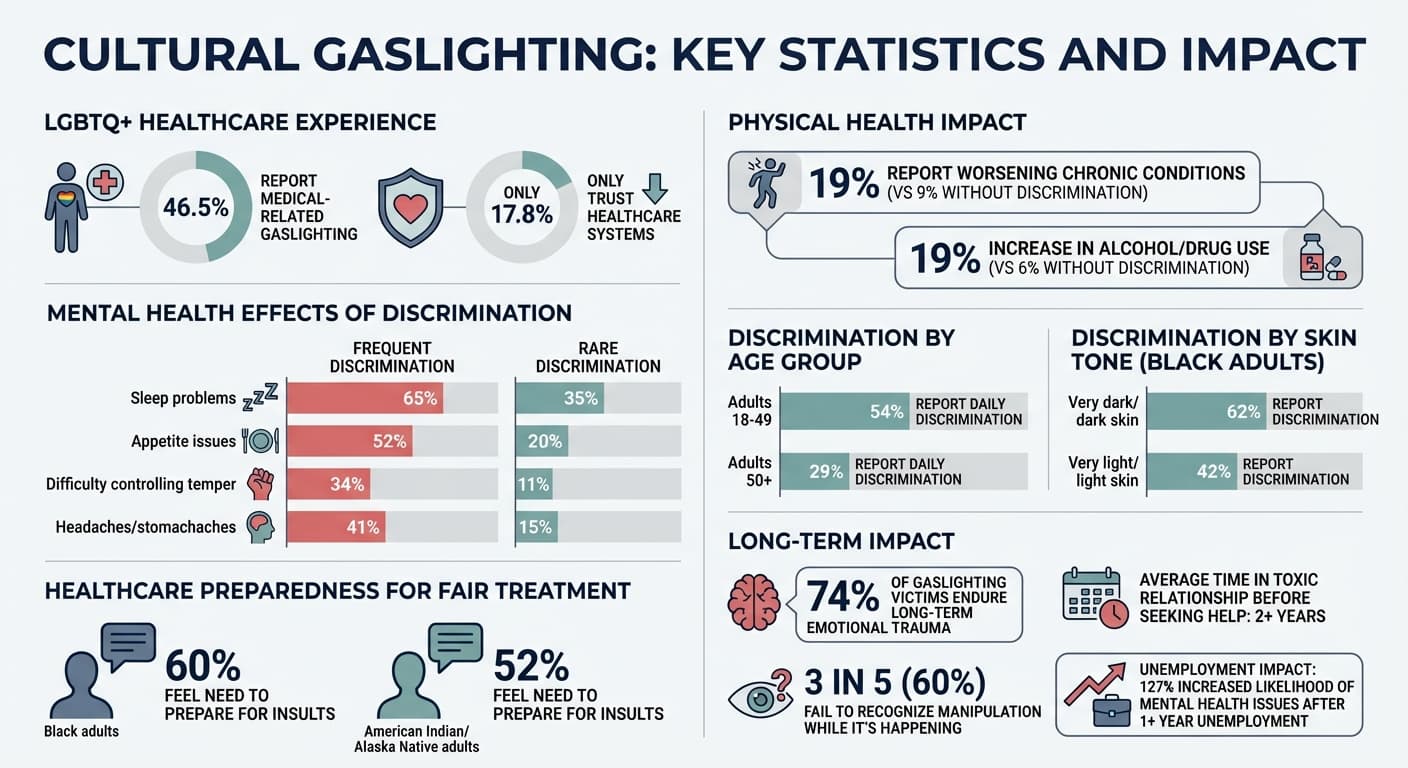
- LGBTQ+ individuals: 46.5% report medical-related gaslighting, with only 17.8% trusting healthcare systems.
- Mental health effects: Discrimination doubles the likelihood of sleep issues, emotional struggles, and physical symptoms like headaches.
- High-risk groups: Women of color, Indigenous women, and LGBTQ+ individuals face the most harm due to overlapping systemic barriers.
Strategies for recovery include therapy, self-help techniques, and tools like Gaslighting Check, which identifies manipulation in conversations. Addressing this issue requires systemic change and support for those affected.
::: @figure
Research Findings on Cultural Gaslighting
Major Studies and Results
Cultural gaslighting is increasingly understood as a deliberate and systemic tactic. Elena Ruíz’s research highlights it as a mechanism used in settler colonial societies to maintain social inequalities, creating what she terms "abusive mental ambients" that perpetuate harm[1].
A 2024 study led by Felipe De Brigard at Duke University explored responses to "epistemic injustice" through three experiments involving 1,690 participants. Participants were asked to share either factual knowledge or personal feelings about a game, then received dismissive feedback such as, "That isn’t how the game worked. Next time you should pay closer attention." The study revealed that Black men’s emotional reactions to being discredited were linked to their scores on the Race-Based Traumatic Symptoms Scale, showing how prior experiences with discrimination shaped their responses to invalidation[9].
In 2023, Choi and colleagues conducted a meta-analysis of 20 studies focusing on Asian Americans, confirming that racial microaggressions are strongly associated with negative health outcomes. The analysis found that studies centered exclusively on Asian populations showed larger effects than those combining multiple racial groups, emphasizing the importance of cultural specificity[7]. Another meta-analysis of 242 studies identified racial discrimination as most strongly correlated with mental health challenges (r = .207), followed by substance use issues (r = .159) and physical health impacts (r = .067)[8].
These findings provide a foundation for comparing how different studies approach the complex dynamics of cultural gaslighting.
Comparing Study Results
Despite varying methodologies, studies on cultural gaslighting consistently highlight systemic dismissal, psychological harm, and disproportionate effects on marginalized communities. The table below summarizes key findings:
| Study | Behaviors Studied | Mental Health Effects | Groups Most Affected |
|---|---|---|---|
| Ruíz | Systemic mental abuse, structural violence, colonial tactics[1] | Creation of "abusive mental ambients" and health harms[1] | Women of color, Indigenous women |
| Johnson et al. | Secondary microaggressions like gaslighting, 'splaining[6] | Self-doubt and psychological harm on multiple levels[6] | Historically marginalized groups |
| Carter et al. | Racial discrimination’s health and cultural effects[8] | Strong links to mental health (r = .207) and substance use (r = .159)[8] | Asian and Native Americans |
| Choi et al. | Racial microaggressions and psychosocial outcomes[7] | Negative impacts on mental, physical, and substance abuse outcomes[7] | Asian Americans and sub-groups |
The studies reveal that discrediting factual knowledge elicits stronger negative reactions than dismissing personal feelings. This is because factual knowledge is deeply tied to one’s sense of competence and self-worth. When marginalized individuals are told what they know is untrue, it undermines their identity at a fundamental level[9].
These findings shed light on the deep mental health toll of cultural gaslighting, which will be explored further in the next section.
How Cultural Gaslighting Affects Mental Health
Psychological Effects
Cultural gaslighting can profoundly disrupt mental health. When healthcare providers or societal systems dismiss concerns based on someone's race, gender, or sexuality, it creates what experts refer to as "epistemic injustice" - a situation where individuals feel their knowledge and experiences are invalidated [4].
The consequences of this are striking. Research shows that people who frequently experience discrimination are more than twice as likely to report sleep problems (65% versus 35%) and issues like poor appetite or overeating (52% versus 20%) compared to those who rarely encounter discrimination. Emotional struggles also escalate, with difficulty controlling temper rising from 11% to 34%, and frequent headaches or stomachaches affecting 41% of those facing discrimination, compared to just 15% of those who don't [10].
"Medical gaslighting functions as a method in which healthcare professionals may consciously and/or subconsciously perform implicit and explicit forms of discrimination against individuals who may already be marginalized by social, political, and medical systems." - Dustin Z. Nowaskie, MD, Department of Psychiatry and the Behavioral Sciences, Keck School of Medicine [4]
The psychological toll often leads to "minority stress", where external discrimination seeps into one's self-perception, eroding self-esteem and fostering deep distrust. Over time, this stress can evolve into depression, anxiety, symptoms of PTSD, or even suicidal thoughts [4][13].
These mental health effects often go hand in hand with physical consequences, as outlined below.
Physical and Systemic Harm
The stress caused by cultural gaslighting doesn’t stop at mental health - it takes a toll on the body as well. A 2010 study that monitored 24-hour blood pressure in 78 African-American and White adults found that everyday discrimination was linked to higher levels of nocturnal "non-dipping", a condition where blood pressure doesn’t drop at night as it should. This pattern helps explain disparities in blood pressure-related health outcomes [11].
Other physical signs of stress tied to discrimination include increased inflammatory markers, shorter telomeres (a marker of premature aging), oxidative stress, and disrupted cortisol levels [11]. For instance, a 2004 study of 352 women from the Coronary Artery Risk Development in Young Adults (CARDIA) study found that self-reported racial discrimination significantly correlated with higher rates of preterm births and low birth weight babies [11].
Chronic health conditions and substance use are also more prevalent among those facing discrimination. Nearly 19% of those affected report worsening chronic physical conditions, compared to 9% of their peers who don’t face discrimination. Similarly, rates of alcohol or drug use jump from 6% to 19% [10]. Systemic inequities - like residential segregation and anti-LGBTQ+ laws - further compound these issues. These inequities create hostile environments where marginalized groups feel unsafe, often leading to healthcare avoidance. For example, 60% of Black adults and 52% of American Indian and Alaska Native adults report feeling the need to "prepare for insults" or be "very careful about their appearance" just to receive fair treatment in healthcare settings [10].
Who is Most at Risk?
High-Risk Groups
Systemic inequities mean that cultural gaslighting doesn’t affect everyone equally. Certain groups face a much higher risk due to overlapping social and institutional barriers.
Women of color and Indigenous women are among the most vulnerable. Elena Ruíz of Michigan State University highlights how cultural gaslighting operates through systemic structures in settler colonial societies, reinforcing social inequalities and erasing cultural identities [1].
LGBTQ+ individuals also experience disproportionately high levels of medical gaslighting, often leading to lower trust in healthcare systems [4].
Racial and ethnic minorities face significant discrimination as well. Among adults aged 18–49, 54% report experiencing discrimination in their daily lives, compared to just 29% of those aged 50 and older. Skin tone also plays a role: 62% of Black adults with "very dark" or "dark" skin tones report discrimination, while this figure drops to 42% for those with "very light" or "light" skin tones. Gender further complicates this picture - 21% of Black women report unfair treatment by healthcare providers due to their race or ethnicity, compared to 13% of Black men [14].
Socioeconomic status adds another layer of risk. People with lower household incomes, those who are unemployed, and individuals with disabilities are particularly vulnerable. For example, being unemployed for a year or more increases the likelihood of developing mental health issues by 127% [12].
These challenges are amplified by structural and interpersonal factors, creating a web of vulnerabilities for these groups.
Factors That Increase Risk
Several factors intensify the risks faced by high-risk groups, making them more susceptible to cultural gaslighting.
Marginalized individuals, often referred to as "bio-Others", frequently lack the social and economic resources needed to push back against dominant institutional narratives [4]. This lack of capital leaves them at a disadvantage when confronting systemic inequities.
Institutional mistrust further compounds the problem. Many marginalized individuals hesitate to seek help because they distrust the very systems that are supposed to support them [14].
Gaslighting often comes from authority figures - whether it’s a supervisor dismissing concerns or a healthcare provider invalidating symptoms. These power dynamics make it even harder for less powerful individuals to advocate for themselves [5].
The intersections of race, gender, and sexuality add another layer of complexity. For instance, LGBTQ+ students of color often face subtle racist microaggressions even within spaces meant to be inclusive, such as LGBTQ+ communities [3].
All of these factors contribute to what researchers call epistemic injustice. This occurs when people’s knowledge and lived experiences are systematically dismissed or invalidated because of their identity [4]. Together, these dynamics create an environment where cultural gaslighting thrives, leaving marginalized groups more vulnerable to its harmful effects.
Detect Manipulation in Conversations
Use AI-powered tools to analyze text and audio for gaslighting and manipulation patterns. Gain clarity, actionable insights, and support to navigate challenging relationships.
Start Analyzing NowRecovery and Coping Strategies
Therapy and Self-Help Methods
Recovering from gaslighting requires deliberate strategies that help rebuild self-trust, emotional clarity, and a sense of reality. Techniques like self-compassion and cognitive reappraisal play a key role in this process. Research shows that higher levels of self-compassion are linked to lower severity of gaslighting experiences, helping individuals maintain their psychological well-being [15]. Practicing self-kindness becomes essential when gaslighting shakes your sense of perception.
Cognitive reappraisal, on the other hand, helps you reframe situations to stay emotionally regulated, which can counter the emotional suppression often tied to depression [16]. Support from family or close relationships also acts as a buffer, mitigating the mental health effects of gaslighting. Additionally, understanding concepts like projective identification - a mechanism often used by gaslighters - can help separate their distortions from your reality [15][2].
Trauma-informed therapist Amelia Kelley, Ph.D., highlights the importance of awareness in combating gaslighting:
"Gaslighting is most effective when it goes undetected, so awareness is key" [21].
Keeping a record of conversations is another valuable tool. Documenting interactions creates an objective log of your experiences, which can help counter the manipulative nature of gaslighting [21]. Digital tools like Gaslighting Check can further support these efforts by providing concrete evidence of manipulation.
Using Gaslighting Check

In addition to therapy and self-help methods, digital tools offer a modern way to validate and support your experiences. Gaslighting Check was designed to address a unique challenge: gaslighting often goes unnoticed by those enduring it. Using AI-powered analysis, the tool examines both text and voice conversations to identify manipulation tactics like "countering" (questioning your memory), "withholding" (feigning ignorance), and "diverting" (changing the subject to undermine you) [19].
This platform provides real-time analysis of audio and text, creating objective documentation that can be particularly helpful in cases of digital gaslighting. For example, it can identify manipulation in deleted messages or conflicting screenshots meant to confuse you [17]. The detailed reports generated by Gaslighting Check highlight verbal manipulation patterns, offering solid evidence you can share with a trusted friend or therapist for further validation [18][20].
The service offers multiple plans to suit different needs. For $9.99/month, the Premium Plan includes features like conversation history tracking, which helps identify patterns over time - important since gaslighting typically happens repeatedly. Privacy is a priority, with end-to-end encryption and automatic data deletion policies in place. For those just beginning to recognize manipulation, the Free Plan provides basic text analysis, while the Enterprise Plan offers tailored solutions for organizations dealing with systemic gaslighting.
Cultural Gaslighting and the Toll on Mental Health | ThriveAndBeWhole.com

Conclusion: Moving Toward Emotional Well-being
Studies reveal that 74% of gaslighting victims endure long-term emotional trauma, with 3 in 5 failing to recognize the manipulation while it’s happening. On average, victims remain in these toxic relationships for over two years before seeking help [22]. These numbers emphasize just how harmful and deceptive gaslighting can be - it often takes hold silently, leaving deep scars before it’s even identified.
Understanding this reality is a critical step in the healing process. As Stephanie A. Sarkis, Ph.D., puts it:
"Identifying gaslighting patterns is crucial for recovery. When you can recognize manipulation tactics in real-time, you regain your power and can begin to trust your own experiences again" [22].
Rebuilding emotional health after enduring such manipulation requires patience and self-compassion. Giving yourself grace can help repair the psychological damage caused by distorted realities [15]. Additionally, leaning on support from trusted family members or friends provides much-needed external validation [15].
Practical actions, like documenting interactions through journals, screenshots, or recordings, can also serve as powerful tools to counteract gaslighting. These records create objective evidence and help reinforce your sense of reality [24].
Restoring your sense of self is at the heart of recovery. This involves reframing negative thoughts, setting firm boundaries, and finding communities that affirm your experiences [16][23]. Whether you turn to therapy, self-guided strategies, or digital tools designed to track manipulation patterns, recovery is achievable when the right support systems are in place. These efforts not only help you heal but also confront the broader societal patterns that perpetuate gaslighting and its harmful effects.
FAQs
What is cultural gaslighting, and how does it impact marginalized communities?
Cultural gaslighting is a widespread form of psychological manipulation where dominant groups downplay, dismiss, or distort the lived experiences of trauma and oppression faced by marginalized communities. Unlike the one-on-one nature of interpersonal gaslighting, this operates on a much larger scale, woven into societal systems like laws, education, and media narratives. The result? A society that invalidates genuine grievances and perpetuates harm.
For those on the receiving end, the effects are profound. Cultural gaslighting can take a heavy toll on mental health, contributing to heightened anxiety, depression, and trauma. It chips away at self-esteem, fuels self-doubt, and intensifies external pressures like microaggressions or stereotype threats. By rejecting both individual and collective truths, it disrupts healing and resistance, keeping harmful cycles firmly in place.
Tools like Gaslighting Check offer a way to push back against this manipulation. By providing real-time conversation analysis while safeguarding user privacy, these tools help individuals identify and address the subtle dynamics of cultural gaslighting. This not only supports personal mental health but also contributes to broader efforts for social change.
What is cultural gaslighting, and how can people recognize and address it?
Cultural gaslighting happens when dominant groups use media, institutions, or historical narratives to dismiss or undermine the lived experiences of marginalized communities. This can leave individuals feeling confused, doubting their own reality, and emotionally drained. Common signs include feeling like your emotions or memories are "incorrect" when they challenge mainstream stories, noticing the erasure of your community’s history, or experiencing anxiety and low self-worth because of these invalidating messages.
Addressing cultural gaslighting starts with documenting specific instances of invalidation - whether it’s a comment, a situation, or a historical omission. Keeping track of dates, quotes, or events can help you stay grounded in your reality. It’s also important to connect with trusted friends, community groups, or trauma-informed therapists who can provide support and help rebuild your confidence. Tools like conversation analysis platforms can be useful in spotting patterns of manipulation. Additionally, participating in culturally affirming activities - like exploring your community’s history or engaging in traditions - can strengthen your sense of identity and push back against cultural erasure.
What changes are needed to combat the effects of cultural gaslighting?
Cultural gaslighting refers to the systemic ways in which the experiences of marginalized groups - such as women of color, Indigenous peoples, and LGBTQ+ communities - are invalidated. These patterns are deeply ingrained within institutions, making it critical to address them through meaningful structural changes. The consequences of cultural gaslighting extend beyond individual experiences, impacting mental health and perpetuating societal inequities.
Addressing this issue calls for several key actions. Legal reforms are crucial to acknowledge and combat institutional betrayal, ensuring that systems are held accountable. Redistributing resources can empower marginalized communities, giving them the tools to advocate for their rights and well-being. On a broader scale, public health initiatives can frame cultural gaslighting as a population-wide issue, emphasizing the need for widespread intervention.
To dismantle harmful practices, accountability measures - such as anti-racist training and independent oversight - are essential. These steps can help institutions recognize and rectify their roles in perpetuating harm. At the same time, adopting inclusive policies ensures that marginalized groups receive the support they need to thrive. Together, these efforts aim to build a society rooted in fairness and understanding, where everyone’s experiences are validated and respected.