
Cognitive Flexibility Scales in Trauma Recovery
Cognitive flexibility, the ability to shift thoughts and behaviors in response to changing situations, is a key factor in trauma recovery. Research shows that individuals with higher cognitive flexibility experience fewer PTSD symptoms over time. Tools like the Cognitive Flexibility Inventory (CFI) and neurocognitive training programs help measure and improve this skill, aiding recovery.
Key takeaways:
- Cognitive flexibility helps trauma survivors break negative thought patterns and respond better to stress. This includes detecting emotional shifts that might otherwise trigger a trauma response.
- Early levels of flexibility predict long-term PTSD outcomes.
- Interventions like web-based training and self-compassion practices can strengthen cognitive flexibility.
- Scales like the CFI and others provide ways to assess and track progress.
Improving cognitive flexibility isn’t just possible - it’s measurable and actionable for better mental health outcomes.
Research on Cognitive Flexibility and PTSD
How Cognitive Flexibility Predicts PTSD Outcomes
Several clinical studies highlight the connection between cognitive flexibility and long-term trauma recovery. In October 2018, the Sagol Brain Institute conducted a study involving 181 trauma survivors. Led by Ziv Ben-Zion, the research team used a computerized Trail Making Test to measure cognitive flexibility just one month after the participants experienced trauma. The findings were eye-opening: individuals with higher "Switching of Attention" scores had significantly lower CAPS scores 13 months later (p = 0.002) [2].
"Cognitive flexibility, shortly after trauma exposure, emerged as a significant predictor of PTSD symptom severity."
- Ziv Ben-Zion, Sagol Brain Institute [2]
This study underscores the role cognitive flexibility plays in trauma recovery. Current PTSD symptoms are closely linked to cognitive flexibility, while lifetime PTSD symptoms show a stronger connection to regulatory flexibility [3]. This distinction is critical for tailoring treatment strategies. Shilat Haim-Nachum from Bar-Ilan University explains, "People's inabilities to change their thoughts and adaptively respond to different situations are more strongly related to recent PTSD symptoms" [3].
The underlying brain mechanisms behind these challenges are becoming clearer. In 2022, researchers at the National Intrepid Center of Excellence (NICoE) studied 91 combat-exposed service members using Magnetoencephalography (MEG) to examine brain activity during cognitive tasks. Led by Mihai Popescu, the study revealed that participants with severe PTSD symptoms (PCL-5 score ≥ 35) displayed significantly less suppression of beta band activity during task-switching. This suggests a key difficulty in filtering out competing information [6]. These findings further highlight cognitive flexibility's role in helping individuals adapt and recover from trauma.
Cognitive Flexibility and Secondary Trauma
Cognitive flexibility doesn't just benefit primary trauma survivors - it also helps those exposed to secondary traumatic stress. This type of stress affects individuals who repeatedly witness or hear about others' traumatic experiences. Between 2024 and 2025, researchers Farchi and Levy-Gigi examined 172 educational counselors working in primary and secondary schools. These counselors, who regularly dealt with students' traumatic stories, participated in a 10-week (30-hour) psychological first-aid training program based on the "Six Cs" model, which includes Cognitive communication, Control, and Commitment, among others. The results were compelling: the training significantly boosted cognitive flexibility (t = -3.26, p = 0.001) while reducing fear (p < 0.001) and helplessness (p < 0.001) [4].
One of the most striking findings was how cognitive flexibility weakened the connection between trauma exposure and the perception of threat. For counselors who showed the greatest improvements in flexibility, the link between cumulative trauma exposure and feelings of threat was nearly eliminated. This accounted for 7.63% of the explained variance in post-training threat perception [4]. In other words, counselors with high cognitive flexibility were able to maintain low levels of perceived threat regardless of the amount of secondary trauma they encountered.
"In individuals with high cognitive flexibility, PTSD symptom severity remains low independent of their exposure level."
- Farchi et al. [4]
This research highlights the potential of cognitive flexibility as a modifiable protective factor. Unlike fixed personality traits, cognitive flexibility can be improved through targeted interventions, providing a practical way to prevent secondary traumatic stress in high-risk professions. By strengthening cognitive flexibility, we can better support both primary trauma survivors and those who assist them.
Detect Manipulation in Conversations
Use AI-powered tools to analyze text and audio for gaslighting and manipulation patterns. Gain clarity, actionable insights, and support to navigate challenging relationships.
Start Analyzing NowEnhancing PTSD Treatment: Acceptance-Based Exposure Exercises
Scales for Measuring Cognitive Flexibility
::: @figure
Cognitive Flexibility Inventory (CFI)

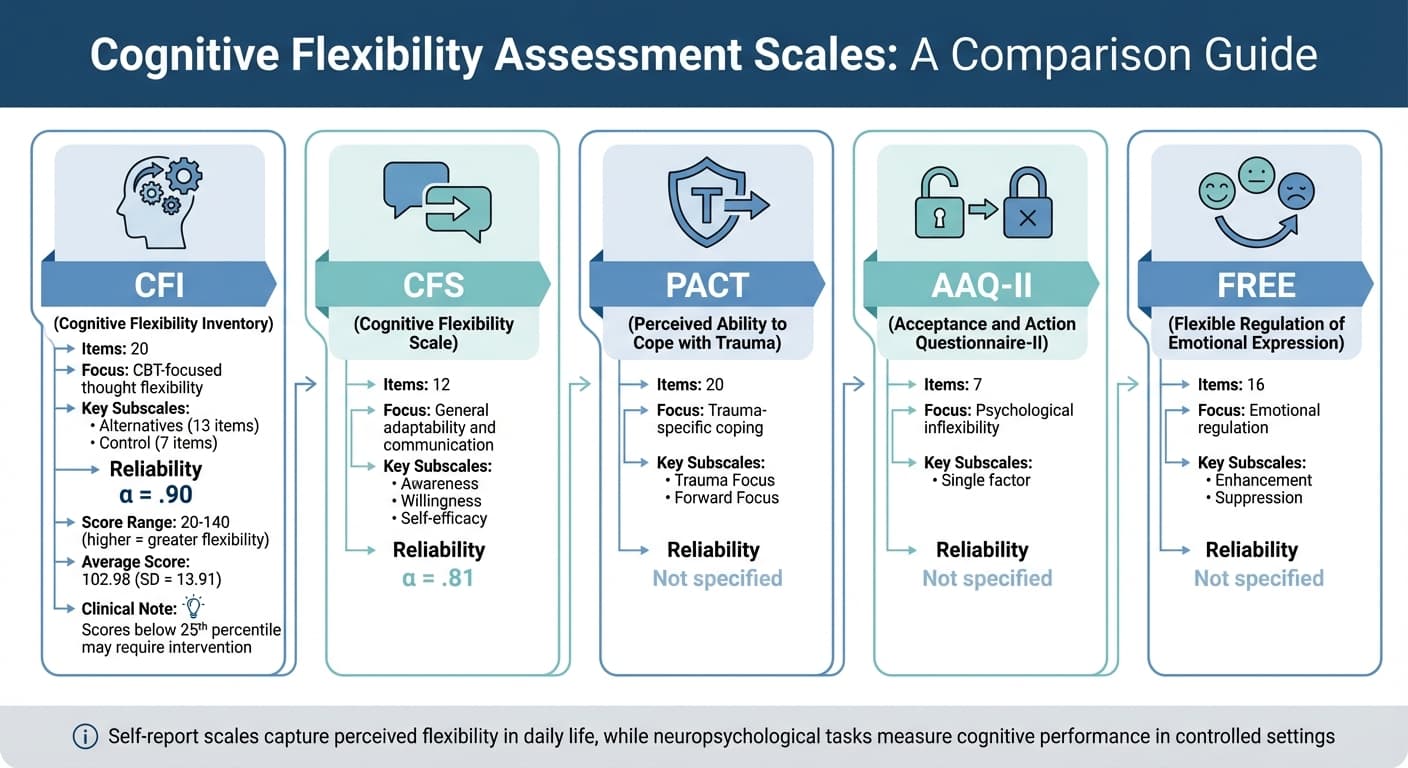
The Cognitive Flexibility Inventory (CFI) is a 20-item self-report tool designed to monitor progress in cognitive-behavioral therapy, particularly in challenging negative thought patterns. It evaluates two main aspects of flexibility:
- Alternatives: A 13-item subscale that measures the ability to come up with multiple explanations or solutions for difficult situations.
- Control: A 7-item subscale that assesses how much control a person feels they have over challenging circumstances.
To ensure accuracy, some items are reverse scored. The CFI has proven to be reliable, with a test-retest correlation of r = .81 and strong internal consistency (Cronbach's alpha = .90). Scores range from 20 to 140, with higher scores reflecting greater cognitive flexibility. Scores below the 25th percentile could indicate significant inflexibility, potentially requiring intervention. Among university students, the average score is 102.98 (SD = 13.91).
This scale is particularly valuable in trauma recovery, as it can be repeatedly used during Cognitive Behavioral Therapy (CBT) to track a patient's response to thought-challenging techniques. Research highlights a clear link between lower cognitive flexibility (as measured by tools like the CFI) and higher PTSD symptom severity.
"Cognitive flexibility enables individuals to think adaptively when encountering stressful life events, and is a core skill that helps individuals avoid becoming stuck in maladaptive patterns of thinking."
While the CFI is a powerful tool, other scales provide additional perspectives on cognitive and emotional adaptability, especially in trauma recovery.
Comparing Common Assessment Scales
Several other scales complement the CFI by assessing different aspects of cognitive and emotional flexibility:
- Cognitive Flexibility Scale (CFS): A 12-item scale that evaluates general adaptability and communication skills. It focuses on three areas: awareness of options, willingness to adapt, and self-efficacy. The CFS demonstrates good reliability, with α = .81 [8].
- Perceived Ability to Cope with Trauma (PACT): A 20-item tool specifically designed for trauma assessment. It includes two subscales: "Trauma Focus", which measures how well someone processes a traumatic event, and "Forward Focus", which reflects their ability to move beyond the trauma [3].
- Acceptance and Action Questionnaire-II (AAQ-II): A concise 7-item measure that examines psychological inflexibility, particularly the extent to which distressing thoughts or memories interfere with living a meaningful life [3].
- Flexible Regulation of Emotional Expression (FREE): A 16-item scale that evaluates emotional regulation, focusing on the ability to both enhance and suppress emotional expression [3].
| Scale | Items | Focus | Key Subscales | Reliability |
|---|---|---|---|---|
| CFI | 20 | CBT-focused thought flexibility | Alternatives, Control | α = .90 |
| CFS | 12 | General adaptability and communication | Awareness, Willingness, Self-efficacy | α = .81 |
| PACT | 20 | Trauma-specific coping | Trauma Focus, Forward Focus | Not specified |
| AAQ-II | 7 | Psychological inflexibility | Single factor | Not specified |
| FREE | 16 | Emotional regulation | Enhancement, Suppression | Not specified |
While self-report scales like these capture an individual's perceived flexibility in daily life, neuropsychological tasks offer insights into cognitive performance in more controlled settings. Both approaches can be valuable, depending on the context and goals of the assessment.
Methods to Improve Cognitive Flexibility
Neurocognitive Training for PTSD Symptoms
Web-based neurocognitive training is a method that helps rebuild cognitive flexibility after trauma. It involves specific exercises designed to enhance skills like working memory, task shifting, and response inhibition. These exercises adjust to your performance, becoming more challenging as you progress.
Between 2015 and 2018, researchers Ziv Ben-Zion and Naomi Fine conducted a study in two general hospitals in Israel with 50 trauma survivors. Participants engaged in daily 30-minute sessions for 30 days using platforms like Lumosity and MyBrainSolutions. The results? The active training group showed significant improvement in cognitive flexibility (mean change: 0.4310 vs. 0.1028) and experienced noticeably lower PTSD symptoms six months later [2].
"Cognitive flexibility, shortly after trauma exposure, emerged as a significant predictor of PTSD symptom severity. It was also ameliorated by a neurocognitive intervention and associated with a better treatment outcome."
- Ben-Zion et al., Frontiers in Psychiatry [2]
The training works by reshaping prefrontal networks, helping the brain distinguish between threats and neutral cues. This is essential for PTSD recovery, as it supports the extinction of fear-based learning patterns. Starting this training within the first month after trauma is particularly effective. This early period is marked by heightened brain plasticity, making it a prime time for learning and adaptation [2].
Another method showing promise is Autobiographical Memory Flexibility (MemFlex), a workbook-based program that helps individuals shift between specific and general memories. In a randomized controlled trial with 43 participants in Tehran, Iran, researchers tested this eight-session program delivered over four weeks. The intervention focuses on three main skills: balancing (accessing positive memories), elaboration (adding detail to non-trauma memories), and flexibility (switching between specific and general recall). Participants showed a large effect size (d = 1.09) for improved memory flexibility and significant reductions in maladaptive post-traumatic thoughts compared to the control group [9].
While cognitive exercises are key, pairing them with emotional self-care can further enhance cognitive flexibility.
Self-Compassion and Cognitive Flexibility
In addition to neurocognitive training, self-compassion - treating yourself with kindness during tough times - plays a vital role in improving cognitive flexibility. A 2020 study by Daneshvar, Basharpoor, and Shafiei examined 252 trauma-exposed individuals. They found that those with PTSD had significantly lower levels of both self-compassion and cognitive flexibility compared to trauma survivors without PTSD [10].
This connection makes sense: harsh self-criticism locks you into rigid thinking and perpetuates negative cycles. On the other hand, self-compassion fosters emotional safety and helps counter psychological abuse tactics, making it easier to explore new perspectives and responses. Its three components - self-kindness, common humanity, and mindfulness - work together to develop the mental adaptability needed to handle changing circumstances [10].
"Findings of the present study suggest that self-compassionate attitude toward shortcomings and failures of self, and cognitive flexibility is lower in people suffering from post-traumatic stress disorder than those trauma-exposed individuals without post-traumatic stress disorder."
- Daneshvar, S., Basharpoor, S., & Shafiei, M. [10]
Therapeutic approaches that reduce self-criticism and isolation while encouraging mindfulness can significantly strengthen cognitive flexibility. This is especially crucial because high levels of self-judgment, isolation, and over-identification - the opposites of self-compassion - are closely tied to cognitive rigidity and more severe PTSD symptoms [10]. Incorporating mindfulness techniques allows individuals to step back from distressing thoughts, creating room for more adaptive and flexible thinking patterns.
Using Cognitive Flexibility in Emotional Recovery
Using Measurement Scales in Clinical Practice
Clinicians often turn to cognitive flexibility scales as an early warning system to identify individuals who may be at risk for chronic PTSD after experiencing trauma. Studies reveal that people with higher cognitive flexibility just one month after a traumatic event tend to report significantly milder PTSD symptoms 13 to 14 months later (p = 0.002) [2].
One commonly used tool, the Cognitive Flexibility Inventory (CFI), helps clinicians zero in on specific thinking patterns that may need attention. For instance, the "Alternatives" subscale assesses whether someone can recognize multiple possible explanations for events, while the "Control" subscale evaluates whether individuals perceive challenging situations as manageable or overwhelming [5]. This detailed insight enables therapists to design interventions that directly address the areas where patients struggle the most.
"Self-report tools are often used clinically to assess one's application of behaviors outside the laboratory setting, thus increasing ecological validity and generalizability."
- Kelly Hohl and Sanda Dolcos, University of Illinois at Urbana-Champaign [1]
Tracking a patient’s cognitive flexibility scores over time provides a way to monitor progress and predict reductions in PTSD symptoms, as research suggests [2]. Experts also recommend combining self-report tools with neuropsychological tasks for a more complete picture [1]. Together, these methods not only refine treatment strategies but also pave the way for digital innovations in trauma recovery.
How Gaslighting Check Supports Trauma Recovery

Digital tools are expanding the ways clinicians and individuals can approach emotional recovery. By integrating technology with traditional assessments, these tools offer a fresh avenue to foster adaptive thinking.
One such tool, Gaslighting Check, addresses a specific and often overlooked aspect of trauma: identifying emotional manipulation in real-time interactions. The platform analyzes both text and voice patterns to detect tactics that undermine a person’s ability to trust their own perceptions.
Gaslighting Check provides users with detailed, actionable reports to help them spot manipulation patterns they might otherwise overlook. These reports serve as a foundation for challenging distorted thoughts and rebuilding cognitive flexibility. For $9.99 per month with the Premium Plan, users gain access to features like conversation history tracking, allowing them to review interactions over time and measure their personal growth.
The platform’s privacy features, including end-to-end encryption and automatic data deletion, create a secure space for this sensitive work. Users can record and analyze conversations privately while accessing a supportive, moderated community. This emphasis on safety and autonomy aligns closely with trauma-informed care principles, ensuring that users feel empowered and in control throughout their recovery journey.
Conclusion
Research shows that cognitive flexibility isn't set in stone - it can be improved with specific interventions, making it a critical tool in trauma recovery. Studies reveal that individuals with stronger cognitive flexibility tend to experience less severe PTSD symptoms over time [2]. This makes measurement tools essential - not just for identifying those who could benefit from early support, but also for monitoring their progress throughout recovery.
The link is undeniable: enhancing cognitive flexibility leads to better clinical outcomes. Recent findings highlight how brief, focused neurocognitive training can boost cognitive flexibility while easing PTSD symptoms [2]. As Ziv Ben-Zion and colleagues explained:
"Cognitive flexibility, shortly after trauma exposure, emerged as a significant predictor of PTSD symptom severity. It was also ameliorated by a neurocognitive intervention and associated with a better treatment outcome." - Ziv Ben-Zion et al. [2]
Combining self-report scales with neuropsychological tasks provides a powerful approach to creating personalized trauma recovery interventions. This reinforces cognitive flexibility as a skill that can be cultivated to aid trauma recovery [1]. Regular assessments can play a pivotal role in shaping targeted recovery strategies, paving the way for more effective and individualized trauma care.
FAQs
What role does cognitive flexibility play in recovering from PTSD?
Cognitive flexibility, which refers to the ability to shift thoughts, behaviors, and responses based on changing circumstances, is a key factor in recovering from PTSD. Research indicates that people with greater cognitive flexibility often report fewer PTSD symptoms. This skill helps them handle distress more effectively and adopt healthier ways to cope.
Further studies highlight that improving cognitive flexibility can lessen the intensity of intrusive thoughts and emotional difficulties. By allowing individuals to reframe traumatic memories and adapt to stressors, it fosters a more effective and resilient path to recovery from trauma.
What are the best ways to improve cognitive flexibility during trauma recovery?
Improving cognitive flexibility during trauma recovery calls for a mix of structured exercises and strategies to manage emotions. Studies highlight that programs like psychological first aid, which emphasize flexible thinking, can equip trauma survivors with coping tools while easing feelings of fear and helplessness. These programs often incorporate activities such as brainstorming alternative solutions, adopting new perspectives, and navigating uncertain situations.
Equally important is incorporating emotional regulation techniques like mindfulness and cognitive reappraisal. These methods help individuals recalibrate their emotional reactions to various challenges. When combined, these approaches foster resilience and contribute to a more effective recovery journey.
How does practicing self-compassion improve cognitive flexibility during trauma recovery?
Practicing self-compassion - treating yourself with kindness, acknowledging shared human struggles, and staying aware of difficult emotions - can play a powerful role in improving mental flexibility during trauma recovery. Studies suggest that people with greater self-compassion are better at adjusting their thinking and tackling challenges. On the other hand, those dealing with PTSD often struggle with rigid thinking patterns. This connection exists because self-compassion reduces self-criticism, eases feelings of isolation, and helps avoid becoming overly attached to negative emotions.
By calming emotional intensity and encouraging balance, self-compassion creates a mental environment where the brain can shift perspectives and solve problems more effectively. Practices like mindfulness exercises, compassionate imagery, or taking brief moments for self-kindness can help trauma survivors break free from rigid thought cycles, view negative experiences in a new light, and build healthier coping mechanisms - key steps in the recovery journey.