
AI Conflict Resolution: Benefits and Challenges
AI is reshaping conflict resolution across digital systems and workplace environments by offering faster, data-driven solutions. This article explores three main AI approaches: Gaslighting Check, rule-based consensus algorithms, and machine learning negotiation systems. Each method has strengths, limitations, and specific use cases:
- Gaslighting Check: Uses NLP to detect emotional manipulation in communications with 89% accuracy. It excels in real-time analysis but struggles with sarcasm and requires frequent retraining.
- Rule-Based Consensus Algorithms: Focus on technical consistency (e.g., blockchain systems) but lack flexibility in addressing interpersonal conflicts. They face scalability challenges in large networks.
- Machine Learning Negotiation Systems: Predict and mediate disputes using reinforcement learning, achieving up to 84% alignment with human mediators. However, they face computational demands and bias issues.
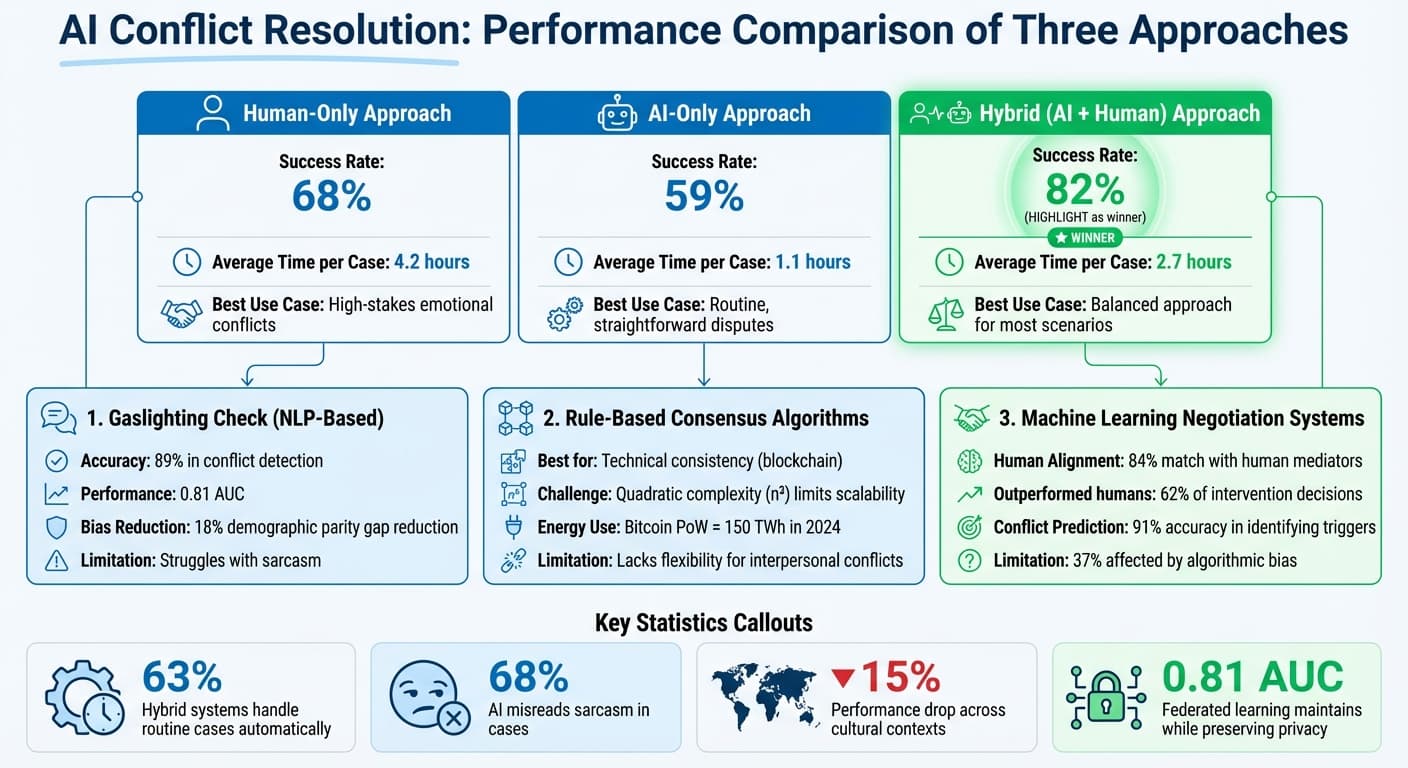
While AI systems improve efficiency and handle large-scale disputes, they fall short in areas requiring emotional intelligence. Hybrid AI-human models, combining AI's analytical power with human judgment, achieve the best outcomes, with an 82% success rate in workplace disputes. These systems balance speed, accuracy, and the need for nuanced understanding, making them a practical choice for most scenarios.
::: @figure
Prompt Engineering for Relationship Dynamics: Designing Conversational AI for Conflict Resolution
1. Gaslighting Check

Gaslighting Check takes conflict detection to the next level by using detailed tone and behavior analysis to understand interactions better [1]. This platform dives into both text and voice communications, identifying subtle shifts in tone, mismatched expectations, and communication breakdowns - potential red flags for emotional manipulation or escalating conflicts.
Effectiveness in Conflict Detection
Gaslighting Check boasts an impressive 89% accuracy in classifying conflict types from digital communications [1]. By analyzing communication patterns, it identifies gradual tone changes, inconsistent messaging, and signs of manipulation. Julio Lopez from Sonatafy highlights its value:
AI can help reduce bias and promote fair decision-making by providing a neutral platform for conflict resolution [6].
The system is designed to spot stress indicators and trust issues early, comparing current interactions with past communication data to predict when conversations might go off course [5][4]. That said, it does have its blind spots - it struggles with interpreting sarcasm, extended silences, or moments of emotional withdrawal [4].
Scalability
Gaslighting Check processes data from emails, chats, and voice recordings in real time, while leveraging federated learning to keep sensitive information on users' devices instead of centralized servers. This approach allows it to maintain a conflict prediction performance of 0.81 AUC. However, regular retraining is necessary, as performance can drop by 0.15 AUC per month [1]. Its versatility makes it suitable for both individuals managing personal relationships and organizations monitoring workplace dynamics, even across remote teams [4].
Bias Mitigation
To address fairness, the platform includes debiasing layers that reduce demographic parity gaps by 18%, creating a more neutral foundation for analysis [1]. However, about 22% of users attempt to manipulate sentiment analysis, and the "explainability gap" inherent in neural networks means human oversight is still crucial for high-stakes decisions [1].
User Privacy
Privacy is a cornerstone of Gaslighting Check's design. With end-to-end encryption and automatic data deletion policies, the platform ensures that all analysis remains localized through federated learning [1]. By processing data in secure digital environments and adhering to strict ethical standards [4][7], it minimizes the risk of breaches while maintaining transparency about data usage - a critical factor in earning user trust [6]. Premium users, for $9.99/month, can access conversation history tracking under the same robust privacy protections. These privacy measures, combined with its scalability, form the backbone of Gaslighting Check's conflict resolution approach, setting a benchmark for other AI-driven solutions.
2. Rule-Based Consensus Algorithms
Rule-based consensus algorithms, such as Proof of Work (PoW), Proof of Stake (PoS), and Practical Byzantine Fault Tolerance (PBFT), are designed to tackle technical challenges in distributed systems. Their primary goal is to ensure fault tolerance and maintain ledger consistency by focusing on achieving a technical consensus rather than addressing behavioral dynamics [9]. These systems rely on concepts like an "honest majority" or "weighted consensus" to resolve issues like double-spending. However, they often fail to account for minority viewpoints in more complex decision-making scenarios [9]. As Apurba Pokharel from the University of North Texas highlights:
The existing consensus mechanisms... are primarily designed by focusing on majority or weighted consensus to tolerate faults in a network... these protocols are not implemented in a way that can process the inclusion of every participant's opinion to reach a unanimous agreement [9].
Unlike adaptive AI-driven tools, rule-based methods remain rigid, which can impact their efficiency when dealing with nuanced or evolving scenarios.
Effectiveness in Conflict Detection
Rule-based algorithms handle conflict detection by flagging resource contention when nodes compete for the same assets [2]. For instance, PBFT achieves strong consistency by requiring more than two-thirds of the nodes to agree before resolving conflicts [9]. Similarly, Multi-Paxos relies on a stable leader to streamline communication and speed up decision-making [3]. However, these systems are static in nature and struggle to adapt to real-time challenges like Sybil attacks or network congestion without manual intervention [10]. While effective for addressing technical conflicts, they lack the flexibility to manage more subtle issues, such as communication breakdowns, which AI-driven tools like Gaslighting Check are better equipped to handle.
Scalability
Scalability is a persistent hurdle for rule-based systems. For example, PBFT's communication complexity increases quadratically (n²) with the number of nodes, limiting its usability in larger networks [3][11]. Bitcoin's PoW mechanism highlights another issue - its energy consumption exceeded 150 TWh in 2024, showcasing its inefficiency [3]. Delegated Proof of Stake (DPoS) offers improved throughput by electing a smaller group of nodes to represent the network, but this approach risks creating power imbalances that can bottleneck the system [3]. As networks grow, the time required to reach consensus increases, reducing overall transaction speed and making these algorithms less practical for large-scale, multi-stakeholder environments [3][11].
Bias Mitigation
These algorithms incorporate game theory principles like Nash equilibrium and Pareto efficiency to promote fairness. The goal is to ensure that no participant can improve their position without negatively affecting others, and any loss is distributed equitably [2][9]. For Byzantine fault tolerance to work, the system requires that the number of honest nodes satisfies the condition n > 3t + 1, where n is the total number of nodes and t represents the dishonest ones [9]. However, the rigid structure of these algorithms limits their ability to foster dynamic collaboration. DPoS systems, in particular, are prone to centralization risks, which can undermine fairness [9].
User Privacy
While rule-based blockchain systems emphasize transparency, integrating AI for conflict resolution introduces risks related to data centralization. Modern DPoS designs address privacy concerns to some extent, but traditional rule-based algorithms prioritize achieving consensus over safeguarding user data. Organizations using these systems must adopt additional measures, such as Secure Multi-Party Computation, to protect sensitive information [8]. This stands in contrast to AI-driven tools like Gaslighting Check, which prioritize privacy as a core feature. These limitations underscore the growing importance of adaptive AI solutions in addressing both technical and privacy-related challenges in conflict resolution.
Detect Manipulation in Conversations
Use AI-powered tools to analyze text and audio for gaslighting and manipulation patterns. Gain clarity, actionable insights, and support to navigate challenging relationships.
Start Analyzing Now3. Machine Learning-Based Negotiation Systems
Machine learning-based negotiation systems take conflict resolution to a new level by using tools like natural language processing (NLP) and reinforcement learning. Unlike older rule-based methods that rely on static decision trees, these systems analyze workplace disputes in real time. They pick up on subtle linguistic details, shifts in sentiment, and emotional cues in communication. For example, advanced transformer models can identify these nuances with impressive precision, while analyzing executive communication patterns has revealed hidden triggers for conflict with 91% accuracy [1].
Effectiveness in Conflict Detection
These systems shine in identifying conflict patterns as they emerge. By analyzing email threads, chat logs, and other digital communications, machine learning models can predict disputes before they escalate. In blind evaluations, large language models (LLMs) have shown they can match - or even surpass - human mediators in resolving conflicts. They equaled or outperformed human mediators in 62% of intervention decisions and achieved an 84% alignment in quality [12]. As Jinzhe Tan from the University of Montreal highlights:
LLMs demonstrated consistent and coherent interventions across multiple cases, with fewer instances of judgment errors [12].
That said, these systems still face challenges, such as interpreting sarcasm and performing effectively in diverse cultural contexts [1].
Scalability
ML-powered negotiation tools significantly speed up arbitration processes and are highly accurate in identifying evidence tampering. However, their scalability is somewhat limited due to the computational demands required for explainability [13]. These limitations naturally bring attention to the issue of algorithmic bias.
Bias Mitigation
Tackling algorithmic bias is a key focus, as it affects around 37% of AI-driven conflict resolution cases [1]. Techniques like customized debiasing layers and SHAP values have been implemented to reduce demographic disparities by 18%, while still adhering to principles like Nash equilibrium and Pareto efficiency [1]. As Satyadhar Joshi, an International MBA alumnus from Bar-Ilan University, notes:
Hybrid AI-human systems achieve 23% higher resolution rates in workplace disputes compared to either method alone [1].
This hybrid approach - where AI handles routine cases and human mediators manage emotionally complex disputes - has proven most successful. It boasts an 82% success rate, compared to 68% for human-only methods and 59% for AI-only systems [1].
User Privacy
Federated learning ensures sensitive data remains local, achieving a conflict prediction performance of 0.81 AUC without exposing raw data [1]. Additionally, cryptographic methods like SHA-256 hashing provide tamper-proof data verification [13]. These privacy-focused techniques make ML-based negotiation systems especially valuable for organizations managing sensitive workplace disputes. Tools like Gaslighting Check further enhance privacy through encrypted data handling and automatic deletion policies, ensuring user information remains secure.
Advantages and Disadvantages
AI-driven conflict resolution systems offer unmatched speed and the ability to handle large-scale operations compared to traditional methods. For instance, eBay's AI-powered Online Dispute Resolution (ODR) system manages millions of disputes every year without requiring human intervention. This showcases how technology can efficiently handle routine cases on a scale that human mediators simply cannot match [4][14]. In a notable development from September 2025, researchers at Universidad de Las Américas created a consensus system using reinforcement learning. This system reduced average consensus latency by 34% and cut energy consumption by 17% during node-crash scenarios [10]. Another strength of these systems lies in their ability to analyze vast amounts of communication data and historical precedents, offering settlement suggestions that might elude human mediators [5][14][7]. These examples highlight how AI can reshape routine dispute management.
That said, AI falls short in areas requiring emotional intelligence and cultural sensitivity. As Giuseppe De Palo, a mediator with JAMS, points out:
The human element - empathy, creativity, cultural literacy - remains irreplaceable [5].
AI struggles to interpret sarcasm accurately, misreading it in 68% of cases, and experiences a 15% drop in performance when applied across different cultural contexts [1]. Generative AI models also pose risks by confidently fabricating non-existent laws or introducing factual inaccuracies, which can be particularly problematic in legal disputes [5][4].
Another significant issue is algorithmic bias, which impacts about 37% of AI-driven conflict resolution cases [1]. Although AI can identify human biases, it often inherits biases from flawed training data [4][14]. Jeremy Pollack, the founder of Pollack Peacebuilding Systems, cautions:
AI solutionism, which refers to trusting machines to fix what requires human care, can easily backfire [4].
To address these limitations, systems that combine human oversight with AI capabilities offer a more balanced approach. Hybrid AI-human models have demonstrated an 82% success rate in resolving workplace disputes, outperforming both human-only methods (68%) and AI-only systems (59%). In these hybrid setups, AI handles 63% of routine cases, allowing human mediators to concentrate on more complex, emotionally charged conflicts [1].
| Method | Success Rate | Average Time per Case | Best Use Case |
|---|---|---|---|
| Human-only | 68% | 4.2 hours | High-stakes emotional conflicts |
| AI-only | 59% | 1.1 hours | Routine, straightforward disputes |
| Hybrid (AI + Human) | 82% | 2.7 hours | Balanced approach for most scenarios |
Conclusion
AI-powered conflict resolution systems bring impressive efficiency and scalability to managing routine disputes. For instance, transformer-based models have demonstrated an 89% accuracy rate in classifying conflict types, showcasing their analytical strength [1]. However, these systems fall short when it comes to the emotional intelligence and nuanced understanding that human mediators bring to the table. While rule-based consensus algorithms perform well in structured scenarios, such as calculating Nash equilibrium solutions, they often falter when faced with the complexities of interpersonal conflicts. This contrast highlights the need for a hybrid approach that blends the strengths of both AI and human expertise.
The future lies in combining AI's precision with human judgment, especially in addressing challenges like the explainability gap, which can undermine trust in high-stakes situations. To maintain performance and fairness, organizations should prioritize bias testing, regular retraining, and ongoing evaluation [1]. Federated learning offers a promising solution by allowing AI to analyze conflict patterns without compromising sensitive data, achieving an AUC of 0.81 while preserving confidentiality [1]. Tools like SHAP and LIME further enhance trust by making algorithmic decisions more transparent and understandable. These advancements underscore the importance of building AI systems that are not only effective but also ethically sound.
As Satyadhar Joshi aptly observes:
The integration of AI into conflict resolution processes has emerged as a transformative approach, offering scalable, data-driven solutions while preserving essential human elements [1].
FAQs
How do hybrid AI-human systems improve conflict resolution compared to AI alone?
Hybrid AI-human systems are reshaping how conflicts are resolved by blending the analytical power of artificial intelligence with the nuanced judgment of human expertise. AI is exceptional at tasks like spotting patterns, forecasting potential conflicts, and handling data-heavy processes. Meanwhile, humans contribute essential elements like empathy, ethical decision-making, and a deep understanding of context. Together, this partnership leads to smarter, more balanced solutions.
Take, for instance, the role of human oversight in addressing AI’s shortcomings, such as biases or its struggles with interpreting complex social dynamics. By combining these strengths, hybrid systems ensure that conflict resolution is not just efficient but also sensitive to the nuances of situations like workplace disputes or personal disagreements. This collaborative approach builds trust and ensures fairer, more effective outcomes.
What privacy protections are used in AI conflict resolution tools?
AI-powered conflict resolution tools take privacy seriously, employing measures such as data encryption, strict access controls, and compliance with privacy regulations. These steps are crafted to block unauthorized access and handle sensitive information with care and security.
At the same time, organizations and industry groups are crafting ethical guidelines to encourage responsible use of AI in conflict resolution. These guidelines focus on transparency, fairness, and strong privacy safeguards to address concerns like bias and data misuse. The combined efforts aim to create AI tools that are not only efficient but also secure and trustworthy for resolving disputes.
What is algorithmic bias in AI conflict resolution, and how can it be addressed?
Algorithmic bias in AI conflict resolution happens when these systems generate outcomes that are unfair or discriminatory. This often stems from biases present in their training data, design choices, or even ingrained societal stereotypes. The result? Certain groups may face unequal treatment, especially in delicate scenarios like negotiations or resolving disputes.
To tackle these challenges, developers rely on tools designed to test for fairness and identify bias within AI systems. Methods such as debiasing frameworks and continuous testing play a key role in reducing inconsistencies and ensuring outcomes are more balanced. By focusing on transparency and fairness, AI can become a more reliable tool for impartial conflict resolution.