
Writing Exercises to Process Emotional Manipulation
If someone keeps making me doubt my memory, writing things down can help me hold onto what happened. A short, private writing habit can help me sort facts from blame, calm my body, and rebuild trust in my own view of events.
Here’s the core idea in plain language:
- I start with safety first: a private space, a short timer, and a simple opening and closing line
- I use grounding writing when I feel foggy, flooded, or shut down
- I write facts before feelings so I don’t get pulled into confusion
- I track exact words, body reactions, and repeated tactics like denial or blame-shifting
- I answer harsh self-talk with kinder, more accurate statements
- I end by naming red flags, boundaries, and support people
A few concrete numbers help keep this simple:
- Grounding can take 1 minute
- Short check-in writing can take 3–5 minutes
- Deeper writing works best in 15–20 minute sessions
- A safety list can be just 3 to 5 signs that tell me I’m okay enough to keep going
What matters most is this: I do not need to write a lot. Even one clear entry, one timeline, or one sentence about what is true right now can help me push back against self-doubt.
Below, I’ll walk through the main exercises, when to use each one, and how I can keep the practice simple enough to return to.
6 Ways to Process your Feelings in Writing: How to Journal for Anxiety and Depression
How to Set Up a Safe and Private Writing Practice
A steady setup makes it much easier to come back to this work. Small choices, like where you sit, what you use, and how you start and stop, can lower friction. That matters when manipulation has left your thoughts feeling shaky. A repeatable routine helps turn the safety rules from earlier into something you can actually use again and again.
Create a Grounded Writing Space You Can Return To
Pick a calm, private spot. It could be a chair by a window, a corner of your bedroom, or any place that feels settled. Keep a glass of water and tissues nearby so you don't have to get up once you begin.
Before you write, do a one-minute 5-4-3-2-1 grounding check: name 5 things you can see, 4 you can touch, 3 you hear, 2 you smell, and 1 you taste [1]. Then bring yourself back to the present with a short statement. For example: Today is July 23, 2026. I am sitting in my blue chair, the room is quiet, and I am safe to write for ten minutes. Writing about the past while staying rooted in the present can help you stay steady [5].
Keep sessions short. Aim for 15–20 minutes max [5]. A timer helps put clear edges around the session.
Choose a Format That Protects Your Privacy
Use the format that feels safest to you. Paper can offer the most privacy if you store it well. A notes app may feel easier to use day to day. A password-protected file can work well if you want to track things over time.
For digital journaling, keep the basics tight:
- Use a screen lock
- Choose a strong password
- Store files in a secure folder
Use a Short Opening and Closing Ritual
Start each session with one sentence that states your intention. End with one sentence of self-compassion. These small rituals give the session a clear beginning and a clear stopping point.
If the writing starts to feel too heavy, stop. Close the notebook, save the file, and come back later. If needed, take a longer break [7][6].
Once this routine feels steady, move into the grounding exercises below.
Grounding Writing Exercises to Use Before or After Deeper Work
Use these short exercises before deeper writing or after a heavy session to help you stay steady.
Write What Is True Right Now
When manipulation blurs your memory, write only what you can verify in this moment. Start with plain facts: where you are, what you see, and what you know is true right now. For example: I am at my kitchen table. I am alone. I can hear traffic outside. Factual writing can help clear gaslighting-related confusion [4].
Ask yourself: "What actually happened?" Then keep your answer to three to five sentences. Short and concrete is the goal.
If the facts still feel hard to pin down, shift your focus to your body and your surroundings.
Notice Your Body and Room
When manipulation leaves you flooded or cut off from yourself, begin with body sensations before you try to sort anything out. Before or after a writing session, take 60 seconds to scan your body from your forehead to your jaw, throat, chest, and belly. Name what you notice without trying to explain it. Then orient yourself by listing what you see, hear, and feel: "jaw tight", "chest open", "stomach hollow" [1][2].
After that, write down a few small signs that tell you you're safe enough to keep going.
List Small Signs of Safety and Stability
Write down three to five small signs of safety or stability. That might be a warm drink, a pet nearby, or a decision you trusted. You can also add two or three small wins from the day, like a moment you didn't apologize for a valid feeling or a minor decision you made and stood by.
These small details matter. They help you lean on your own sense of what feels steady, especially before or after harder work.
4 Writing Exercises to Process Emotional Manipulation
::: @figure
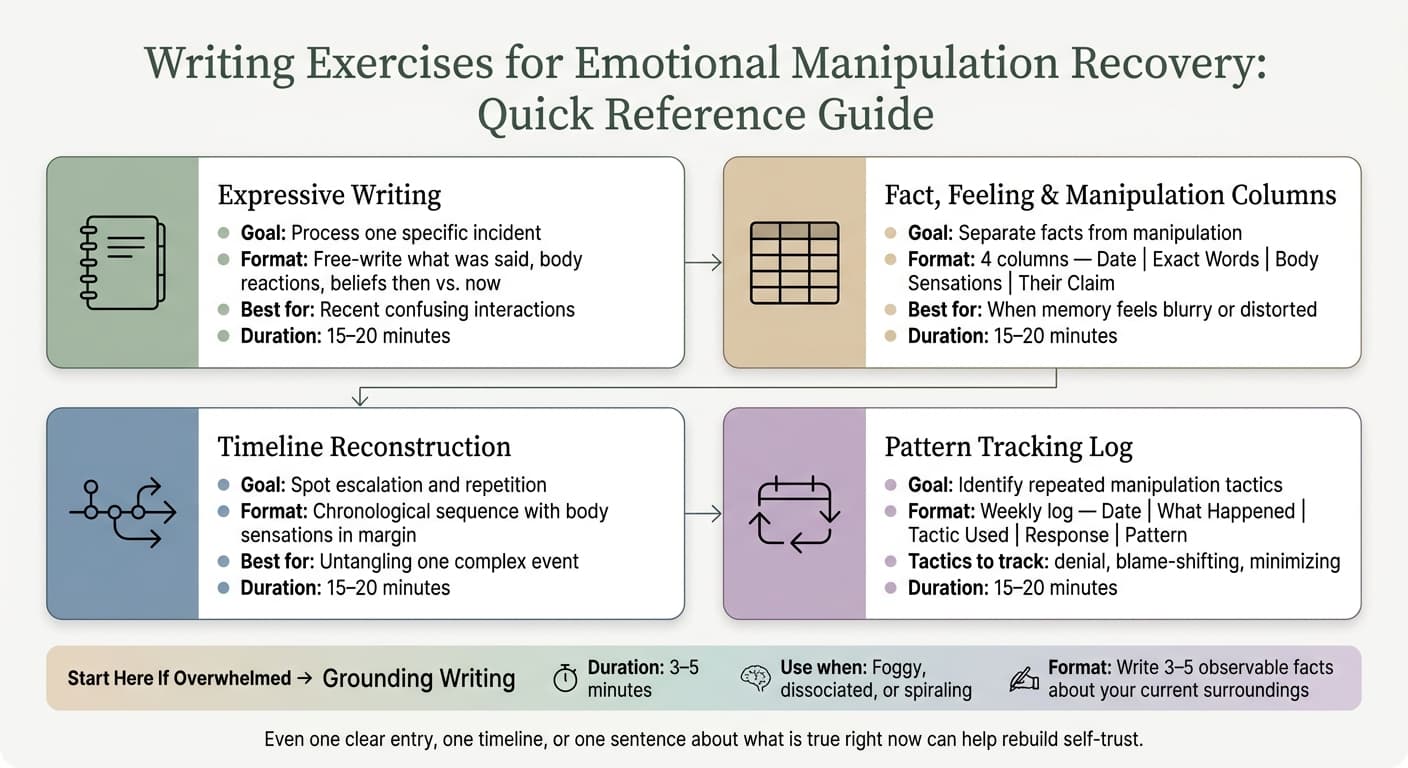
These four exercises move from a single event to repeated patterns. The goal is simple: separate what happened from what you were told happened. You can go in order, or start with the one that feels easiest today. If your memory feels scattered, begin with the most concrete option.
Expressive Writing About One Specific Incident
Choose one interaction, not the whole relationship. Just one moment that still feels confusing, heavy, or hard to place.
Write down what was said, how your body reacted, what you believed about yourself at the time, and what you know now. Try to do this soon after the incident, while the details are still clear. That written record can give you something steady to come back to when your memory starts to wobble.
If that event still feels blurry, shift to a stricter, fact-based format.
Fact, Feeling, and Manipulation Columns
Draw four columns on a page or open a private document. Label them:
- Date
- Exact words
- Body sensations
- Their claim
In the facts column, write only what was said or done. No guessing. No added meaning. No trying to decode intentions. Keep each note short and focused on behavior so it's easier to review later.
Timeline Reconstruction
If one moment feels tangled, lay it out in order: what happened first, what happened next, and the exact phrases you remember. Add body sensations in the margin.
Seeing the sequence on paper can make it easier to spot escalation, retreat, and repetition.
And if one incident doesn't tell the whole story, look across time instead.
Pattern Tracking Across Repeated Interactions
For each interaction you want to track, note the date, what happened, the tactic used, how you responded, and what pattern you see now. Tactics like denial, blame-shifting, and minimizing often stand out more once they're written down in one place.
A simple weekly log can help:
| Field | What to Write |
|---|---|
| Date | MM/DD/YYYY |
| What happened | Brief description of the interaction |
| Tactic used | e.g., denial, blame-shifting, minimizing |
| How I responded | Your reaction in the moment |
| Pattern I notice | What keeps repeating across entries |
Keep entries short and factual. Brief notes are usually easier to write in the moment, and a lot easier to review later.
Rebuild Self-Trust, Set Boundaries, and Plan Next Steps
The exercises above help you name what happened. These next steps help you start trusting your own view of it again.
Replace Internalized Criticism With Self-Compassion
Once you have the facts on paper, answer the messages those facts left behind.
Emotional manipulation can leave a kind of echo. After a while, you may hear the other person's words in your own head: "I'm too sensitive", "I always overreact", "I can't trust my own memory." Those are internalized messages from the other person. That voice is part of the aftereffect of manipulation, not proof that your memory is wrong.
Write down one of those messages. Then, right under it, write a kinder and more accurate reply. It doesn't need to sound polished or overly positive. It just needs to be honest. If "I'm too sensitive" is the criticism, your response might be: "My emotions were signaling that something was wrong. That's not weakness - that's information."
You can also use a fact journal that records only facts about your worth, memories, and boundaries. [4]
Define Red Flags, Non-Negotiable Boundaries, and Support
After you name what happened, name what you won't keep accepting.
Write a short list of behaviors you will no longer excuse. Be specific. Instead of writing "disrespect", spell out the exact behavior that crosses the line. Clear boundaries make it harder to get pulled back into confusion.
Then name one to three trusted people or places where you feel understood. [1][3]
If you need words for the moment, language like "I feel disoriented when my memory is challenged" can help you stay rooted in your own experience during a hard conversation. [3]
Choose the Right Exercise for the Day and Keep Going
Some days you may only have the energy for a few lines. Other days, you may want to write things out in more detail. Match the exercise to your current capacity.
| Exercise Type | Primary Goal | Typical Duration | Best Time to Use |
|---|---|---|---|
| Grounding Writing | Feel grounded and present [1][3] | 3–5 minutes | When feeling foggy, dissociated, or spiraling [1] |
| Expressive / Evidence Journaling | Document facts and body sensations to counter memory distortion [1][2] | 15–20 minutes | Immediately after a confusing or invalidating interaction [3] |
| Self-Compassion / Decision Journaling | Rebuild self-trust and challenge self-criticism [8][2] | 15–20 minutes | On clearer days when feeling regulated and reflective [8][2] |
If you want extra reality-checking, Gaslighting Check can analyze conversations for manipulation tactics and track patterns over time.
Start small: one entry, one truth, or one boundary.
Final Takeaways
Writing helps because it creates an outside record of reality that a manipulator's version of events can't easily distort. [3][2] The core steps are simple: set up a private, safe space first; use grounding exercises when you feel overwhelmed; and keep separating observable facts from the messages you were handed about yourself. Done on a regular basis, even in short sessions, writing can help rebuild self-trust.
FAQs
What if I can’t remember details clearly?
If your memory feels shaky, that doesn’t automatically mean you’re the problem. Self-doubt is often part of gaslighting.
When details feel patchy, write down what you do know, what you suspect, and what still feels unclear.
Stick to objective notes when you can, such as:
- Timestamps
- Quotes
- Physical reactions
That matters more than having perfect recall. Gaslighting Check can also help document manipulation patterns. The goal isn’t perfect proof. It’s to separate facts from fear.
How do I know when to stop writing?
If writing starts to feel too heavy, stop. If you begin to feel overwhelmed, attacked, or upset, pause right away and put your well-being first.
You don't have to force an ending. These exercises are here to help you process things, not to pressure you, and if writing adds more tension, it's okay to step away or talk with a therapist.
Can journaling help if the manipulation is ongoing?
Yes. Journaling can help even while the manipulation is still happening. It gives you a real-time record of what took place, which can help counter gaslighting when someone questions your memory. Just as important, it can help you start trusting your own mind again.
Write down the date, time, and what happened in plain detail. Keep the journal private and secure. If writing it all out starts to feel like too much, a trauma-informed therapist can help you work through it and think about safety.