
Why Privacy Matters in Gaslighting Detection Apps
Gaslighting detection apps analyze sensitive data like conversations, voice recordings, and text messages to help users identify emotional manipulation. While they can be helpful, they also pose serious privacy risks. These apps often handle deeply personal information, such as mental health struggles, mood patterns, and even GPS data. Without proper safeguards, this data could be exploited by hackers, sold to third parties, or accessed by abusers - putting users in even greater danger.
Key concerns include:
- Sensitive Data Risks: Apps collect private details like trauma logs, session metadata, and psychological profiles.
- Legal Gaps: Most apps aren’t covered by healthcare regulations like HIPAA, leaving emotional data less protected.
- Breach Impacts: Exposed data can reveal escape plans, support systems, or personal vulnerabilities, leading to severe safety and emotional consequences.
To protect users, apps need features like:
- End-to-End Encryption: Secures data from interception or unauthorized access.
- Automatic Data Deletion: Limits how long sensitive information is stored.
- User Control: Lets users decide what data to keep or delete.
- No Third-Party Sharing: Prevents data from being sold or shared with advertisers.
Gaslighting Check is an example of an app that prioritizes user safety with strong privacy measures. However, users should also take steps to protect themselves by avoiding social logins, reviewing app permissions, and limiting the personal information shared.
When privacy is prioritized, these tools can provide a secure way to document manipulation and seek help without fear of exposure.
Privacy Risks in Gaslighting Detection Tools
The Sensitive Data These Apps Handle
Gaslighting detection tools often manage highly personal information, including conversation transcripts, intake responses, and usage metadata. During onboarding, many apps ask for sensitive details like gender identity, sexual orientation, panic attack history, phobias, and even suicidal ideation [1]. Beyond that, they track metadata such as session lengths, login times, and how frequently the app is used [1].
Take the case of BetterHelp in 2022. This mental health platform was found sharing sensitive intake data - like responses about suicidal thoughts and panic attacks - with an analytics company. It also passed along metadata, including session durations and login times, to third parties like Facebook and Google [1]. This level of data collection can create a psychological profile far more detailed than users might expect. When breaches occur, the fallout becomes much more severe due to the depth of this information.
What Happens When Data Gets Breached
The consequences of a data breach involving such personal information can be devastating. In 2023, the average cost of a healthcare data breach in the U.S. reached $10.93 million [3]. But the financial toll pales in comparison to the human impact. Breaches involving this type of data can expose private conversations, emotional vulnerabilities, and even physical locations through GPS metadata.
For those in abusive relationships, the stakes are especially high. Exposed conversation logs might reveal escape plans, support systems, or evidence collected for legal protection. Audio recordings, in particular, could be exploited for extortion or even identity theft using voice cloning technology. Even so-called "anonymized" data isn’t entirely safe - it can often be re-identified when combined with login patterns or device IDs [1]. These breaches don’t just compromise privacy; they open the door to unresolved legal and safety challenges.
Legal and Safety Consequences
The legal landscape for protecting this kind of sensitive data is riddled with gaps. Many apps users choose aren’t covered by HIPAA [1], meaning emotional and mental health data often lacks the legal protections afforded to physical health records.
These regulatory shortcomings amplify safety risks. Technical vulnerabilities that enable data leaks undermine what limited legal protections exist. For example, if an abuser gains access to a device or intercepts sensitive data, they could use conversation logs or location details to monitor movements or tighten control. Alarmingly, over 80% of mental health app users express concern about how their data is handled [2]. These fears are justified, given how often apps share data with third parties for advertising or analytics [4].
| Risk Category | Specific Danger | Potential Consequence |
|---|---|---|
| Safety | Location tracking / GPS leak | Physical stalking or escalation of domestic violence |
| Legal | HIPAA/GDPR non-compliance | Fewer legal protections for users; corporate fines |
| Emotional | Exposure of trauma logs | Abusers or hackers exploiting vulnerabilities |
| Technical | Plain-text transmission | Interception of sensitive audio/text by malicious actors |
Coercion concerns over location-sharing apps in relationships | ABC News
Privacy Features Every Gaslighting Detection App Needs
::: @figure
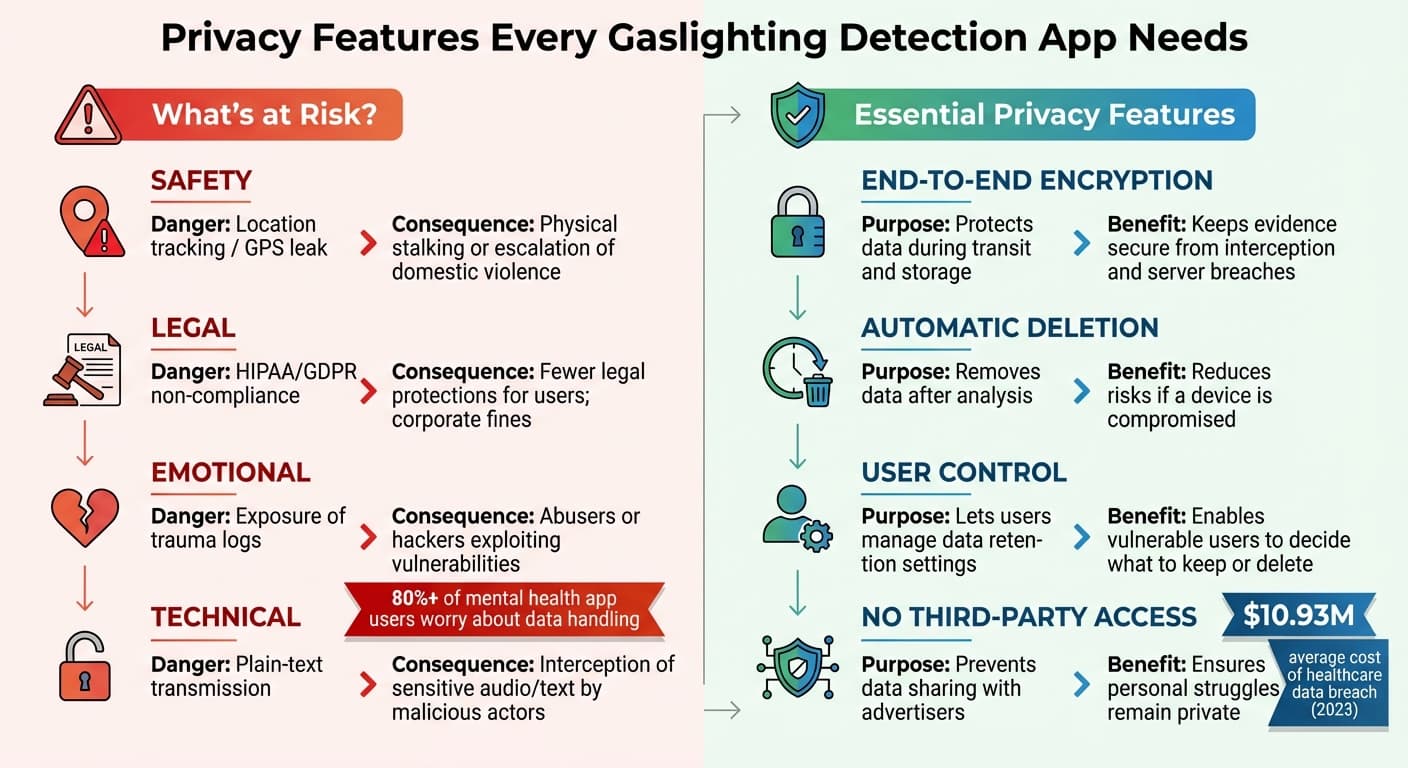
Gaslighting detection apps must prioritize user privacy to effectively counter the risks users face. Gaslighting Check, for example, incorporates several privacy-focused features to safeguard sensitive communications and ensure user safety.
End-to-End Encryption
End-to-end encryption (E2EE) ensures that only you can access your data - whether it's text messages, audio recordings, or analysis results. Even if the data is intercepted during transmission or a server is compromised, it remains unreadable to anyone else. With E2EE, not even the app provider can view your raw data.
This level of protection is especially important in gaslighting scenarios, where traditional security measures like secret questions often fail. Abusers may know the answers to these questions or coerce victims into revealing them. Combining E2EE with strong authentication adds an extra layer of security, ensuring that your evidence stays private and protected.
Automatic Data Deletion
In addition to encrypting your data, managing how long it exists is equally important. Automatic data deletion removes sensitive information after it has been analyzed, minimizing the risk of exposure if your device is lost, stolen, or accessed without permission. Instead of keeping extensive logs indefinitely, the app only retains data for a short period - sometimes just hours or days.
This feature discreetly protects users by reducing the time sensitive information is stored, striking a balance between documenting manipulation and minimizing potential risks.
Giving Users Control Over Their Data
Privacy also means giving you control over your data. Apps should allow you to customize retention settings, decide which conversations to save, and delete data permanently when needed. This flexibility is essential for adapting to changing needs.
For instance, you might want to save detailed records while preparing a legal case but delete everything once you're in a safer situation. Apps that prevent data sharing with advertisers add another layer of security, ensuring your personal experiences aren’t exploited for profit.
| Feature | Purpose | Benefit for Gaslighting Detection |
|---|---|---|
| End-to-End Encryption | Protects data during transit and storage | Keeps evidence secure from interception and server breaches |
| Automatic Deletion | Removes data after analysis | Reduces risks if a device is compromised |
| User Control | Lets users manage data retention settings | Enables vulnerable users to decide what to keep or delete |
| No Third-Party Access | Prevents data sharing with advertisers | Ensures personal struggles remain private |
Privacy by Design: Building Secure Apps
Privacy-First Development Principles
Creating secure apps goes beyond just handling data responsibly; it requires building privacy into the app from the very beginning. This is where Privacy by Design comes into play. It’s a framework based on seven principles, starting with a proactive approach. Instead of reacting to problems after they arise, developers should anticipate privacy risks upfront. For instance, authentication systems should be designed to block common bypass techniques before they even become an issue [5].
Another cornerstone of this approach is making privacy the default setting. Users shouldn’t have to dig through complicated menus to protect their data - it should be protected automatically [5]. As noted by OneTrust experts, this method ensures privacy is seamlessly integrated into the app’s core functionality [5].
Apps like Gaslighting Check showcase how to balance functionality with privacy. By using strong encryption and real-time analysis, the app ensures users don’t have to compromise their safety for accuracy. It also adheres to end-to-end security principles, safeguarding data from the moment it’s recorded until it’s deleted automatically [5]. Additionally, conducting Data Protection Impact Assessments (DPIAs) before rolling out features that handle sensitive emotional data is crucial [6][7]. These assessments complement technical safeguards like encryption and data deletion.
Following Privacy Regulations
Building privacy-conscious apps also means aligning with key privacy laws. Compliance isn’t just about avoiding penalties - it’s about earning the trust of users, especially those in vulnerable situations. Gaslighting detection tools need to meet multiple regulatory standards. Here’s a quick breakdown:
| Regulation | Primary Focus | Key Requirement for Apps |
|---|---|---|
| GDPR | User Rights & Consent | Explicit opt-in; right to erasure; data minimization. |
| CCPA | Consumer Control | Right to know what is collected; right to opt-out of data sales. |
| HIPAA | Health Data Security | Technical safeguards (encryption); Business Associate Agreements. |
| PIPEDA | Meaningful Consent | Users must have access to their data and understand its use. |
One of GDPR’s core principles is data minimization - apps should only collect the bare minimum needed for functionality [6]. For example, instead of storing full names, developers can use pseudonyms or randomly generated IDs. To meet HIPAA and GDPR standards, technical safeguards like AES-256 encryption for stored data and TLS/SSL protocols for data in transit are essential. Automated data lifecycle management can further enhance compliance by ensuring sensitive recordings and transcripts are deleted after analysis unless users specifically opt to keep them.
Transparency and User Consent
Trust erodes quickly when users don’t understand how their data is being used. That’s why obtaining granular consent - clear, specific permissions for each app feature - is essential [6]. The Information Commissioner’s Office (ICO) emphasizes this:
You must make it as easy for people to refuse consent as it is to accept consent [6].
Instead of burying details in lengthy privacy policies, apps should use just-in-time notices. For instance, when Gaslighting Check asks for microphone access, it explains why at that exact moment rather than relying on a vague agreement signed weeks earlier [8]. The app should also offer a clear exit option, detailing how users can leave the service and what happens to their data afterward [6].
This level of transparency is critical, especially considering that 85% of Americans believe the risks of data collection outweigh the benefits, and 81% worry that AI will misuse their information [5]. By openly communicating how data is handled, apps can establish the trust that gaslighting victims need to feel safe.
Balancing Privacy with Accurate Detection
Maintaining Analysis Quality While Protecting Privacy
Modern technology is making it possible to analyze encrypted data without compromising privacy. On-device processing and Trusted Execution Environments (TEEs) allow real-time analysis directly on a user's phone, keeping sensitive conversations secure. Companies like Apple and Samsung have adopted this approach, integrating AI features that process end-to-end encrypted content locally [9]. TEEs work by creating secure areas within a device's processor, enabling algorithms to detect manipulation patterns without exposing the actual content of conversations [9]. Gaslighting Check leverages these technologies, combining real-time analysis with encryption to ensure users don’t have to choose between privacy and accurate detection.
Experts like Mallory Knodel point out that using encrypted conversations to train shared AI models conflicts with the principles of end-to-end encryption (E2EE). Such practices require explicit user consent to maintain trust [9]. By focusing on secure processing and respecting user privacy, apps like Gaslighting Check not only detect harmful behaviors but also encourage users to seek professional help when necessary.
Combining App Insights with Professional Help
Detection apps are a helpful starting point, but they're not a substitute for professional support. These tools can identify patterns like blame-shifting, denial, or contradictory statements - behaviors that may signal emotional abuse. However, trained professionals, such as therapists or counselors, are essential for interpreting these patterns in context and creating effective safety plans.
Gaslighting Check enhances this process by providing detailed reports. These reports organize specific instances of manipulation, offering users a clear way to present their experiences in therapy sessions. Instead of relying on vague feelings of unease, users can share concrete examples, making it easier for mental health professionals to offer targeted guidance. The app becomes one piece of a larger support system aimed at recovery and safety.
Documenting Evidence Safely
In situations where gaslighting escalates and legal or workplace intervention becomes necessary, proper documentation is key. As WomensLaw.org advises:
If you aren't sure what could be useful, it is generally better to keep more evidence rather than less [10].
Before gathering evidence, it’s critical to understand your state’s consent laws regarding recording. Gaslighting Check’s encryption features can help users securely store evidence while ensuring only legally relevant data is retained. For physical evidence, such as damaged property or visible injuries, take photos immediately and seek medical care - even if injuries seem minor, especially in cases involving choking [10].
If you suspect your partner is monitoring your device, clear your browser history and use quick-exit features to avoid detection [10]. Store evidence in encrypted folders or secure cloud accounts that are inaccessible to your partner. By prioritizing safe documentation, the app not only helps protect your privacy but also strengthens your ability to seek legal or professional assistance when needed.
Conclusion
Privacy isn’t just a feature in gaslighting detection apps - it’s the cornerstone that makes seeking help safe. When dealing with manipulation, the last thing you should worry about is your information being exposed to third parties or, worse, your abuser. Strong privacy protections create a secure space where you can validate your experiences without fear of retaliation or judgment.
Justin Brookman, Director of Privacy and Technology Policy at Consumer Reports, emphasizes this point:
Your mental health is incredibly personal. You should be able to reach out for help without worrying about how that data might be shared or misused.[4]
Since most mental health apps aren’t covered by HIPAA protections, the responsibility falls on developers to implement robust privacy safeguards.
To recap, a secure app environment isn’t optional - it’s essential. Gaslighting Check addresses these concerns head-on with features like end-to-end encryption and automatic data deletion, ensuring your conversations stay private. This level of security allows you to document evidence and trust your findings without hesitation.
You can also take steps to protect your privacy: avoid using social logins, opt out of analytics, and limit the personal information you provide in intake forms. These actions help keep your experiences confidential[1][4]. When selecting a detection tool, prioritize apps that offer granular data controls and operate with a consent-first mindset[11].
A privacy-first approach doesn’t just protect your data - it empowers you to break free from manipulation and take steps toward recovery, whether that means seeking therapy, pursuing legal action, or simply reclaiming trust in yourself.
FAQs
How do gaslighting detection apps ensure user privacy?
Gaslighting detection apps are designed with privacy as a top priority, employing measures like end-to-end encryption to safeguard sensitive information. This ensures that conversations remain private and protected from unauthorized access.
Many of these apps also include features like automatic data deletion, which removes conversations after a specified time, adding an extra layer of security. Users are given control over their data, with options to decide how and when their information is shared.
By integrating these protections, gaslighting detection apps offer a secure space for users to seek help without worrying about their privacy being compromised.
What could happen if my data from a gaslighting detection app is exposed?
If data from a gaslighting detection app gets exposed, the fallout could be severe. Information such as conversation logs, voice recordings, or personal details might fall into the hands of unauthorized individuals. This could lead to privacy breaches, emotional distress, or even exploitation.
The exposure of mental health-related data can also open the door to social stigma, discrimination, or misuse by those with harmful intentions. On top of that, inadequate privacy safeguards might create opportunities for stalking, harassment, or further manipulation. To protect your personal information, it’s crucial to choose an app with robust privacy measures, like encrypted storage and automatic data deletion policies.
Why aren’t gaslighting detection apps subject to HIPAA regulations?
Gaslighting detection apps fall outside the scope of HIPAA regulations because they are not considered healthcare providers, health plans, or entities handling protected health information (PHI). HIPAA is aimed at protecting data within official medical or mental health treatment environments, which typically excludes apps like these.
Although these tools may process sensitive information from personal interactions, they generally operate beyond the reach of healthcare privacy laws. This makes it crucial to select apps that emphasize user privacy, offering features such as data encryption and automatic deletion to safeguard your information.