
Shame in Manipulative Relationships: Red Flags
Shame is a powerful tool often used in manipulative relationships to control and erode self-worth. Manipulators exploit your fear of rejection and dependence on external validation to gain control. Common tactics include guilt-tripping, public or private humiliation, blaming, dismissing your feelings, and withholding affection. These behaviors can distort your judgment, leading to self-doubt and compliance.
Key warning signs of manipulation:
- Guilt-tripping: Using fear, obligation, or guilt to manipulate.
- Humiliation: Publicly or privately eroding your self-esteem.
- Blaming: Shifting focus to your flaws instead of resolving issues.
- Invalidation: Dismissing your feelings as "too sensitive" or "crazy."
- Withholding affection: Silent treatment or conditional love.
To combat these tactics:
- Document incidents to validate your experiences.
- Use "I" statements to express your feelings.
- Set and enforce boundaries.
- Rebuild confidence by making independent decisions.
Tools like Gaslighting Check can help identify manipulation patterns in real-time, offering insights through text and voice analysis. For $9.99/month, this tool provides detailed reports while ensuring privacy with encrypted data and automatic deletion.
Recognizing these red flags is the first step to reclaiming your autonomy and protecting your mental well-being.
::: @figure
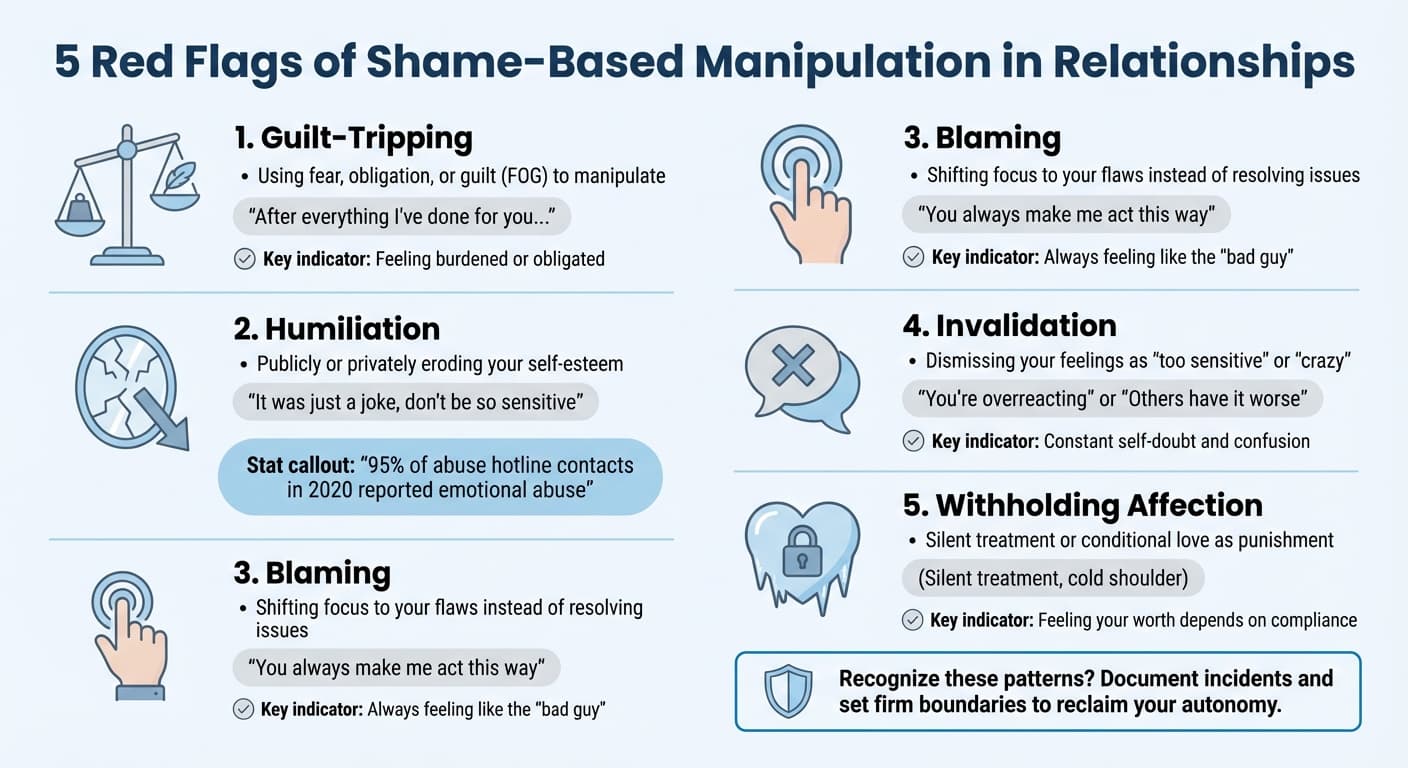
Signs you're being manipulated
Warning Signs That Shame Is Being Used to Control You
Recognizing when shame is being used as a tool for manipulation is crucial for protecting your autonomy. These tactics often start subtly but follow predictable patterns aimed at making you feel off-balance and compliant. Here’s how to identify the telltale signs of shame-based control.
Guilt-Tripping and Emotional Blackmail
Emotional blackmail thrives on the "FOG Factor" - fear, obligation, and guilt - and often unfolds in a cycle: demand, resistance, pressure, threats, compliance, and repetition [3][4]. Therapist Susan Forward explains:
"Emotional blackmail is a powerful form of manipulation in which people close to us threaten, either directly or indirectly, to punish us if we don't do what they want." [3]
Manipulators may use direct threats or silent punishment, employing phrases like, "After everything I've done for you" or "If you really loved me, you would." They might label you "selfish" to undermine your self-image. Passive-aggressive behaviors - like exaggerated sighs, pouting, or slamming doors - are also common.
To counter this, buy yourself time by saying something like, "I need to think about this before I respond." Avoid justifying or explaining your decisions, as this can give manipulators more leverage.
Public or Private Humiliation
Humiliation is a powerful weapon for eroding self-worth, leaving you dependent on the manipulator or feeling you deserve the abuse [5][7]. Statistics show that nearly half of U.S. adults have experienced psychological aggression - such as criticism or humiliation - from an intimate partner [6]. In 2020, 95% of individuals contacting The Hotline reported emotional abuse [7].
Public humiliation uses social pressure to silence you, while private humiliation relies on consistent criticism to create a power imbalance. Insults may be disguised as jokes, and any reaction is dismissed as oversensitivity. Manipulators might even weaponize your insecurities or secrets to maintain control.
Psychotherapist Christine Scott-Hudson describes how this control can take over your life:
"Your money is no longer yours; your time is no longer yours; your space is no longer yours; your body is no longer yours. You begin to have less and less say over your life, your time, and how you spend it." [5]
If you constantly feel like you’re walking on eggshells or fear ridicule, it’s a serious red flag. When insults are masked as jokes, call them out directly or use AI tools for recognizing verbal abuse to disrupt the manipulator’s control.
Blaming and Provocation
Manipulators often provoke emotional reactions and then blame you for them, leaving you feeling ashamed and doubting yourself. Counseling psychologist Kala Balasubramanian explains:
"Whenever you have a problem or bring up an issue with your partner, somehow the conversation gets turned around and you end up being blamed and accused back." [8]
This tactic shifts focus from the issue at hand to your perceived flaws or past mistakes. Manipulators may even involve others to isolate you [1]. By avoiding accountability and casting themselves as martyrs, they position you as the "bad guy." Unlike healthy disagreements, these arguments are filled with personal attacks and name-calling.
To recognize this pattern, step back and ask yourself objective questions like, "What exactly is being asked of me?" or "How did they react when I didn’t immediately agree?"
Dismissing Your Feelings and Concerns
Manipulators may invalidate your feelings by labeling you "too sensitive" or "crazy", or by insisting you "get over it." They might use comparative shaming, suggesting you "appreciate what you have" or pointing out that "others have it worse", to make you feel guilty for having needs.
Gaslighting, a more extreme form of invalidation, distorts your sense of reality. Psychologist Emily Mayfield clarifies:
"Gaslighting is invalidating but not all invalidation is gaslighting." [10]
Counselor Janet Chui highlights the importance of trusting your own perceptions:
"Confusion is in fact the giveaway you're being manipulated because manipulators are bent on dictating how you should feel." [9]
Manipulators often use "should" statements - like "You should be over this by now" - to replace self-acceptance with shame. Combat this by using "I" statements, such as, "I feel like my feelings are being dismissed when you say that." Documenting events can also help affirm your reality. You can also use emotional tone detection to help identify these patterns.
Withholding Affection as Punishment
Another common tactic is the silent treatment or deliberate withdrawal of affection. This approach sends a clear message: your worth is conditional on compliance.
"It might appear as withholding of affection, disappointment, or even a slight shift in body language." [4]
The goal is to make you feel responsible for repairing the relationship by giving in to their demands. To counter this, set firm boundaries. Clearly communicate what behaviors are acceptable, and enforce consequences when those boundaries are crossed.
How Shame Affects Your Decision-Making
Shame has a way of creeping into your decision-making process, altering it in ways that can feel almost invisible at first. Over time, the manipulator's voice doesn’t just criticize - you begin to internalize it. Their judgment becomes your own, influencing every choice you make.
This leads to something called "self-alienation" - a state where you lose touch with your intuition and sense of clarity. Instead of knowing what you truly want, the manipulator's perspective overshadows your own. Emily Mayfield from Mindset Therapy explains this dynamic clearly:
"Gaslighting is a form of psychological manipulation in which the goal of the person engaging in the gaslighting... is to have the victim doubt their truths" [10].
As this manipulation takes hold, you begin to question your memories, your perceptions, and ultimately, your reality. The result? You start relying on the manipulator's version of events as the truth.
This erosion of self-trust often leads to decision paralysis. Instead of making choices based on what you want or value, you start asking, "What will they think? What will they do if I choose this?" Your decisions become about avoiding conflict or punishment, not pursuing your desires. Over time, you might even adopt their preferences, opinions, and lifestyle just to keep the peace. This isn't genuine decision-making - it’s compliance driven by fear. And in the process, you lose sight of your own values and identity.
Here’s how this dynamic plays out:
| Sign of Influence | Manipulation-Driven Decision | Value-Based Decision |
|---|---|---|
| Motivation | Fear of disapproval or "punishment" | Personal interest or moral alignment |
| Internal Feeling | Anxiety, heavy obligation, or "walking on eggshells" | Confidence, peace, or authentic desire |
| Self-Perception | Feeling "crazy", inadequate, or always at fault | Feeling capable and worthy of boundaries |
To start breaking free from this cycle, try documenting your experiences in a private journal. Write down specific incidents, what was said, and how you felt in those moments. This can help counteract the memory distortions caused by shame. Learning how to respond to gaslighting can further protect your mental space. Another helpful strategy? Ask yourself, "Am I acting out of fear or desire?" This simple question can help you differentiate between decisions that reflect your true self and those that are shaped by the manipulator’s influence. Recognizing these patterns is a crucial step in reclaiming your autonomy.
Using AI Tools to Spot Manipulation
Shame can twist your decision-making, leaving you unsure if a problem is real or just in your head. This is where AI tools like Gaslighting Check step in, offering a clear, objective way to identify manipulation. These tools analyze your interactions without the emotional baggage, helping you see things as they are.
Gaslighting Check works by reviewing both text and voice patterns in your communications. On the text side, it scans messages, emails, and chats for language that hints at shame-based tactics - phrases like "You're making me look bad", "It's all your fault", or "You're too sensitive." It flags these manipulative cues and provides a manipulation intensity score, giving you tangible proof of what you might be experiencing. On the voice side, it analyzes recordings for tone, pitch, and speed, picking up on emotional pressure or aggression that might not come across in the words alone. This dual approach helps you understand the subtle ways manipulation can show up in your daily life.
One standout feature is real-time tracking, which alerts you immediately during tense conversations if guilt-tripping or emotional blackmail is detected. This instant feedback allows you to pause, recognize the manipulation, and make decisions based on your values instead of fear or shame.
The tool also generates detailed reports that summarize its findings. These reports highlight the specific tactics used, how often they occur, and patterns over time. For instance, you might learn that 70% of your interactions include blaming language - clear evidence of how toxic shame can undermine your confidence and relationships [11] [12]. These insights can validate your feelings and provide a roadmap for addressing the issue. And with end-to-end encryption and automatic data deletion, your privacy remains protected.
Gaslighting Check is accessible, too, with a Premium Plan priced at $9.99/month and a free option for basic text analysis. These tools aren’t about replacing your instincts - they’re about helping you trust them again by giving you the evidence you need to see manipulation for what it is.
Self-Assessment Checklist for Shame Patterns
This checklist is designed to help you identify and understand patterns of shame-based manipulation. By combining this tool with other resources, you can start recognizing and documenting manipulative behaviors that might be affecting you.
| Manipulation Tactic | Internal Feeling (Shame/Guilt Indicator) | Common Phrase Used by Manipulator |
|---|---|---|
| Gaslighting | Confusion, doubting your own perceptions | "You're imagining things; that never happened." |
| Guilt-Tripping | Feeling obligated or burdened by guilt | "After all I've done for you, this is how you repay me?" |
| Victim-Playing | Feeling like the "bad guy" for asserting yourself | "I guess I'm just a terrible partner then." |
| Withholding Affection | Feeling unworthy or unloved | (Silence or cold shoulder after a disagreement) |
| Invalidation | Feeling overly sensitive or dismissed | "You're overreacting; it was just a joke." |
| Word-Twisting | Feeling drained from defending your intentions | "So what you're actually saying is you hate me." |
Take time to review this checklist regularly to see if these tactics are influencing your behavior. Pay attention if you notice yourself apologizing unnecessarily or walking on eggshells to avoid triggering a negative reaction. Knowing how to deal with gaslighting can help you regain control. These can be signs that manipulation is at play.
If you recognize recurring patterns, try documenting specific incidents. Keep a secure log with dates, times, and details of what happened. For instance, note any situations where you felt responsible for someone else's emotions or where affection seemed tied to "earning" love. This record can provide clarity and validation of your experiences [13].
Conclusion: Taking Back Control from Shame-Based Manipulation
The first step to breaking free from shame-based manipulation is recognizing it. If you've noticed recurring emotional abuse warning signs like guilt-tripping, withholding affection, or constant invalidation, trust your instincts. Manipulation thrives in isolation and self-doubt, so documenting your experiences and seeking outside validation can help you see the situation clearly.
This awareness is the foundation for change.
"Manipulation is an emotionally unhealthy psychological strategy used by people who are incapable of asking for what they want and need in a direct way." - Sharie Stines, Therapist [2]
Start rebuilding your confidence by making small, independent decisions. Even simple choices, like picking a meal or activity without seeking approval, can help you reconnect with your inner guidance. Use the "Observe, Don't Absorb" approach to recognize manipulative behavior without letting it affect your self-worth. And when faced with big decisions, give yourself time to reflect - this can help you see through the fog of manipulation [2].
As you identify patterns of manipulation, tools like Gaslighting Check can provide valuable insights. This platform offers features like text and voice analysis, detailed reports, and conversation tracking to highlight manipulation tactics such as blame-shifting or DARVO. For just $9.99/month with the Premium Plan, you gain access to these resources while benefiting from encrypted data protection and automatic deletion policies to maintain your privacy.
Additionally, building a support network and setting firm boundaries are critical steps. Share your records with trusted friends or professionals who can offer objective feedback. Manipulators often ignore dialogue but respond to clear, consistent consequences. By enforcing boundaries and standing firm when they're crossed, you send a strong message that shame-based tactics won't work [14].
Combining personal insight with objective tools empowers you to take back control and reclaim your autonomy from manipulative behaviors.
FAQs
How can I tell if shame is being used to manipulate me in a relationship?
Recognizing shame as a tool of manipulation in a relationship means paying attention to certain emotional and behavioral patterns. If you often find yourself feeling guilty, second-guessing your own perceptions, or stuck in a cycle of confusion, it could be a red flag. Manipulators often use shame to shift blame onto you for problems that aren’t your fault, leading to excessive apologizing or spiraling self-doubt.
You might also notice that your personal boundaries are repeatedly ignored, leaving you feeling like you’re constantly on the defensive. Manipulative tactics such as criticism, guilt-tripping, or even the silent treatment are often used to chip away at your confidence and influence your choices. Spotting these behaviors early is essential for protecting your mental well-being and maintaining firm boundaries.
How can I protect myself from shame-based manipulation in a relationship?
Recognizing shame-based manipulation is the first step in protecting yourself. Tactics like guilt-tripping, blame-shifting, and emotional blackmail are often used to create feelings of shame and exert control. Understanding these behaviors helps you spot when someone is trying to manipulate you.
To protect yourself, focus on setting clear boundaries and practicing assertive communication. Be upfront about your feelings and limits, but avoid taking responsibility for the manipulator's emotions. Strengthening your emotional resilience is also crucial - turn to trusted friends, family members, or mental health professionals for support and validation when needed.
You can also benefit from tools designed to identify manipulation in conversations. These tools can offer insights into subtle tactics, making it easier to address them. By staying aware, setting firm boundaries, and seeking support, you can guard your emotional well-being effectively.
How can Gaslighting Check help spot manipulation in relationships?
Gaslighting Check is designed to spot manipulation by examining conversations for tactics such as guilt-tripping, gaslighting, emotional invalidation, and blame-shifting. It highlights subtle behaviors that may be used to control or distort your understanding, helping you become more aware of unhealthy interactions.
Equipped with tools like real-time analysis and comprehensive reports, it offers a clearer view of communication patterns, giving you the confidence to trust your instincts and decisions.