
Real-Time Social Dynamics Analysis with AI
Gaslighting, a form of emotional manipulation, can leave you doubting your memory and perception. AI tools like Gaslighting Check analyze conversations in real time to detect manipulation tactics, such as denial, blame-shifting, or emotional invalidation. These tools use advanced technologies like Natural Language Processing (NLP) and voice analysis to identify patterns of manipulation based on tone, context, and behavior.
Key Highlights:
- Gaslighting Check identifies manipulation through both text and voice analysis.
- Detects tactics like "You're remembering it wrong" or dismissive tones instantly.
- Offers real-time alerts, detailed reports, and conversation history tracking for recurring patterns.
- Privacy features include encryption, automatic data deletion, and user control over stored data.
- Free plan for text analysis; premium plan ($9.99/month) includes voice analysis and advanced features.
This AI-powered tool provides clarity during emotionally charged interactions, helping you recognize gaslighting vs. manipulation patterns, set boundaries, and protect your emotional well-being.
Social Manipulation and Its Effects
::: @figure
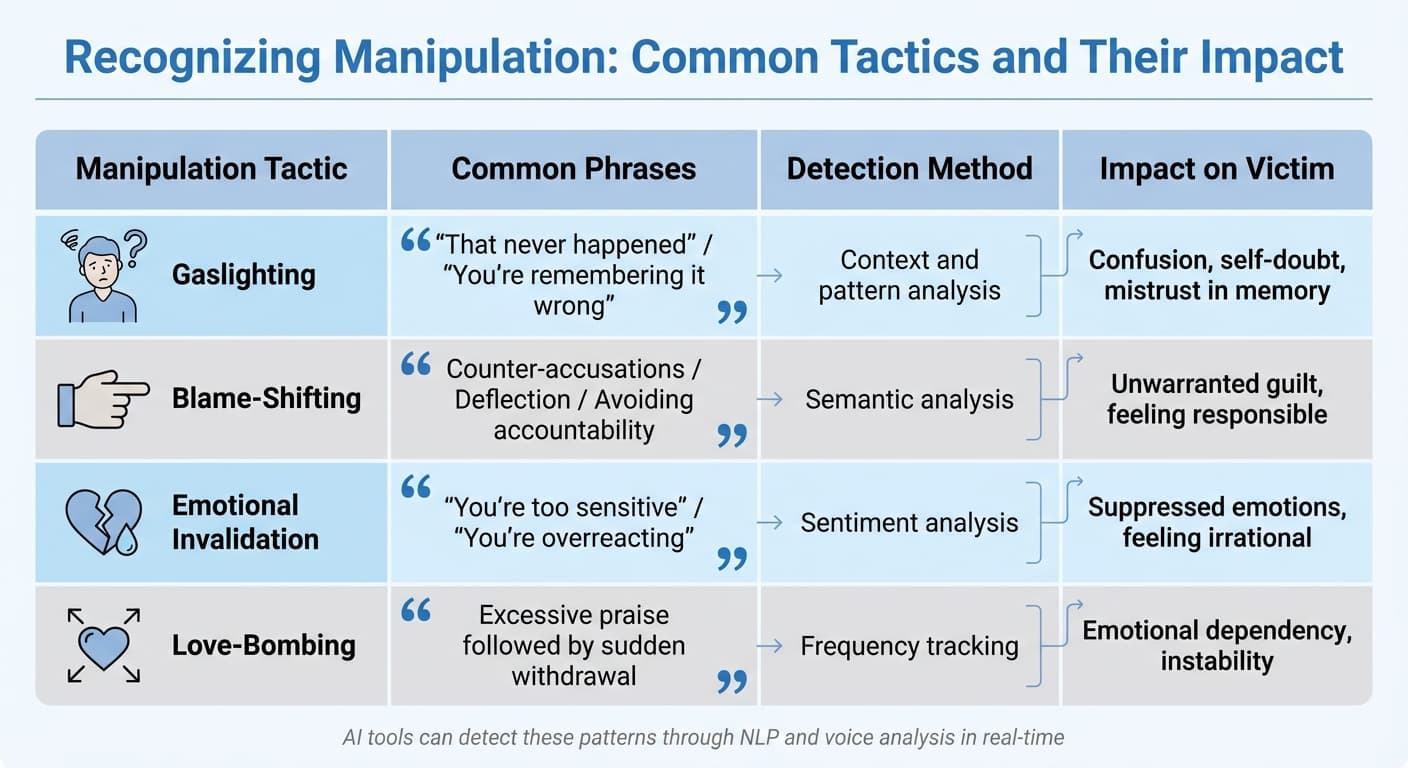
Social manipulation involves deliberate behaviors designed to control or exploit others. Unlike everyday misunderstandings or disagreements, these tactics twist reality and erode confidence, leaving lasting scars on self-esteem and decision-making abilities.
What Gaslighting Is and Why It Causes Harm
Gaslighting is a psychological manipulation technique where someone makes you doubt your memory, perception, and even your sanity. Manipulators achieve this by denying facts, distorting events, and insisting their version of reality is the only truth. Over time, this creates deep confusion, self-doubt, and anxiety, making it difficult to trust your own judgment.
In these dynamics, the manipulator takes control while the victim becomes emotionally dependent, often cutting ties with friends or family who could offer support and clarity. This loss of self-trust affects not only immediate decisions but also long-term well-being, often lingering even after the relationship ends. Recognizing gaslighting and its effects is essential to reclaiming emotional strength and clarity.
Identifying Manipulation Patterns in Conversations
Manipulators often employ a range of tactics beyond gaslighting to destabilize their targets emotionally. One common method is emotional invalidation, where they dismiss your feelings with remarks like "you're overreacting" or "you're too sensitive." This tactic makes you feel irrational for having normal emotions. Another is blame-shifting, where they redirect accountability onto you, leaving you burdened with guilt. Then there’s love-bombing, a cycle of overwhelming affection followed by sudden withdrawal, which fosters emotional dependency and instability.
| Manipulation Tactic | Common Phrases | Impact on Victim |
|---|---|---|
| Gaslighting | Contradictory statements, denial | Confusion, self-doubt, mistrust in memory |
| Blame-shifting | Counter-accusations, deflection | Unwarranted guilt, feeling responsible |
| Emotional Invalidation | "You're too sensitive", dismissals | Suppressed emotions, feeling irrational |
| Love-bombing | Excessive praise, sudden withdrawal | Emotional dependency, instability |
These strategies are insidious because they unfold gradually. With each interaction, the manipulator chips away at your confidence, leaving you questioning what’s real. Recognizing these patterns is a critical step in safeguarding your emotional health, and AI can now detect manipulation in real time, though it can be an uphill battle when emotions are already strained.
Detect Manipulation in Conversations
Use AI-powered tools to analyze text and audio for gaslighting and manipulation patterns. Gain clarity, actionable insights, and support to navigate challenging relationships.
Start Analyzing NowHow AI Analyzes Social Dynamics in Real Time
AI systems are changing the way we monitor social interactions by analyzing text, audio, tone, and behavior data simultaneously. Unlike traditional methods that depend on manual reviews or simple keyword searches, AI works continuously, processing interactions within seconds. This speed is critical because emotional manipulation often unfolds subtly, requiring quick detection to prevent further harm. These real-time capabilities are laying the groundwork for tools that can identify emotional abuse as it happens, which we'll explore further in the upcoming sections.
AI Technologies Used for Social Analysis
These advanced technologies power tools like Gaslighting Check, which actively protects users by identifying manipulation patterns in the moment.
Natural Language Processing (NLP) is the backbone of manipulation detection. It doesn’t just flag individual words or phrases but examines the context, sentiment, and patterns of denial or contradiction in conversations. By analyzing how words connect, NLP reveals broader manipulation techniques that might otherwise go unnoticed.
Supervised machine learning plays a crucial role in training models to identify manipulation. By using thousands of labeled examples from annotated conversations, these models achieve 85–90% precision during controlled testing [1][3]. They’re designed to recognize patterns like sudden shifts in sentiment or repeated questioning of reality, making them highly effective in detecting subtle manipulative behaviors.
Detecting Emotional Manipulation as It Happens
AI takes these technologies a step further by monitoring emotional manipulation in chats and flagging potential manipulation in real time.
It does this by analyzing three key dimensions: tone, context, and behavior patterns. Tone analysis focuses on prosody - elements like pitch, speech rate, and stress - to detect signs of aggression or dismissiveness. These acoustic cues often reveal emotional pressure that words alone might not convey. Context analysis uses NLP to connect current statements with known manipulation tactics. For example, phrases like "You're overreacting" gain deeper meaning when paired with dismissive tone cues. Behavior pattern recognition tracks the flow of conversation, identifying spikes in negative sentiment or repeated attempts to deflect accountability.
Real-time systems process all of this data instantly, issuing alerts when they detect a high likelihood of manipulation. For example, if invalidating language is paired with tone shifts that suggest emotional pressure, the AI generates an immediate notification. By combining tone, context, and behavior into a unified analysis, these systems help users recognize abuse patterns that might otherwise be dismissed. This instant feedback is a game-changer for documenting and addressing gaslighting as it happens.
Gaslighting Check: Features and How It Helps

Gaslighting Check uses advanced AI to identify emotional manipulation in real time. By combining real-time monitoring, pattern tracking, and detailed analysis, it helps users spot gaslighting as it happens. Whether analyzing text or voice data, the platform brings clarity to situations that often feel confusing or overwhelming. These tools build on earlier discussions about AI’s role in real-time analysis, offering practical ways to detect manipulation.
The platform offers two pricing options: a free plan for basic text analysis and a premium plan at $9.99/month. The premium version includes voice analysis, detailed reports, and conversation history tracking. This structure makes the service accessible while offering advanced features for those who need deeper insights. As one user shared:
"The AI analysis confirmed what I suspected but couldn't prove. It gave me the clarity I needed to make important decisions." - David W., User
To protect user privacy, all data is encrypted end-to-end and follows strict automatic deletion policies. This ensures users can safely document manipulation without risking their confidentiality.
Real-Time Audio Recording and Voice Analysis
Gaslighting Check takes real-time detection further with its audio analysis feature, which captures subtle vocal cues. Live conversations are recorded and analyzed instantly, helping users identify manipulation as it occurs rather than relying on memory. This is especially important since gaslighting often involves tone shifts or vocal subtleties that fade quickly from recollection.
The voice analysis evaluates pitch changes, speech speed, and stress patterns to uncover emotional pressure tactics that text analysis might miss. For instance, if the AI detects a dismissive tone paired with invalidating language, it sends instant alerts. These notifications help users recognize manipulation in the moment, empowering them to respond or disengage. The system also tracks multiple manipulation types at once, such as reality distortion or emotional invalidation, creating a clear picture of interaction dynamics.
Text and Voice Analysis with Detailed Reports
Beyond immediate alerts, the platform generates in-depth reports that highlight manipulation tactics and provide actionable advice. These reports combine text and voice data to expose inconsistencies, contradictions, and patterns of denial. Instead of just flagging problematic phrases, the system explains why they’re manipulative and how they fit into broader patterns of abuse.
| Manipulation Indicator | AI Detection Method | Common Indicators |
|---|---|---|
| Reality Distortion | Context and pattern analysis | "That never happened", "You're remembering it wrong" |
| Blame Shifting | Semantic analysis | Avoiding accountability, creating false comparisons |
| Emotional Invalidation | Sentiment analysis | "You're too sensitive", "You're overreacting" |
| Memory Manipulation | Frequency tracking | Questioning past events, inconsistent storytelling |
These reports also include guidance on how to respond, helping users set boundaries or seek support. By turning raw data into actionable insights, the platform equips users to protect themselves emotionally.
Conversation History Tracking for Pattern Analysis
The premium plan’s conversation history tracking adds another layer of insight by revealing recurring patterns in communication. Gaslighting often relies on repeated tactics rather than isolated incidents, making it hard to recognize without a broader view. This feature archives analyzed conversations, allowing users to spot recurring behaviors over weeks or months.
This historical perspective is crucial because gaslighters often use gradual escalation, making their tactics harder to detect in the short term. By tracking changes in manipulation indicators over time, users can document the progression of abuse and make informed decisions about their relationships. The system ensures privacy through encryption and user-controlled deletion options.
Privacy and Ethics in AI Tools
AI tools designed to analyze emotional manipulation often handle deeply personal data, and any breach of this information could have serious consequences for users. For instance, when platforms process audio recordings or text conversations related to abuse, unauthorized access could endanger victims or alert manipulators that they're being monitored. This makes strong privacy protections a non-negotiable aspect of these tools. To address these risks, robust technical safeguards are essential.
Encryption and automatic deletion are key to managing sensitive data responsibly. Gaslighting Check, for example, encrypts conversation data using authentication keys to ensure recordings remain secure, even in the event of a breach. Additionally, automatic deletion policies ensure that stored data is removed after a set period - typically 30 to 90 days - preventing sensitive information from lingering indefinitely in company databases. The system also anonymizes user data to minimize the risk of re-identification. Together, these measures protect data while it's in use and ensure it is erased when no longer needed.
Beyond technical safeguards, ethical AI requires transparency about limitations. AI systems analyzing sentiment and behavior patterns can sometimes misinterpret sarcasm, cultural nuances, or expressions from neurodivergent individuals as manipulative behavior[2]. Users must be informed about the system's capabilities and limitations, including its potential for false positives and the specific language patterns it assesses. Dr. Stephanie A. Sarkis emphasizes the importance of such tools in empowering individuals:
Identifying gaslighting patterns is crucial for recovery. When you can recognize manipulation tactics in real-time, you regain your power and can begin to trust your own experiences again.[4]
Moreover, user-controlled access is critical. Individuals should have the ability to decide what data to keep, export, or delete, maintaining control over their own information. This is particularly important for abuse victims, who may worry that documentation could be weaponized against them in legal disputes, immigration cases, or even by their abuser. Ensuring users retain autonomy over their data can provide a sense of security and empowerment during vulnerable times.
Conclusion: Using AI to Recognize and Stop Manipulation
AI's ability to detect manipulation in real time changes how you handle emotionally charged interactions. Instead of replaying conversations in your head days later and doubting yourself, AI tools can flag manipulation tactics - like reality distortion, blame shifting, or emotional invalidation - right as they happen. This instant feedback strengthens your confidence in your own perceptions and helps you decide your next steps, whether that means pausing the discussion, setting boundaries, or reaching out for support. It’s about having the clarity to respond effectively, right when it matters most.
Gaslighting Check offers an easy-to-use, affordable solution by combining tools like audio recording, voice and text analysis, and detailed reports that highlight specific manipulation patterns. Its ability to track conversation histories also helps identify recurring cycles - like tension-building followed by "honeymoon" phases - that can be hard to recognize when you’re caught in the moment.
Your privacy is a top priority, with strong data protections in place. You decide what to keep, export, or delete, ensuring that your personal information stays under your control - critical if you’re worried about how documentation might be used.
This tool bridges analysis with action: record interactions when you suspect manipulation, review AI-generated insights for red flags, and use this information to make clear, evidence-based decisions about your relationships. Seeing manipulation patterns laid out - complete with specific cues like "You're remembering it wrong" or shifts in vocal stress - gives you the clarity and confidence to take control. AI doesn’t just validate your instincts; it provides the tangible evidence you need to act decisively.
FAQs
How accurate are real-time gaslighting alerts?
Real-time gaslighting alerts achieve an impressive 94% accuracy rate, according to validation using AI technology from Gaslighting Check. This system carefully examines conversations to identify manipulation patterns, offering a high level of reliability in its results.
Can the AI mistake sarcasm or cultural phrasing for manipulation?
AI tools, such as Gaslighting Check, can occasionally misread sarcasm or expressions tied to specific cultural contexts as manipulative behavior. These subtleties often depend on tone, context, and a shared understanding - elements that can be tough for AI to interpret accurately. While the tool does well at spotting clear manipulation tactics, recognizing more nuanced signals like sarcasm or culturally unique phrasing often calls for human insight to ensure a more precise evaluation.
How can I use reports and history tracking to spot long-term patterns?
Tools like Gaslighting Check offer features like reports and history tracking to help spot patterns of manipulation. By analyzing conversation history, these tools can highlight tactics such as dismissive remarks, sudden changes in tone, or phrases like "That never happened." Detailed reports and long-term data make it easier to recognize consistent behaviors that point to emotional abuse or gaslighting over time.