
How Manipulative Questions Create Self-Doubt
Manipulative questions are subtle yet powerful tools that can make you doubt your memory, emotions, and judgment. Phrases like "Don't you trust me?" or "Why would I lie?" shift focus away from the manipulator's actions, forcing you to defend yourself. Over time, this tactic erodes confidence, leaving you dependent on the manipulator's version of reality.
Key tactics include:
- Redirecting attention to your reactions instead of their behavior.
- Using emotional appeals to distort facts and create confusion.
- Repeatedly challenging your memory and emotions to undermine self-trust.
The effects are damaging - leading to anxiety, loss of confidence, and reliance on the manipulator. Recognizing these patterns is the first step to regaining control. Tools like Gaslighting Check can help identify manipulation in real-time, offering clarity and actionable insights to restore your self-assurance.
When responding to manipulative questions:
- Stick to facts and avoid emotional traps.
- Set boundaries and use “I” statements to express your feelings.
- Seek support from trusted individuals or professionals to rebuild trust in yourself.
Common Manipulative Questions and How They Work
Examples of Manipulative Questions and What They Really Mean
"Don't you trust me?"
This question puts you on the defensive, forcing you to justify your feelings rather than address the actual problem at hand.
"Why would I lie about something like that?"
Here, the manipulator leans on the assumption that honesty is logical. They subtly suggest that doubting them is unreasonable, shifting the burden of proof onto you.
"Can you keep a secret?"
This question plays on your desire to feel trusted and special. By isolating you as a confidant, it discourages you from seeking outside perspectives.
"Don't you remember?"
A classic gaslighting move, this question challenges your memory repeatedly, creating self-doubt and making you more dependent on the manipulator's version of events.
"Do you want me to feel guilty?"
This turns the focus onto your empathy, framing the manipulator as the victim. Research shows that guilt can increase compliance, making it a powerful tool for control [1].
These examples highlight how manipulative questions twist conversations. Next, let's explore the tactics that make them so effective.
Tactics Behind Manipulative Questions
Manipulative questions rely on psychological strategies to erode your confidence. One common approach is to redirect attention from their actions to your reactions. This tactic forces you to defend yourself, steering the discussion away from the real issue.
Another strategy is cognitive distortion. By appealing to emotions rather than facts, manipulators shift the focus to subjective feelings. This can make you feel guilty or even question your own judgment for seeking clarity.
The intent behind a question often reveals whether it’s healthy or manipulative. Healthy questions vs. gaslighting aim to resolve misunderstandings or seek accountability. For instance, "Are you sure that's what happened?" can express genuine curiosity when asked sincerely. But when used manipulatively, the same question plants seeds of doubt about your perception.
"Trust is like fragile glass: it takes years to build, but one sharp blow can shatter it completely."
– Jonathan Reyes, Author
Understanding these tactics helps you recognize manipulation and trust your instincts, making it harder for others to undermine your confidence.
Detect Manipulation in Conversations
Use AI-powered tools to analyze text and audio for gaslighting and manipulation patterns. Gain clarity, actionable insights, and support to navigate challenging relationships.
Start Analyzing Now10 Questions That Expose A Narcissist's Gaslighting
How Manipulative Questions Affect Your Mental Health
Repeatedly facing challenges to your memory, judgment, or emotions can take a serious toll, gradually distorting how you see yourself and your reality.
At first, the damage might seem small - just a little doubt here, a second-guess there. But over time, these moments stack up, like cracks spreading through a foundation, until they leave you questioning your entire sense of reality.
"Gaslighting targets an individual's perception of themselves. This makes them question their thoughts, emotions, and memories." – Trust Mental Health [4]
Research from Harvard Business School points out that rebuilding broken trust is much harder than maintaining it [1]. Once manipulative questions have chipped away at your confidence, regaining it becomes a steep, uphill climb. The psychological fallout often shows up as anxiety, depression, and isolation [3].
This slow erosion of self-assurance paves the way for deeper emotional and psychological dependency.
Loss of Self-Trust and Confidence
Losing trust in your own memory and judgment doesn’t happen overnight - it’s a gradual process. It starts with seemingly harmless questions like, "Are you sure?" These repeated doubts cause you to second-guess experiences you once felt certain about.
This happens because manipulative questions attack the core of how you perceive yourself. Instead of trusting your own senses, you begin to rely on the manipulator’s version of events. Your internal compass - the one that guides your decisions - becomes unreliable, spinning in every direction.
The damage doesn’t stop at memory. When your emotions are dismissed as "overreactions", it undermines their validity, forcing you to ignore your instincts and gut feelings.
Confusion becomes your default state. Manipulators often contradict themselves or change their story without acknowledging it. This deliberate chaos makes you question your intelligence and your understanding of even the simplest situations. You end up walking on eggshells, unsure of what’s real and what’s not.
How Victims Become Dependent on Manipulators
As this pattern deepens, you may find yourself increasingly reliant on the manipulator’s perspective. When your self-trust is shattered, you start seeking validation from the very person who’s undermining you. Over time, their distorted version of reality becomes your truth.
This dependency isn’t accidental - it’s by design. Questions like "Do you want me to feel guilty?" weaponize your empathy, making you feel responsible for their emotions. Research shows that people experiencing induced guilt are twice as likely to give in to others’ demands just to ease their discomfort [1].
It’s a vicious cycle. The more you doubt yourself, the more you turn to the manipulator for reassurance. They become your sole source of "truth", leaving you unable to make decisions on your own.
Studies also reveal that some leaders use gaslighting as a power tactic, shifting blame and distorting reality to maintain control. This highlights how power imbalances can amplify these effects [3].
"The subtle yet powerful art of using questioning as a tool for control can be difficult to detect, leaving you vulnerable to the whims of these cunning puppeteers." – Naya Lizardo [2]
Recognizing these patterns is an essential first step toward breaking free and rebuilding trust in your own perceptions.
How to Spot and Respond to Manipulative Questions
::: @figure
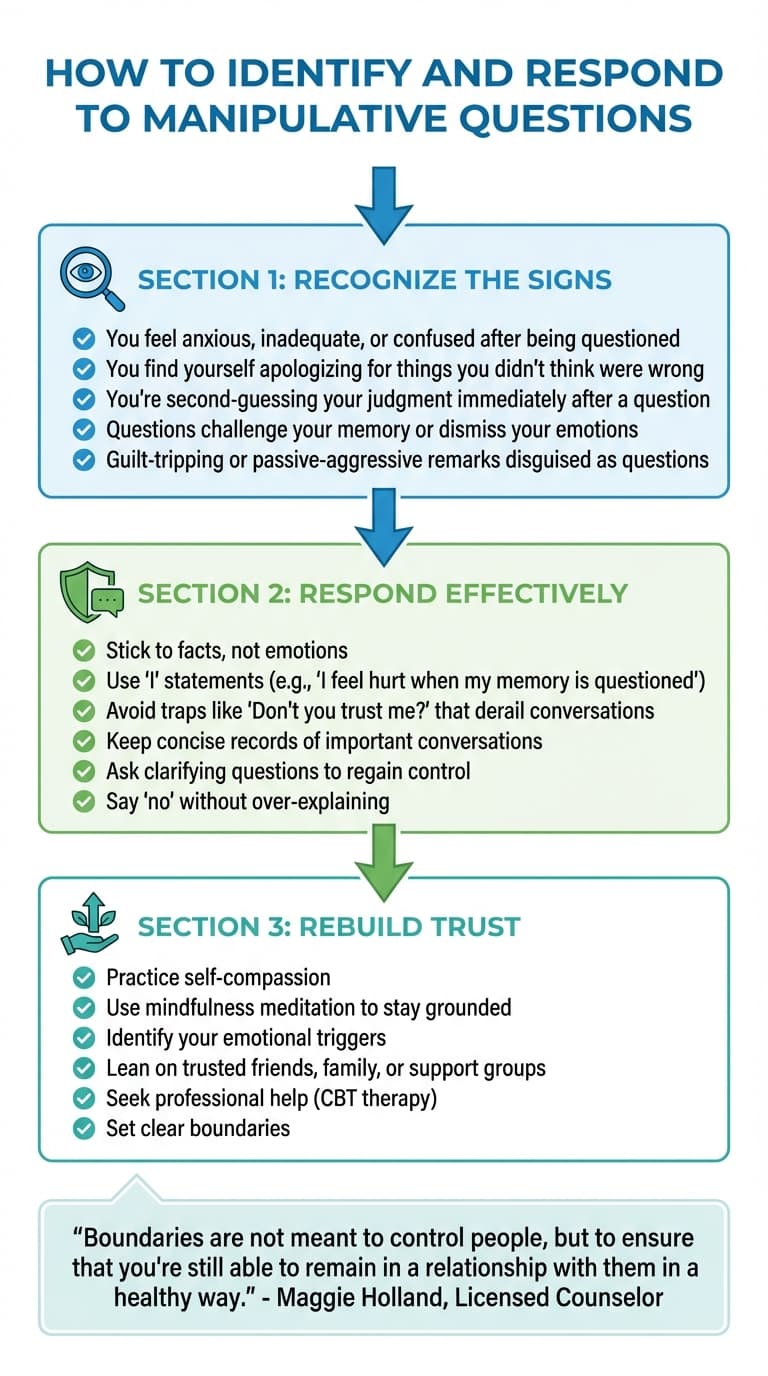
Manipulative questions can chip away at your confidence, leaving you feeling uncertain or even doubting yourself. Recognizing these tactics is the first step to regaining control.
Often, your instincts will give you clues. If a question leaves you feeling anxious, inadequate, or confused, it could be a sign of manipulation. For example, if you find yourself apologizing for something you didn’t think was wrong or second-guessing your judgment right after a question is asked, take notice - this could be deliberate.
Look for patterns in the questions being asked. Manipulative questions often challenge your memory, dismiss your emotions (e.g., “Aren’t you being too sensitive?”), or shift blame. Guilt-tripping or passive-aggressive remarks disguised as questions are also common tactics.
"Gaslighting, a common manipulation tactic, involves making the victim question their own reality and judgment through persistent lying and denial of events." - Bay Area CBT Center [3]
Interestingly, research shows that about 5 out of every 100 CEOs display psychopathic traits, highlighting how manipulative behavior can even thrive in professional settings.
Let’s look at how you can respond effectively and rebuild your confidence in the process.
Practical Ways to Respond to Manipulative Questions
When faced with a manipulative question, stick to the facts. For instance, if someone asks, "Why would I lie?" avoid diving into their motives. Instead, redirect the discussion back to the actual events. Using “I” statements - like “I feel hurt when my memory is questioned” - can help you express your feelings without escalating the situation. Be wary of traps like “Don’t you trust me?” which are designed to derail the conversation into broader, less productive debates.
"Trust is built on openness, not on avoiding answers." - Jonathan Reyes, Mental Health Specialist [1]
To protect yourself, it’s essential to set clear boundaries. Saying “no” without over-explaining is a good start. Keeping concise records of important conversations can also help counter attempts to distort your memory. For example, if someone asks, “Who told you that?” you can respond by saying the source isn’t relevant and focus instead on the accuracy of the information. If you notice DARVO tactics - where the manipulator Denies, Attacks, and Reverses the roles of Victim and Offender - step back immediately to avoid getting stuck in their narrative. Calmly ask clarifying questions to regain control of the discussion.
How to Rebuild Trust in Yourself
Rebuilding self-trust begins with self-compassion. Treat yourself with the same understanding you’d offer a close friend. Acknowledge your feelings without judgment. Practices like mindfulness meditation can help you stay grounded, making it harder for manipulators to distort your perception of reality. Additionally, identifying your emotional triggers can reduce their ability to provoke you.
Lean on your support system. Trusted friends, family, or support groups can provide valuable outside perspectives. Professional help, such as working with a therapist trained in Cognitive Behavioral Therapy (CBT), can also be incredibly helpful in managing the stress caused by manipulation.
"Boundaries are not meant to control people, but to ensure that you're still able to remain in a relationship with them in a healthy way." - Maggie Holland, Licensed Counselor [5]
Tools That Help Detect Manipulation in Conversations
Advanced AI tools are stepping up to help identify manipulation in conversations, offering a layer of clarity when emotions might otherwise cloud your judgment.
Manipulative conversations often leave you second-guessing yourself. Phrases like "You're too sensitive" or "I never said that" can erode your confidence over time. AI tools analyze these interactions in real time, spotting patterns you might miss. By identifying emotional shifts or manipulative tactics like urgency and fear-mongering, these tools help flag deceptive behavior and restore clarity.
How Gaslighting Check Identifies Manipulative Patterns

Gaslighting Check is one such tool that uses Natural Language Processing (NLP) to dissect conversations. When you input text, it highlights manipulative tactics, such as guilt-tripping ("You don’t want to let me down, right?"), reality denial ("That never happened! You’re acting crazy."), or patronizing remarks ("What makes you think you can do that?").
The tool categorizes manipulation into six areas:
- Emotional Manipulation
- Reality Distortion
- Blame Shifting
- Memory Manipulation
- Emotional Invalidation
- Truth Denial
For audio recordings, Gaslighting Check goes a step further by analyzing tone, stress, and pacing. For instance, if someone says "I’m not angry" in an elevated, tense voice, the tool flags the inconsistency between their words and emotions.
Another standout feature is conversation history tracking. It archives threads with timestamps, allowing the AI to cross-check statements across different interactions. For example, if someone denies saying something in March but a February conversation proves otherwise, the tool identifies this contradiction. Real-time alerts add another layer - if a guilt-tripping phrase pops up repeatedly in a single conversation, you’ll get an instant notification.
By offering objective confirmation of manipulation, Gaslighting Check helps reinforce trust in your own perceptions, which is key to rebuilding self-assurance.
Privacy is a priority, with end-to-end encryption and automatic data deletion policies in place. The basic plan is free and covers text analysis, while the premium plan, priced at $9.99/month, includes voice analysis, detailed reporting, and full conversation history tracking.
These insights provide a strong foundation for regaining emotional control.
How AI Tools Help You Regain Emotional Control
Once manipulation tactics are identified, these tools can help you regain control over your emotional responses.
One of the most important things these tools offer is validation. When you've been told repeatedly that you're wrong or overly sensitive, objective data confirming your experiences can be empowering. Reports generated by these tools not only pinpoint manipulation but also suggest measured, factual responses. Instead of being drawn into emotional arguments, you can respond with statements like, "I need clarity on this situation" or "I trust my judgment."
"Identifying gaslighting patterns is crucial for recovery. When you can recognize manipulation tactics in real-time, you regain your power and can begin to trust your own experiences again." - Stephanie A. Sarkis, Ph.D., Author of Healing from Toxic Relationships [6]
These tools also help you set boundaries. For instance, if the analysis shows that guilt-tripping happens every time you express your needs, you have concrete evidence to reevaluate how you engage with the manipulator - or whether to engage at all. This data-driven approach fosters independence and counters the reliance manipulators often try to create.
To make the most of these tools, document conversations as soon as possible and analyze patterns across multiple interactions rather than focusing on isolated incidents. Use the insights as objective confirmation to rebuild trust in your instincts. While these tools aren’t a substitute for professional help, sharing reports with a therapist or counselor can deepen your recovery process and speed up healing.
Conclusion: Taking Back Your Confidence and Clarity
Manipulative questions are crafted to throw you off balance, but recognizing them can help you regain control. For example, when faced with phrases like "Don't you trust me?", focusing on objective facts instead of emotional traps can shift the power dynamic. This awareness is key to breaking the psychological hold manipulators often use to chip away at your self-esteem and force dependence on their version of reality.
It's also important to separate genuine concern from attempts to undermine you. Questions like "Are you sure you can handle this?" might sound caring but could be subtle digs at your abilities. Studies reveal that guilt can double the likelihood of compliance, as people try to alleviate their discomfort [1]. Understanding these tactics allows you to demand accountability rather than internalizing misplaced blame.
To rebuild trust, rely on concrete evidence like written records or timestamps instead of subjective arguments. As Jonathan Reyes aptly puts it, "Trust is like fragile glass: it takes years to build, but one sharp blow can shatter it completely." Research from Harvard Business School highlights that repairing broken trust is far harder than maintaining it [1].
For additional support, technology can provide objective insights. Tools such as Gaslighting Check analyze text and voice patterns to identify manipulation in real-time. The free version handles basic text analysis, while the premium plan ($9.99/month) includes features like voice analysis and conversation history tracking, offering tangible evidence to back your instincts.
Reclaiming confidence starts with trusting your perceptions and setting firm boundaries. Armed with awareness and the right tools, you can recognize manipulative tactics for what they are - attempts to erode your autonomy. By doing so, you take back control of your emotional well-being and reinforce your sense of self.
FAQs
How can I tell a manipulative question from a normal one?
Manipulative questions are crafted to sow doubt and confusion, often making you second-guess your own emotions or perceptions. These questions typically use loaded or leading language to steer your response in a way that serves the manipulator's agenda. On the other hand, standard questions are straightforward, meant to gather information or clarify without any underlying motives. To identify manipulation, pay attention to subtle cues or pressure embedded in the phrasing.
What should I say when someone keeps questioning my memory?
When someone keeps questioning your memory, it might be an attempt at gaslighting - a tactic meant to make you doubt yourself. Try to stay composed and stand by your perspective with responses like, "I recall it differently, and that's okay," or "I trust my memory and feelings." Keeping a record of these interactions and establishing firm boundaries can help safeguard your mental well-being and strengthen your confidence.
How can I rebuild self-trust after being gaslit?
Rebuilding self-trust after experiencing gaslighting requires deliberate and steady effort to reconnect with your instincts and choices. Simple practices like journaling your thoughts, engaging in mindfulness exercises, and establishing clear boundaries can gradually help you rebuild confidence in your own judgment. Healing is a process, so take time to acknowledge and celebrate small victories - whether it’s confidently making a decision or standing firm on a boundary. With patience and consistency, you can strengthen your connection to your inner voice and regain trust in yourself.