
How Cognitive Reframing Builds Resilience
Gaslighting can leave you doubting your own mind, but cognitive reframing offers a way to regain clarity and confidence. This therapeutic technique, rooted in Cognitive Behavioral Therapy (CBT), helps you challenge distorted thoughts and replace them with balanced, fact-based perspectives. It’s especially effective for those recovering from emotional manipulation, which often undermines self-trust and resilience.
Here’s how cognitive reframing works:
- Identify triggers: Notice emotions or physical reactions like shame or anxiety that signal manipulation.
- Challenge distorted thoughts: Use questions to evaluate whether your thoughts are based on facts or feelings.
- Replace harmful beliefs: Shift “I’m overreacting” to “My feelings are valid given the situation.”
Tools like thought records, journaling, and even AI-powered apps can support this process. Over time, reframing helps rebuild trust in your perceptions and strengthens emotional resilience. It’s not about dismissing your experiences but about seeing them clearly and regaining control over your narrative.
Reframe Your Negative Thoughts: Change How You See the World 17/30 How to Process Emotions
Detect Manipulation in Conversations
Use AI-powered tools to analyze text and audio for gaslighting and manipulation patterns. Gain clarity, actionable insights, and support to navigate challenging relationships.
Start Analyzing NowThe Emotional Toll of Gaslighting
Gaslighting can deeply affect how you see yourself. When someone manipulates you repeatedly, it creates a sense of inner chaos, making you question your own memories, decisions, and feelings. Dr. Chivonna Childs, PhD, a psychologist at Cleveland Clinic, explains it this way:
"Gaslighting is a form of emotional manipulation to make you feel as if your feelings aren't valid, or that what you think is happening isn't really happening." [2]
Recognizing gaslighting vs. healthy conflict is a crucial step before using cognitive reframing to rebuild your sense of strength and stability.
How Gaslighting Distorts Thinking and Emotions
Gaslighting works by replacing your understanding of reality with the manipulator's version. They deny, downplay, or twist events, creating a cycle of confusion and self-doubt. Over time, this behavior reinforces specific mental patterns, such as catastrophizing (expecting the worst), all-or-nothing thinking (seeing things in extremes), and emotional reasoning (believing something is true simply because it feels true) [1][3].
These distortions can even lead to what researchers call testimonial injustice - a state where manipulation makes you mistrust your own memories and perceptions [6]. The result? A skewed view of your own thoughts and feelings that chips away at your confidence and emotional strength.
Why Gaslighting Weakens Resilience
When these distorted thought patterns take hold, they make it harder to recover from emotional challenges. Resilience, the ability to bounce back, relies on trusting yourself. But if you’re constantly doubting your own experiences, setting boundaries or standing up for yourself feels out of reach. Learning how to respond to gaslighting is essential for reclaiming your agency. For instance, a study based on 122 interviews revealed that about 30% of participants identified a parent as their primary gaslighter [6], showing how deeply these effects can be rooted in early life.
Gaslighting also triggers physical stress responses - like a racing heart, sweating, or nausea - that drain the emotional energy needed to recover [4]. As one domestic violence survivor, Selah, described it: "They live in an alternate reality. And they want you to live there with them." [6] The longer you stay in that distorted reality, the harder it becomes to reconnect with your own sense of self.
What Is Cognitive Reframing?
Cognitive reframing is a technique rooted in cognitive-behavioral therapy (CBT). For those recovering from gaslighting, it provides a structured way to challenge and replace distorted thought patterns with balanced, evidence-based ones. This process helps rebuild trust in your own judgment. By addressing these skewed thoughts, you regain control over your emotional responses, creating a foundation for further recovery steps.
How Cognitive Reframing Works
Reframing helps you shift your perspective. For example, it turns a thought like "I'm overreacting" into "My feelings are valid responses." This approach directly counters the manipulative distortions of a gaslighter. Instead of relying on their version of reality, you assess your thoughts based on facts and your own experiences, reclaiming your sense of truth.
Core Principles of Reframing for Gaslighting Recovery
Cognitive reframing is especially effective in gaslighting recovery due to three key principles:
- Distinguish facts from feelings: Emotional reactions, like feeling "crazy" or "guilty", stem from manipulation and aren't objective truths.
- Identify automatic thoughts: These quick, reflexive beliefs often mirror the gaslighter's narrative and can perpetuate self-doubt.
- Use Socratic questioning: This involves critically examining whether your thoughts are grounded in evidence, encouraging clarity and self-awareness.
These principles set the stage for the practical reframing process that follows.
What Cognitive Reframing Is Not
Some mistakenly believe reframing is about forcing positivity or downplaying experiences. It’s not. Instead, it encourages you to fully acknowledge and explore your emotions. The goal isn’t to dismiss or minimize the abuse but to stop treating distorted thoughts as facts. Reframing helps you develop thinking habits that are fair, grounded, and compassionate toward yourself.
A Step-by-Step Guide to Cognitive Reframing After Gaslighting
::: @figure
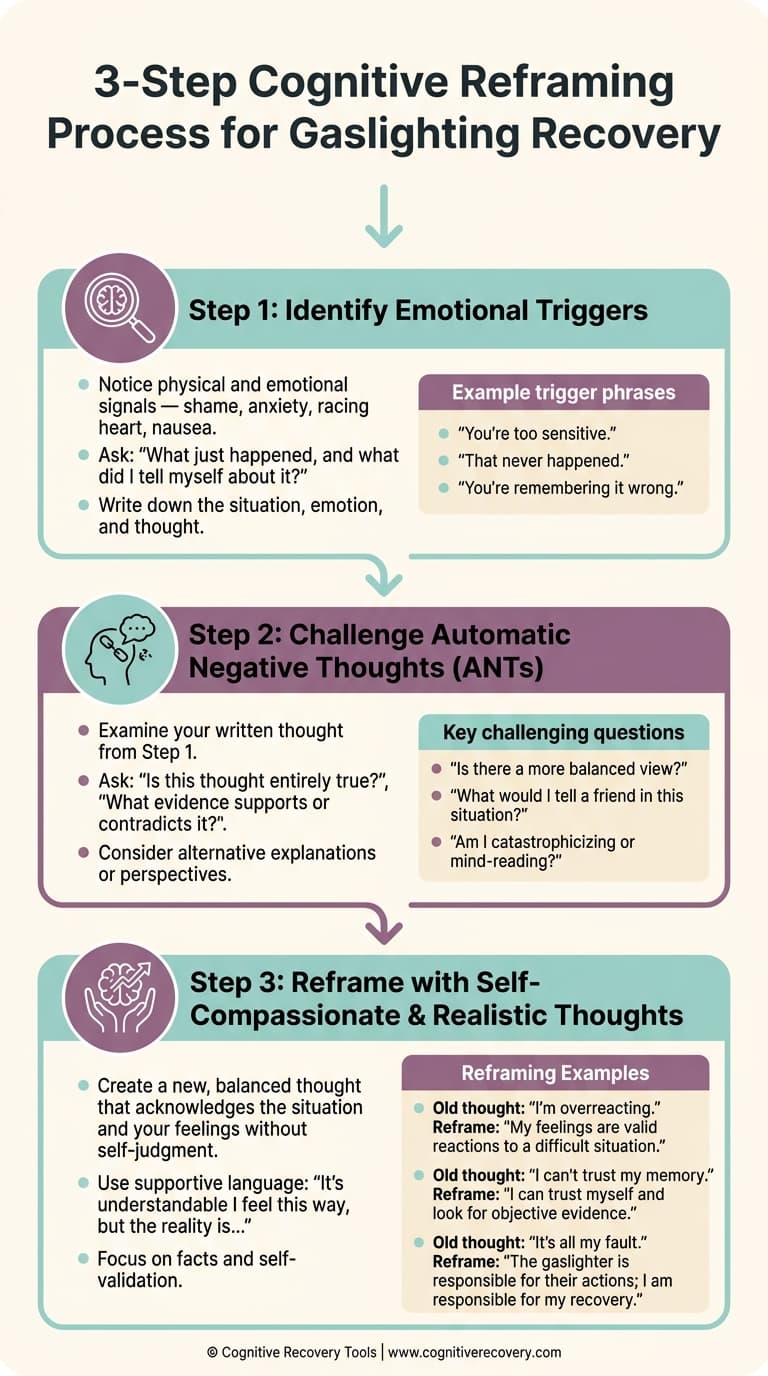
Recovering from gaslighting requires more than just understanding the concept of cognitive reframing - it’s about actively applying it to regain your confidence and emotional balance. This process unfolds in three clear steps, each building on the one before it.
Identifying Emotional Triggers
Your emotions and physical reactions can be powerful clues when dealing with gaslighting. Feelings like sudden shame, an unwarranted need to apologize, or physical sensations such as a racing heart, nausea, or a tight stomach signal that your nervous system is reacting to something [4].
The first step is to notice and name these emotions. When you feel a surge of anxiety or self-doubt, pause and ask yourself: "What just happened, and what did I tell myself about it?" Writing down the situation, the emotion, and your thoughts can help uncover recurring patterns. For example, you might realize that phrases like "You're too sensitive" or "I never said that" consistently provoke the same emotional response. Once you’ve recognized these patterns and learned how to communicate effectively, you’re ready to evaluate the thoughts behind them.
Challenging Gaslighting-Driven Thoughts
Once you’ve identified your triggers, the next step is to examine the thoughts they bring up. Gaslighting often leads to distorted thinking patterns, such as:
- All-or-nothing thinking: "I’m always wrong."
- Overgeneralization: "Nobody ever believes me."
- Catastrophizing: "If I speak up, everything will fall apart."
To challenge these thoughts, try using Socratic questioning - a technique that encourages you to critically evaluate your thoughts. Ask yourself:
- Is this thought based on facts, or does it stem from how I’m feeling right now?
- What evidence supports this thought? What evidence contradicts it?
- Am I seeing this in black-and-white terms when the truth might be more nuanced?
This approach not only helps you think more clearly but also empowers you to set boundaries and respond to gaslighting. As Dr. Chivonna Childs, PhD, explains:
"Calling out gaslighting behaviors helps set boundaries and change the power dynamic. It puts the other person on notice that you will no longer accept this type of treatment." - Dr. Chivonna Childs, PhD, Psychologist, Cleveland Clinic [2]
The goal isn’t to dismiss your emotions but to separate the facts from the distorted reality created by the gaslighter.
Replacing Distorted Thoughts with Balanced Alternatives
Finally, replace those distorted thoughts with more balanced ones grounded in reality. This isn’t about forcing yourself to think positively - it’s about creating statements that reflect what you genuinely believe and that align with your experiences.
For instance, if the thought "I’m overreacting and making things up" arises, you could reframe it as: "I noticed something that felt off, and my reaction makes sense given what happened." Writing these balanced thoughts in a Positive Belief Record can help you reinforce healthier thinking patterns over time, gradually loosening the hold of the gaslighter’s narrative on your mind.
Tools and Techniques to Support Cognitive Reframing
Practical tools can be a game-changer when it comes to cognitive reframing. Knowing what to do is one thing, but having the right tools at hand makes it easier to apply that knowledge consistently - especially when self-doubt creeps in.
Using Thought Records and Journals
A thought record is a simple yet powerful tool borrowed from Cognitive Behavioral Therapy (CBT). When a distressing thought pops up, you jot down the event, the emotion it triggered, and the thought itself. This process slows things down, giving you the space to analyze the thought instead of reacting impulsively [7].
What makes thought records especially helpful in the context of gaslighting recovery is the evidence-based approach they encourage. For example, if you catch yourself thinking, "I'm the problem", you can treat it as a hypothesis rather than a fact. Then, you ask: What evidence supports this? What contradicts it? Over time, this habit teaches your brain to automatically question distorted thinking patterns [4]. Plus, tracking your progress in writing gives you a clear picture of how reframing is reshaping your emotional responses.
Using Gaslighting Check to Support Reframing

Pairing journaling with technology can add another layer of support. Recovering from gaslighting often involves second-guessing your own memories. This is where a tool like Gaslighting Check can step in to provide clarity.
Gaslighting Check uses AI to analyze both text and voice conversations, identifying patterns of emotional manipulation in real time. Its detailed reports offer objective evidence of what was said, which can be incredibly grounding when you start doubting yourself with thoughts like, "Maybe I imagined it." For those looking to track patterns over time, the conversation history feature (available with the Premium plan for $9.99/month) helps you spot recurring manipulation tactics, reinforcing the pattern recognition that makes reframing easier [4].
The platform prioritizes privacy, with encrypted data that’s automatically deleted, so you can use it without worrying about compromising sensitive information.
Adding Emotional Regulation Techniques
Before diving into a thought record, it's essential to calm your nervous system. Gaslighting often triggers a stress response - think racing heart, tight chest, or even nausea. When you're in fight-or-flight mode, it's much harder to engage in logical analysis [4].
A few slow, deep breaths can make all the difference. Grounding techniques can also help: try focusing on five things you can see or feel in your immediate surroundings to bring your body back to a calmer state. These physical tools don’t replace the cognitive work - they create the conditions that make it possible [7].
"The goal isn't relentless positivity or talking yourself out of genuine problems. It's accuracy and flexibility - learning to see situations more completely." - Positivity.org Editorial Team [7]
Conclusion: Rebuilding Resilience Through Cognitive Reframing
Gaslighting can leave you doubting your own mind, but cognitive reframing offers a way to counteract this harm. By replacing distorted thoughts with more balanced perspectives, you can gradually rebuild trust in yourself. Studies indicate that cognitive restructuring helps reduce PTSD symptoms and improves daily functioning [3]. With consistent effort, reframing can become second nature, guiding you back to a place of self-confidence.
Licensed therapist Stefanie Kuhn, LMFT, captures this process perfectly:
Recovery isn't linear. Some days you'll feel strong; other days, fragile. Remember that healing takes time. You're not behind. You're rebuilding. - Stefanie Kuhn, LMFT, Therapy Works Well [5]
This reminder underscores the importance of persistence and patience in reshaping your thought patterns.
The key is consistency. Each time you identify a distorted thought, challenge it, and replace it with a more grounded perspective, you're strengthening your mental resilience [4]. Practical tools like thought records, emotional regulation techniques, science-backed trauma processing, and resources such as Gaslighting Check can help you stay connected to reality.
Over time, this practice sharpens your boundaries, strengthens your instincts, and deepens your sense of self [5]. These aren't just small wins - they form the backbone of lasting resilience. Every reframed thought is a step toward reclaiming your personal truth and rebuilding a stronger, more assured version of yourself.
FAQs
How do I tell facts from feelings after gaslighting?
To navigate the aftermath of gaslighting and distinguish facts from emotions, start by focusing on objective evidence. Document conversations, events, and specific incidents to create a clear record. This can help you see the situation more clearly and counter any distorted narratives.
Reconnect with your inner truth by journaling, identifying and naming your emotions, or confiding in trusted friends who can offer a grounded perspective. These practices can help you process your feelings and regain a sense of stability.
Engage in grounding techniques, like breathwork, taking a walk, or other calming activities. These can help you restore emotional balance and clarity. As you reflect on your experiences, stick to factual details rather than subjective interpretations. This approach allows you to better understand what happened without letting emotions cloud your judgment.
What do I do when reframing feels like “making excuses” for abuse?
If reframing feels like it’s excusing abuse, it’s important to recognize that genuine reframing should validate your emotions, not justify harmful actions. Feeling this way could be a sign of self-doubt or downplaying your own experience. Instead, try focusing on clearly identifying what happened, setting firm boundaries, and reaching out for external support. These steps can help you process your feelings while honoring the reality of your experience.
How can I use Gaslighting Check to support cognitive reframing?
Gaslighting Check aids in reshaping your thought patterns by analyzing conversations to spot emotional manipulation and distorted thinking often tied to gaslighting. With tools like real-time audio recording, text and voice analysis, and conversation history tracking, it helps you uncover patterns that might otherwise go unnoticed.
Armed with these insights, you can shift distorted thoughts into more balanced and constructive perspectives. This process not only reduces emotional distress but also strengthens your ability to resist manipulation over time.