
Reducing Bias in Hate Speech Detection Algorithms
Hate speech detection algorithms often fail to treat all users fairly due to biased training data, flawed models, and cultural misunderstandings. These issues lead to over-censoring marginalized groups or missing harmful content. Here's a quick breakdown of the problem and solutions:
Key Problems:
- Biased Training Data: Datasets often over-represent certain groups (e.g., English speakers) while neglecting others, like African American English or low-resource languages.
- Flawed Algorithms: Older methods (e.g., TF-IDF) amplify biases, while even advanced models (e.g., BERT) misinterpret identity terms.
- Language Barriers: Models struggle with slang, dialects, and code-mixing (e.g., Hinglish), leading to higher false positives for minority communities.
Solutions:
- Diverse Training Data: Include voices from underrepresented groups and languages.
- Better Algorithms: Use modern tools like transformer models and fairness-aware training techniques.
- Regular Monitoring: Update systems with new slang, coded language, and user feedback.
By addressing these challenges, we can create systems that detect hate speech more equitably while protecting free expression.
Where Bias Comes From in Hate Speech Detection
Bias in Training Data
The quality of training data directly affects the fairness and accuracy of hate speech detection systems. One major issue is annotator subjectivity - personal and cultural perspectives can influence how annotators label data. Even when advanced models like GPT-4o and Llama-3.1 assist in the annotation process, they carry their own biases related to gender, race, religion, and disabilities [6].
Another challenge is lexicon-based collection bias, where datasets are built using "seed words" like slurs or profanity. This method can skew the dataset, leading to an overemphasis on curse words as definitive indicators of hate speech. Researchers Rezvan M. et al. emphasize this limitation:
The presence of curse words is not a sufficient indicator of harassment... offensive language per se is not necessarily harassing [7].
Demographic imbalance in datasets further compounds the issue. For example, African American English is often misclassified as toxic due to a lack of diverse examples in training data. Studies show that in some re-annotated datasets, over 75% of harassing tweets were racial, which can cause models to over-focus on race while ignoring other forms of abuse, like those targeting appearance or intellect [7]. Additionally, most research prioritizes high-resource languages like English, leaving low-resource languages like Pashto and Dzongkha underrepresented [3][2].
These data-related shortcomings directly influence how algorithms perform, often leading to biased outcomes.
Model and Algorithm Limitations
The technical design of detection systems also plays a role in perpetuating bias. For instance, feature extraction methods like Term Frequency (TF) and TF-IDF are more prone to unintended bias compared to newer transformer-based embeddings such as BERT and RoBERTa [5]. When paired with classifiers like Decision Trees or Multi-Layer Perceptrons, these older methods can amplify bias even further [5].
A common challenge for these systems is the accuracy–fairness trade-off. Optimizing for higher accuracy often sacrifices fairness, explainability, and inclusiveness [3]. Additionally, unimodal models that rely solely on text data fail to detect hate speech in multimedia content, such as memes or videos, where harmful intent may arise from the combination of text and images [3].
Another issue is identity term overgeneralization, where algorithms flag non-hateful content simply because it includes terms like "woman", "black", or "gay." This misstep highlights the flawed assumptions embedded in many models [5].
Language and Cultural Differences
Language and cultural nuances add another layer of complexity to hate speech detection. Many systems are English-centric, which means they often miss hate speech in languages like Amharic, Swahili, or South Asian dialects. Models trained on standard language data frequently misinterpret slang or dialect-specific expressions as toxic, leading to higher false positive rates for minority communities [3].
Code-mixing - where multiple languages are used in a single post, such as Hinglish or Arabizi - poses additional challenges. Traditional monolingual models struggle to process these mixed-language patterns effectively [3]. Zahra Safdari Fesaghandis and Suman Kalyan Maity highlight this issue:
Hate speech in low-resource languages is disproportionately overlooked due to data scarcity, code-mixing (e.g., Hinglish, Arabizi), and culturally specific expressions that evade English-centric detection models [8].
Translation-based solutions often fail to capture cultural context, leading to over-censorship of marginalized voices or missed detection of subtle "dog whistles" and coded speech [8]. Implicit hate, expressed through sarcasm, irony, or culturally coded symbols, requires a deep understanding of socio-political context - something most automated systems lack [3]. Even among human annotators, agreement rates vary widely depending on the context. For example, annotators tend to agree more on appearance-related harassment but show less consensus in political or sexual contexts, where distinguishing between healthy conflict and abusive tactics becomes more difficult due to their inherent ambiguity [7].
Detect Manipulation in Conversations
Use AI-powered tools to analyze text and audio for gaslighting and manipulation patterns. Gain clarity, actionable insights, and support to navigate challenging relationships.
Start Analyzing NowHate speech detection: Bias in data and annotations | Sandra Kübler | DiLCo Video Reader
How to Reduce Bias in Hate Speech Detection
::: @figure
This section provides actionable steps to address the challenges posed by biased data and algorithms in hate speech detection.
Using Diverse Training Data
Creating fair hate speech detection systems starts with using datasets that reflect a wide range of voices and contexts. Models trained primarily on white, English-language data often misclassify African American English as toxic, highlighting the need for more balanced data [3].
To build more inclusive datasets, it's essential to incorporate annotations from native speakers, regional slang, and reclaimed terms that communities use in non-harmful ways. A good example is the MMCFND framework, which includes Hindi, Bengali, and Marathi data with caption-aware encodings, achieving an impressive 99.6% accuracy and F1-scores of 0.997 [3]. For multimodal content like memes, integrating diverse visual and auditory data is equally critical. For instance, a fine-tuned CLIP model reached 87.42% accuracy on a hateful meme dataset [3].
For languages with fewer resources, like Pashto or Swahili, techniques such as few-shot learning and cross-lingual transfer can be effective. These methods allow models to leverage data from high-resource languages when training examples are limited. Additionally, using multi-aspect schemas - categorizing content by target group, directness, and sentiment - can help reduce the risk of over-censoring marginalized voices [8]. These enhancements in data diversity set the stage for refining algorithms to further improve fairness.
Adjusting Algorithms and Measuring Fairness
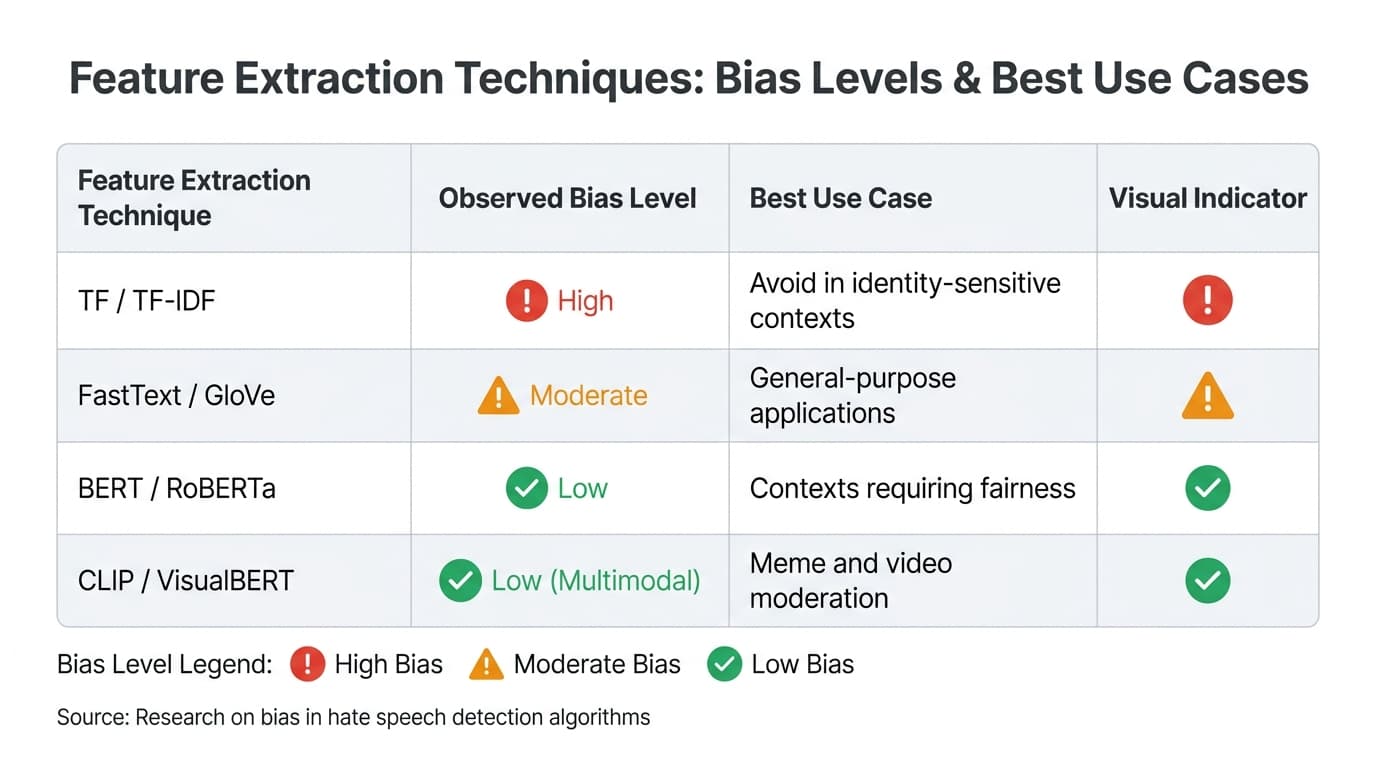
Improving algorithms is another critical step in reducing bias. Traditional methods like Term Frequency (TF) and TF-IDF often introduce more bias compared to modern transformer-based embeddings like BERT and RoBERTa [5]. When paired with classifiers such as Decision Trees or Multi-Layer Perceptrons, these older methods can amplify unintended biases.
| Feature Extraction Technique | Observed Bias Level | Best Use Case |
|---|---|---|
| TF / TF-IDF | High | Avoid in identity-sensitive contexts [5] |
| FastText / GloVe | Moderate | General-purpose applications [5] |
| BERT / RoBERTa | Low | Contexts requiring fairness [5] |
| CLIP / VisualBERT | Low (Multimodal) | Meme and video moderation [3] |
Fairness-aware training involves embedding fairness constraints directly into the model. This includes adjusting training samples and preventing algorithms from associating identity terms like "woman", "gay", or "black" with hateful content [3][5]. Testing models with identity term templates (e.g., "You are a good [identity]") helps detect if different groups receive unequal toxicity scores in identical situations [5]. Metrics like False Positive Equality Difference (FPED) and False Negative Equality Difference (FNED) are useful for identifying disproportionate censorship or inadequate protection for certain communities [5]. While these technical adjustments improve fairness, ongoing feedback from users remains essential.
Regular Monitoring and User Feedback
Hate speech evolves over time, incorporating new slang, coded language, and references as societal dynamics shift. Regular audits using dialect-specific datasets can help identify and address systematic biases quickly [3]. User feedback plays a vital role in capturing subtleties like sarcasm, regional dialects, and broader socio-political contexts that automated systems often miss.
As Springer Nature highlights:
Existing data sets, while valuable, often lack comprehensive and may not encapsulate the evolving nuances of hate speech, necessitating continuous updates and expansions [4].
Tracking metrics like Macro F1-scores, along with precision and recall for minority classes, provides a transparent way to measure model performance across all groups - not just dominant ones [3]. As hate speech increasingly appears in multimodal formats like memes, short videos, and audio, monitoring these media types simultaneously becomes crucial [3]. Zahra Safdari Fesaghandis and Suman Kalyan Maity emphasize the importance of collaboration in this field:
Meaningful progress in this domain requires interdisciplinary collaboration across computer science, linguistics, and social sciences, as well as partnerships with local communities and policymakers to ensure that solutions are not only scalable but also contextually appropriate and ethically responsible [8].
Tools for Detecting Bias and Emotional Manipulation
Gaslighting Check: Detecting Emotional Manipulation

Detection tools are expanding beyond bias in hate speech to address the subtleties of emotional manipulation. Unlike hate speech, which is often overt and identifiable at scale, emotional manipulation can be subtle, context-driven, and aimed at distorting someone's reality. Tools like Gaslighting Check are stepping into this space, using contextual analysis to identify manipulation patterns in personal conversations.
Gaslighting Check works by analyzing both text and voice interactions to detect signs of emotional manipulation. It offers features like real-time audio tracking, detailed reporting, and a history tracker (available with the Premium plan for $9.99/month). A key strength of the tool is its semantic analysis, which identifies contradictions between a statement’s literal meaning and its intent. This mirrors how advanced hate speech detection tools differentiate between reclaimed language and genuine attacks [11].
To minimize false positives, Gaslighting Check employs multifactor analysis, combining insights from abusiveness detection, sentiment analysis, and topic analysis - a methodology inspired by the TiALD benchmark [9]. By integrating tools like this into larger detection frameworks, the goal is to enhance transparency and address nuances that traditional algorithms often miss.
Privacy and Ethics in Detection Tools
While these tools offer powerful detection capabilities, they also handle highly sensitive personal data, making privacy and ethical considerations critical. Gaslighting Check addresses privacy concerns through end-to-end encryption and automatic data deletion policies. This ensures users maintain control over their data, reducing the risk of misuse.
The ethical challenges are significant. A study analyzing 155,800 Twitter posts across five academic datasets revealed pervasive racial bias, particularly against Black speech [1]. Giuseppe Attanasio from the Association for Computational Linguistics highlights the risks:
The unconscious use of these techniques for such a critical task comes with negative consequences [13].
To address this, tools like Gaslighting Check focus on transparency. They provide detailed reports explaining flagged content, allowing users to review confidence levels and identify potential algorithmic biases [10]. This approach avoids the pitfalls of opaque, automated decision-making.
Ethical detection systems must go beyond binary classifications. For instance, UC Berkeley’s Measuring Hate Speech project uses continuous measurement scales to reflect diverse annotator perspectives [12]. As Shirin Ghaffary aptly notes:
What is considered offensive depends on social context [1].
Conclusion: Building Better Hate Speech Detection Systems
Creating effective hate speech detection systems means tackling challenges like multilingualism, multimodality, and bias head-on. As highlighted by Springer Nature, "Solving for multilingualism, multimodality and bias is not only a technical necessity but also a moral obligation to provide equal and secure digital environments" [3]. This makes it clear that these systems must do more than just achieve high accuracy - they need to actively address biases embedded in training data and model design.
The process involves three key steps: balancing datasets during preprocessing, incorporating fairness-aware techniques during model training, and conducting thorough post-hoc evaluations using unbiased test sets [3]. Despite advancements, many models still struggle with bias. For instance, systems trained primarily on data from white, English-speaking users often misclassify African American English as toxic, even when no offensive intent exists [3].
Since 2020, transformer-based models like BERT and RoBERTa have become the go-to tools for hate speech detection, outperforming older methods like TF-IDF in reducing unintended bias [5]. In one study, a multimodal framework combining text, visuals, and audio achieved an impressive 98.53% accuracy and 97.71% interpretability [14]. This approach is especially useful for identifying hate speech embedded in visual media or disguised through sarcasm - areas where text-only systems often fall short.
New tools are also emerging to address more nuanced challenges, such as emotional manipulation. For example, Gaslighting Check uses AI to detect subtle gaslighting tactics through real-time audio recording, text analysis, and voice evaluation. This tool not only helps users identify manipulation but also prioritizes privacy through strong data protection measures.
Language and communication styles continue to evolve, with hate speech creators adopting coded language and visually rich formats to bypass detection systems [4][14]. To keep up, regular monitoring and user feedback are essential. These measures help ensure detection systems stay accurate and unbiased, avoiding harmful associations between identity-related terms and toxicity [3]. This ever-changing landscape underscores the need for constant vigilance and iterative improvements.
FAQs
How can I tell if a hate speech model is biased?
To spot bias in a hate speech model, it's crucial to assess how it performs across various demographic groups and language styles. For example, African American English (AAE) is frequently misclassified as hate speech, leading to a high rate of false positives. Carefully examine the training data for embedded stereotypes and apply fairness-focused evaluation methods to pinpoint biases. Approaches like causal analysis and adversarial training can address these problems while keeping the model accurate.
What data changes reduce false flags on dialects and slang?
Data diversification and algorithmic tweaks, like dialect priming and adversarial training, play a key role in cutting down false positives related to dialects and slang. These strategies improve how models handle different language varieties and help address biases often linked to specific dialects, such as African-American English (AAE).
How do you audit and update detectors as hate speech evolves?
To maintain the effectiveness of hate speech detectors, it's crucial to consistently evaluate models using fresh, diverse datasets to spot and address biases. This involves several key actions:
- Data diversification and augmentation: Expanding datasets with varied examples ensures better representation of different contexts and perspectives.
- Model retraining and algorithm tweaks: Regularly updating models and refining algorithms helps them stay accurate and reliable.
- Causal analysis: This technique can pinpoint underlying biases in the system.
- Mitigation strategies: Approaches like multi-task learning or targeted data interventions can strengthen the model's ability to handle complex scenarios.
Additionally, keeping models aligned with current cultural and linguistic trends is essential to tackle the ever-changing nature of hate speech effectively.