
Gaslighting vs. Implicit Power Cues
Gaslighting and implicit power cues both involve power dynamics, but they operate differently. Gaslighting is deliberate manipulation aimed at making someone doubt their reality, while implicit power cues are subtle, often unintentional signals shaped by social hierarchies. Both can influence decision-making, but gaslighting is abusive, whereas implicit power cues often reflect existing structures. Here's a quick breakdown:
- Gaslighting: Intentional, manipulative, relies on denial and twisting facts, creates self-doubt (e.g., "That never happened").
- Implicit Power Cues: Subtle, shaped by hierarchy, encourages self-censorship, often unnoticed (e.g., tone of voice, interruptions).
Understanding these differences helps in identifying gaslighting vs manipulation and natural power dynamics. Tools like Gaslighting Check can analyze conversations to detect patterns of manipulation, offering clarity and support in navigating complex interactions.
Gaslighting in Decision-Making
Core Characteristics of Gaslighting
Gaslighting works by distorting reality, making it harder for someone to trust their own judgment. This is what makes it different from a regular disagreement. In a typical conflict, both sides aim to reach some mutual understanding. Gaslighting, however, involves one person systematically undermining the other's sense of what actually happened [8].
This leads to something called epistemic uncertainty - a lingering doubt about one's ability to grasp reality. Once that doubt takes hold, it becomes nearly impossible to make decisions without relying on the manipulator. As The Strategic Linguist puts it:
"The issue is manipulative discourse structure, not your failing memory. That shift matters for maintaining epistemic confidence - trust in your own knowledge." [4]
This manipulation isn't about having a bad memory; it's about being made to question your knowledge and perception. Over time, this repeated undermining causes victims to second-guess themselves even before making decisions.
How Gaslighting Appears Across Different Settings
These defining traits of gaslighting can show up in many environments, not just in personal relationships. Workplaces, families, and institutions - any setting with a power imbalance - can become breeding grounds for this behavior.
In work settings, gaslighting often involves managers using "definitional authority." They may rewrite events to control how things are perceived within the organization. The Strategic Linguist explains:
"When someone with definitional authority rewrites what happened, they're not just making a claim about the past. They're exercising the power to determine what counts as true within the organisation." [4]
In medical contexts, this manipulation is often referred to as "medical gaslighting examples." Here, a healthcare provider might dismiss a patient's symptoms as stress or anxiety instead of investigating further [1][3]. Research highlights a stark outcome: women are twice as likely to die from heart attacks, partly because their symptoms are more likely to be dismissed [7].
In family dynamics, gaslighting can start early. A sociological study found that about 30% of participants identified a parent as their primary gaslighter, showing how these patterns can take root in childhood [1].
Behavioral Markers That Signal Gaslighting
Spotting gaslighting as it happens can be tricky, but certain behaviors and language patterns can serve as red flags.
From a linguistic perspective, three common tactics stand out [4][8]:
- Explicit assertives: Denying facts outright, such as saying, "That meeting never happened."
- Covert assertives: Undermining someone's credibility under the guise of concern, e.g., "Are you sure you're tracking things correctly?"
- Inclusive assertives: Embedding false claims in statements about the future, like, "When you're calmer, we can discuss what actually happened", which implies you're currently not calm.
On the psychological side, there are internal warning signs to watch for. These include frequently apologizing without knowing why, feeling incapable of making even simple decisions without someone else's input, and avoiding sharing information with loved ones to prevent having to defend another person's behavior [6][7].
The numbers are telling: in a survey of 2,875 individuals who experienced intimate partner violence, 85.7% reported their partner had called them "crazy," while 73.8% believed their partner had intentionally acted to make them feel that way [2]. These statistics highlight how common - and normalized - this tactic can become, often leaving victims unaware of what's happening.
"When someone is manipulating you, you end up second-guessing yourself and turning your attention to yourself as the person to blame." - Dr. Robin Stern, Director at the Yale Center for Emotional Intelligence [7]
These behaviors and patterns lay the groundwork for understanding how subtle power dynamics can shape decision-making.
Detect Manipulation in Conversations
Use AI-powered tools to analyze text and audio for gaslighting and manipulation patterns. Gain clarity, actionable insights, and support to navigate challenging relationships.
Start Analyzing NowImplicit Power Cues in Decision-Making
What Implicit Power Cues Are
Implicit power cues are subtle signals that influence behavior on an unconscious level - without anyone explicitly asserting authority. These cues are present in things like tone of voice, body language, patterns of interruption, and even the order in which people speak during a meeting. What makes them so effective is their subtlety; they work precisely because they don’t register as overt displays of power. As researcher RJ Starr explains:
"The invisibility of indirect power is not a limitation of the observer. It is constitutive of the mechanism itself. Indirect power depends... on not being recognized as power." [5]
In simpler terms, once you identify these cues as power dynamics, their influence starts to diminish. These signals emerge from various sources, creating a backdrop that significantly shapes decision-making processes.
Where Implicit Power Cues Come From
These cues are rooted in organizational hierarchies, expertise in specific subjects, and control over key information [5]. They are further amplified by social factors like gender, race, and class, which intersect to reinforce existing power structures [1].
How They Affect Decision-Making
Implicit power cues can subtly restrict decision-making by prompting people to self-censor. Without any direct pressure, individuals may abandon ideas that challenge the dominant narrative [5]. Over time, frequent interruptions can chip away at someone’s confidence in their own thoughts, leading them to defer more to those in higher-status roles [5]. Interestingly, research also indicates that individuals in positions of power are often less sensitive to the emotions of others, which can lead them to dominate group discussions regardless of the input from others [9]. As a result, while a group may appear to be engaging in open deliberation, these unseen power dynamics quietly filter and limit the range of ideas, shaping outcomes in ways that are often overlooked. Recognizing these cues is the first step toward mitigating their influence. For those facing more overt tactics, specialized workplace gaslighting detection tools can help document and validate these experiences.
Gaslighting Is About Power - Not Manipulation: Do You Agree?
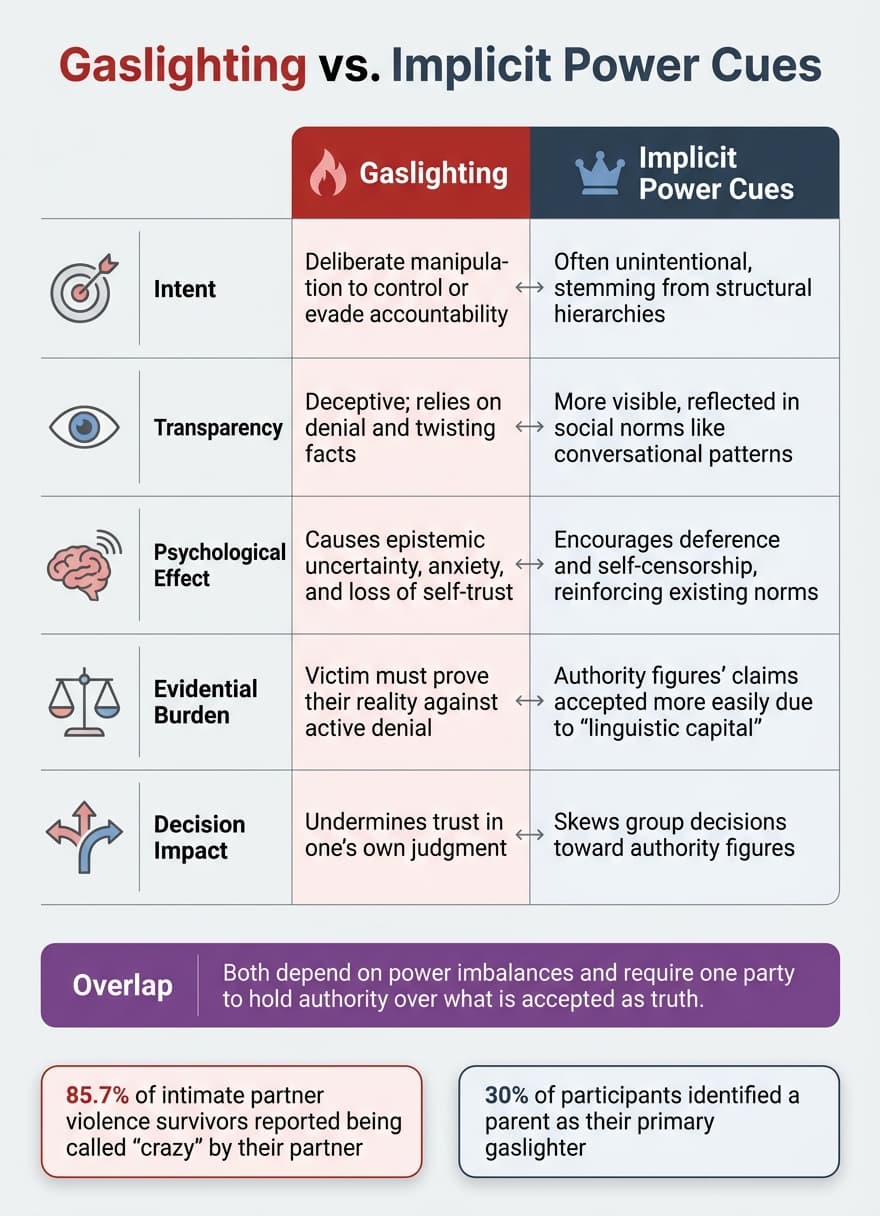
Gaslighting vs. Implicit Power Cues: A Direct Comparison
::: @figure
Key Differences and Similarities
Gaslighting and implicit power cues both involve power dynamics, but they operate in distinct ways. Gaslighting is a deliberate effort to manipulate someone’s perceptions, often to create doubt, while implicit power cues emerge more naturally from existing hierarchies and social structures [3][4].
Their language and methods also differ. Sociologist Paige L. Sweet highlights this distinction:
"mental manipulation typically relies on existing social patterns of domination" [1].
Gaslighting doesn’t invent power - it exploits already-established hierarchies to distort someone’s reality, particularly in decision-making scenarios. Implicit power cues, on the other hand, work subtly through deference and ingrained social norms [4].
The psychological effects are another area where these two diverge. Implicit power cues can cause individuals to self-censor or hold back ideas, especially in environments that feel unwelcoming. Gaslighting goes further, creating what researchers call "epistemic uncertainty" - a deep-seated doubt in one’s ability to trust their own perceptions [4].
Comparison Table
Here’s a quick breakdown of how gaslighting and implicit power cues compare:
| Feature | Gaslighting | Implicit Power Cues |
|---|---|---|
| Intent | Deliberate manipulation to control or evade accountability [3]. | Often unintentional, stemming from structural hierarchies [4]. |
| Transparency | Deceptive; relies on denial and twisting facts [10]. | More visible, reflected in social norms like conversational patterns [4]. |
| Psychological Effect | Causes epistemic uncertainty, anxiety, and loss of self-trust [10]. | Encourages deference and self-censorship, reinforcing existing norms [4]. |
| Evidential Burden | Victim must prove their reality against active denial [4]. | Authority figures’ claims are accepted more easily due to "linguistic capital" [4]. |
| Decision Impact | Undermines trust in one’s own judgment [3]. | Skews group decisions toward authority figures [4]. |
Where the Two Concepts Overlap
Despite their differences, both gaslighting and implicit power cues depend on power imbalances. Neither can thrive in relationships between equals; they require one party to hold enough authority - whether institutional, social, or relational - to dictate what is accepted as "truth" [4].
This dynamic ties directly to "definitional authority", as The Strategic Linguist explains:
"When the person who controls narrative framing also controls written records, their version becomes organisational reality." [4]
Implicit power cues alone can create this authority, but it crosses into gaslighting when used to actively erase or override someone else’s documented experiences. Recognizing these nuances helps us better understand power dynamics and highlights how AI tools might be developed to identify and address manipulative communication patterns. These overlapping dynamics provide a foundation for exploring how technology can mitigate such imbalances.
How AI Can Analyze Power Dynamics
What AI Looks for in Conversations
AI dives into the structure of conversations, paying close attention to speech acts to determine whether words describe reality or attempt to reshape it. For example, phrases like "That never happened" are clear attempts to overwrite established facts. However, manipulation often takes subtler forms, such as covert assertives disguised as questions (e.g., "Are you sure you're tracking everything correctly?") or anti-performatives that undermine their own disclaimers (e.g., "I don't mean to undermine you, but…") [8]. Beyond language, AI evaluates interruptions, speaking time, and shifts in narrative to distinguish genuine power imbalances from manipulative tactics.
How Gaslighting Check Works

Tools like Gaslighting Check take these analytical methods further to assess real-life conversations. Its advanced NLP engine examines word choices and sentence structures, flagging absolute language (e.g., "you always" or "you never") and evasive phrases, particularly when they appear after someone sets a boundary or asks a direct question. The platform also employs sentiment analysis to detect emotional manipulation through sudden tone changes, which may indicate tactics like urgency-based control or guilt induction.
Another key feature is its ability to track conversation history. By cross-referencing statements across multiple interactions, the tool identifies contradictions and repeated denials. As UC Berkeley researcher Marwa Abdulhai explains:
"Deception in dialogue is a behavior that develops over an interaction history, its effective evaluation and mitigation necessitates moving beyond single-utterance analyses."
The results are compiled into a detailed report, complete with frequency charts of manipulative behaviors, offering users a clearer understanding of the dynamics at play.
Limits and Privacy Considerations
While the technology provides valuable insights, it has its limitations. One major challenge lies in interpreting intent. As Soroush Vosoughi, Assistant Professor of Computer Science at Dartmouth, points out:
"Recognizing manipulative intent, especially when it is implicit, requires a level of social intelligence that current AI systems lack."
This is particularly true for implicit power cues, which may reflect existing hierarchies rather than intentional manipulation. In such cases, AI can highlight patterns, but human interpretation is crucial to fully understand the context.
On the privacy side, Gaslighting Check ensures data security with end-to-end encryption. User data is automatically deleted after 30 days, and detailed reports can be exported privately - ideal for sharing with a therapist or trusted advisor. Importantly, no data is shared with third parties.
Conclusion: Telling the Two Apart and Taking Action
Key Takeaways
When comparing gaslighting to implicit power cues, the main difference lies in intent and structure. Gaslighting is a deliberate and systematic attempt to make someone doubt their reality, relying on denial and contradiction to undermine their perception of events [10][8]. In contrast, implicit power cues stem from institutional hierarchies, where senior figures naturally hold more linguistic capital, allowing their narratives to dominate with minimal resistance [4].
Understanding this distinction is critical. Mistaking a power cue for gaslighting can unnecessarily escalate tensions, while ignoring genuine gaslighting allows harm to persist unchecked. Sociologist Paige L. Sweet aptly explains:
"Gaslighting feeds off social vulnerabilities and stereotypes. It entrenches existing power imbalances while fostering new ones." [11]
What can you do? Start by documenting incidents early, look for patterns, and avoid facing manipulation alone. A single contradiction might not mean much, but repeated challenges to your memory or competence could point to gaslighting at work [4]. These insights can help you move from recognizing the issue to taking protective action.
How Tools Like Gaslighting Check Can Help
To turn awareness into action, Gaslighting Check offers a way to track and analyze interactions, helping you identify patterns of contradiction. It doesn’t replace your judgment but provides a clear, external record to support your perspective. By cross-referencing conversations, the tool can transform vague doubts into concrete evidence.
The platform’s Premium Plan ($9.99/month) includes advanced features like voice analysis, detailed reporting, and conversation history tracking - essential for high-stakes situations where self-doubt might cloud your perception. For those starting out, the free plan covers text analysis and basic insights. Whether you choose the free or premium option, the goal remains the same: to move from confusion to clarity by making the invisible visible.
FAQs
How can I tell gaslighting from a normal disagreement?
Gaslighting is a form of emotional manipulation where someone deliberately makes you question your sense of reality. It often involves tactics like twisting facts, invalidating your emotions, or causing you to second-guess your memory and judgment. On the other hand, a normal disagreement stems from differing viewpoints without any intent to deceive or control. Unlike gaslighting, disagreements are usually straightforward, temporary, and don’t leave you feeling disoriented or uncertain.
When do subtle power cues become abusive or manipulative?
Subtle power cues cross the line into abuse or manipulation when they're used to control how someone perceives, feels, or makes decisions, ultimately chipping away at their independence and self-confidence. When these cues are repeatedly employed to twist reality, sow doubt, or weaken someone's sense of self - especially in those who are vulnerable or isolated - they become manipulative. Over time, this calculated behavior erodes the victim's ability to push back, turning it into a form of emotional abuse.
What should I document if I think I’m being gaslit?
If you think you might be experiencing gaslighting, start keeping a record of your interactions. Write down details of conversations, events, and behaviors as soon as you can. Include specifics like dates, times, and any relevant context. If possible, save meeting notes or other forms of evidence that align with your perspective. This documentation can help you identify patterns and affirm your experiences.