
Gaslighting Response: 3 Communication Tips
Gaslighting is a form of manipulation that makes you doubt your own reality. It can cause confusion, anxiety, and even physical symptoms. To counteract it, focus on effective communication, setting boundaries, and staying grounded in your own experiences. Here are three key strategies:
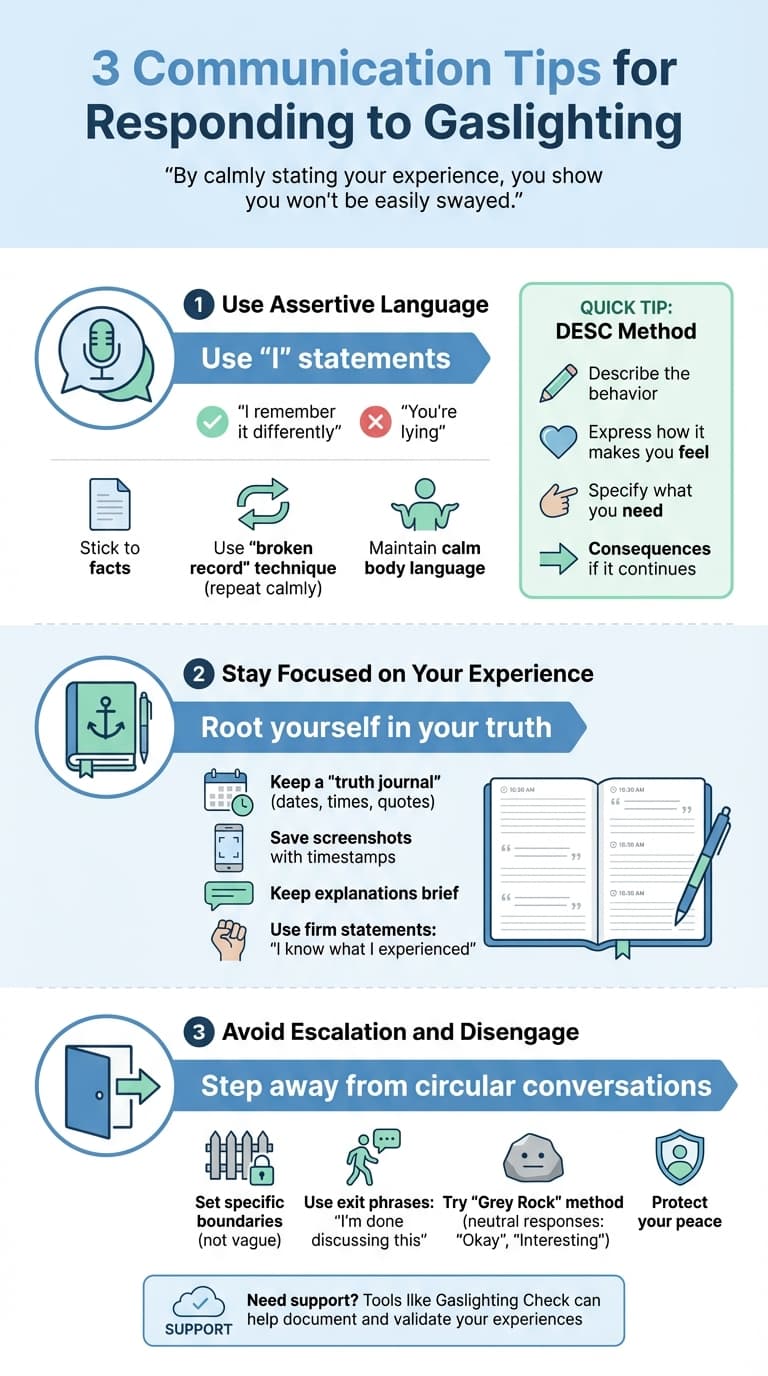
- Assertive Language: Use "I" statements like "I remember it differently" to express your perspective without escalating conflict. Stick to facts and stay calm.
- Focus on Your Experience: Keep a private journal to document conversations and avoid over-explaining. Short, firm responses like "I know what I experienced" can shut down arguments.
- Avoid Escalation: When conversations become circular or hostile, disengage. Use clear boundaries and techniques like the "Grey Rock" method to protect your peace.
For extra support, tools like Gaslighting Check can help you document manipulative behavior and validate your experiences. These steps can help you regain confidence and safeguard your emotional well-being.
::: @figure
5 Ways to Respond to Gaslighting (And Retain Your Power)
Detect Manipulation in Conversations
Use AI-powered tools to analyze text and audio for gaslighting and manipulation patterns. Gain clarity, actionable insights, and support to navigate challenging relationships.
Start Analyzing Now1. Use Assertive Language
Assertive communication strikes a balance between staying silent and becoming aggressive. It allows you to express your thoughts and feelings clearly while showing respect - for both yourself and the other person. When dealing with gaslighting, your goal is to challenge manipulative tactics while affirming your own reality.
One effective strategy is to use "I" statements that center on your personal experience. This approach helps reduce defensiveness and keeps the conversation focused on what you know to be true. For instance, instead of saying, "You're lying", try something like, "I remember our conversation differently." Patrice Le Goy, PhD, MBA, LMFT, highlights the strength of this approach:
Responding to gaslighting can be empowering because you are refusing to accept the false narrative that the other person is trying to make you believe. Responding to it is a way of reclaiming your self-respect and confidence [3].
Stick to the facts. Gaslighters often twist emotional language or exaggerations to their advantage. By communicating plainly and factually - without adding unnecessary detail - you leave them less room to distort your words. If they persist in challenging your reality, try the "broken record" technique: calmly repeat your statement or boundary without engaging in circular arguments. A phrase like, "We remember things differently, but I don’t want to argue about it", can help shut down the back-and-forth.
Your body language plays a role too. Maintain steady eye contact, sit or stand with an upright posture, and speak in a calm, even tone. If emotions start to take over, pause and take a deep breath before continuing. Psychologist Deborah Gilman points out:
By calmly stating your experience, you plant a seed of doubt in their manipulation and show you won't be easily swayed [6].
Another helpful tool is the DESC Method, which provides a structured way to respond. Here’s how it works:
- Describe the behavior factually: "When you said I never mentioned this..."
- Express how it makes you feel: "I feel confused because..."
- Specify what you need: "I need you to acknowledge our previous discussions."
- Consequences if the behavior continues: "If this continues, I'll need to document our conversations for clarity." This is especially critical when using an AI tool for workplace gaslighting to track patterns of behavior.
This method keeps the conversation grounded and focused on the behavior, not the person. By staying calm and factual, you can take control of the discussion and reinforce your perspective.
2. Stay Focused on Your Experience
To shield yourself from manipulation, root your response in your own experiences. Gaslighters thrive on creating doubt, but they can't change what you know to be true. Robin Stern, Ph.D., Co-founder of the Yale Center for Emotional Intelligence, explains it well:
As soon as you understand that it doesn't matter how right you are, the closer you will be to freedom [2].
When you anchor yourself in your truth, it becomes your strongest defense. Avoid lengthy back-and-forth arguments. Instead, focus on how you feel - if you feel disrespected or invalidated, that feeling is valid and doesn't need anyone's approval.
One powerful strategy is keeping a "truth journal." Use it to record key details of conversations, like dates, times, and important quotes. This practice not only strengthens your memory but also provides a clear record that resists distortion. Keep this journal private - whether it's password-protected on your device or stored securely in a safe spot. Save screenshots of texts and emails with timestamps too. These records aren't just personal tools; they serve as undeniable proof of your experience.
Keep your explanations brief. Over-explaining gives gaslighters more material to manipulate. Stick to short, firm statements like "I know what I experienced" or "We remember things differently." These responses shut down arguments without inviting further debate. If you catch yourself wanting to dive into a detailed defense, pause. You don't owe anyone an elaborate explanation of your reality.
And if you find your confidence wavering, step away. A short walk or even a few deep breaths can help you reconnect with the present and regain clarity.
3. Avoid Escalation and Disengage
Sometimes, the best response is no response at all. When a conversation starts going in circles or becomes hostile, it’s a clear signal to step away. If you feel your heart racing or notice your thoughts spiraling, it’s a strong indication that the interaction has turned unhealthy. Setting clear boundaries reinforces your choice to disengage.
Dr. Chivonna Childs, a psychologist at Cleveland Clinic, explains it perfectly:
A fire cannot burn if there's no fuel. They can't fight if there's no one to fight with [1].
Being specific with boundaries can make disengagement easier. Vague statements like "You never respect me" can invite further arguments, especially when you are still learning how to spot gaslighting in the heat of the moment. Instead, opt for concrete examples, such as: "When you interrupted me three times, I felt dismissed. If it happens again, I will leave." This kind of clarity eliminates confusion and puts you in control of how you respond.
Firm boundaries also allow you to exit conversations quickly when necessary. Use short, direct phrases to signal your exit. For example, you could say, "I'm done discussing this", or "I need to step away and revisit this when we can talk respectfully." You don’t need anyone’s permission to leave - enforce your boundaries. For instance, if someone keeps calling excessively, silence your phone to protect your peace [7].
Another technique to consider is the "Grey Rock" method [5]. By offering short, neutral responses like "Okay" or "Interesting", you make yourself less engaging - just like a dull, unremarkable rock. This approach denies the other person the emotional reaction they may be seeking and helps break the cycle of manipulation [4][5]. Prioritizing your emotional well-being isn’t just important - it’s essential. Protecting it is always the right choice.
Using Gaslighting Check for Support

When you're dealing with gaslighting, it can feel like your memory is playing tricks on you. That’s where a tool like Gaslighting Check steps in. This service uses real-time audio recording, text analysis, and voice analysis to identify manipulative phrases such as "You're being too sensitive" or "That never happened" [8] [11]. Instead of second-guessing yourself, you gain concrete evidence of what was actually said.
Gaslighting Check generates detailed reports that include timestamps, identified manipulation tactics and recurring patterns [8] [10]. For example, if a coworker frequently dismisses your contributions by saying, "You're imagining things", the platform analyzes this as a dismissive pattern. It can even highlight tone changes and repeated behaviors, giving you a clear, objective perspective [8] [11]. This kind of documentation can help you stay grounded when someone tries to distort your reality.
Your privacy is a priority, too. Gaslighting Check uses encrypted data storage and automatic deletion policies [8] [10], so you can document sensitive conversations without worrying about them being exposed.
For those interested in more advanced features, the Premium Plan is available at $9.99/month. It includes conversation tracking, in-depth reports, and both text and voice analysis. This makes it a cost-effective option compared to therapy, which can often exceed $100 per hour. A Free Plan is also available, offering basic text analysis [9].
Pair this tool with your communication strategies for even stronger results. After practicing assertive communication, you can upload a recording or transcript to verify any manipulative behavior. Reviewing this data helps you stay focused on your experiences without getting drawn into unnecessary arguments. If patterns of manipulation continue, you’ll have the evidence you need to confidently decide whether to disengage [8] [9]. By validating your experiences, Gaslighting Check supports the boundaries and assertiveness you've worked to establish.
Conclusion
Responding to gaslighting effectively requires setting clear boundaries, speaking assertively, and staying connected to your own sense of reality. The strategies to respond to gaslighting discussed - using "I" statements, focusing on your personal experience, and disengaging to avoid unnecessary conflict - offer practical ways to safeguard your mental health and rebuild confidence. These approaches are designed to help you trust yourself and maintain control over your narrative.
Incorporating self-care into these techniques can make a big difference. Taking short breaks, journaling, or simply pausing to breathe can help you stay grounded without feeling the need to overexplain. It's important to remember that boundaries are not about changing someone else's behavior - they're about managing how you respond to actions that cross the line.
If you're finding it hard to recognize patterns of manipulation or need external validation, tools like Gaslighting Check can be incredibly useful. This platform provides encrypted, real-time analysis to document conversations, offering objective insights to support your perspective. By prioritizing assertive and experience-driven responses, you can protect your emotional well-being and take meaningful steps toward breaking free from gaslighting.
FAQs
How can I tell gaslighting from a normal disagreement?
Gaslighting is a form of manipulation designed to make you question your perception of reality. It often involves tactics like denying facts, invalidating your feelings, or making you doubt your memory. On the other hand, a normal disagreement is simply a difference in opinion, without any intention to distort or undermine your understanding of events.
The key difference? Gaslighting erodes your confidence and sense of reality, while disagreements can usually be worked through with honest, open communication.
What should I say when I start doubting my memory?
If you find yourself questioning your memory, take a moment to calmly assert your perspective. You could say something like, "It seems we remember that differently. This is what I recall." This approach allows you to reaffirm your experience while keeping your thoughts clear and preventing unnecessary conflict. Staying confident in your perception is a crucial step in addressing gaslighting and rebuilding trust in yourself.
Is recording conversations with Gaslighting Check legal where I live?
Recording conversations using Gaslighting Check is allowed, but you need to ensure you're following your state's wiretapping laws. In 38 states and Washington, D.C., only one person involved in the conversation needs to give consent. However, 11 states - like California, Florida, and Massachusetts - require that everyone participating agrees to the recording. Always verify your local regulations to stay within the law.