16 Gaslighting Phrases and Their Hidden Meanings

16 Gaslighting Phrases and Their Hidden Meanings
Gaslighting is a manipulative tactic where someone distorts your reality to gain control, often leaving you questioning your memory, emotions, or sanity. It’s common in relationships, workplaces, and families. Recognizing gaslighting in everyday conversations through phrases like “You’re too sensitive” or “That never happened” is key to protecting yourself. These phrases deflect accountability, invalidate feelings, and create dependency on the manipulator.
Key points:
- Gaslighting undermines your confidence and trust in your perceptions.
- Common tactics include denial of events, emotional invalidation, and shifting blame.
- Responses like documenting interactions or setting boundaries can help counteract manipulation.
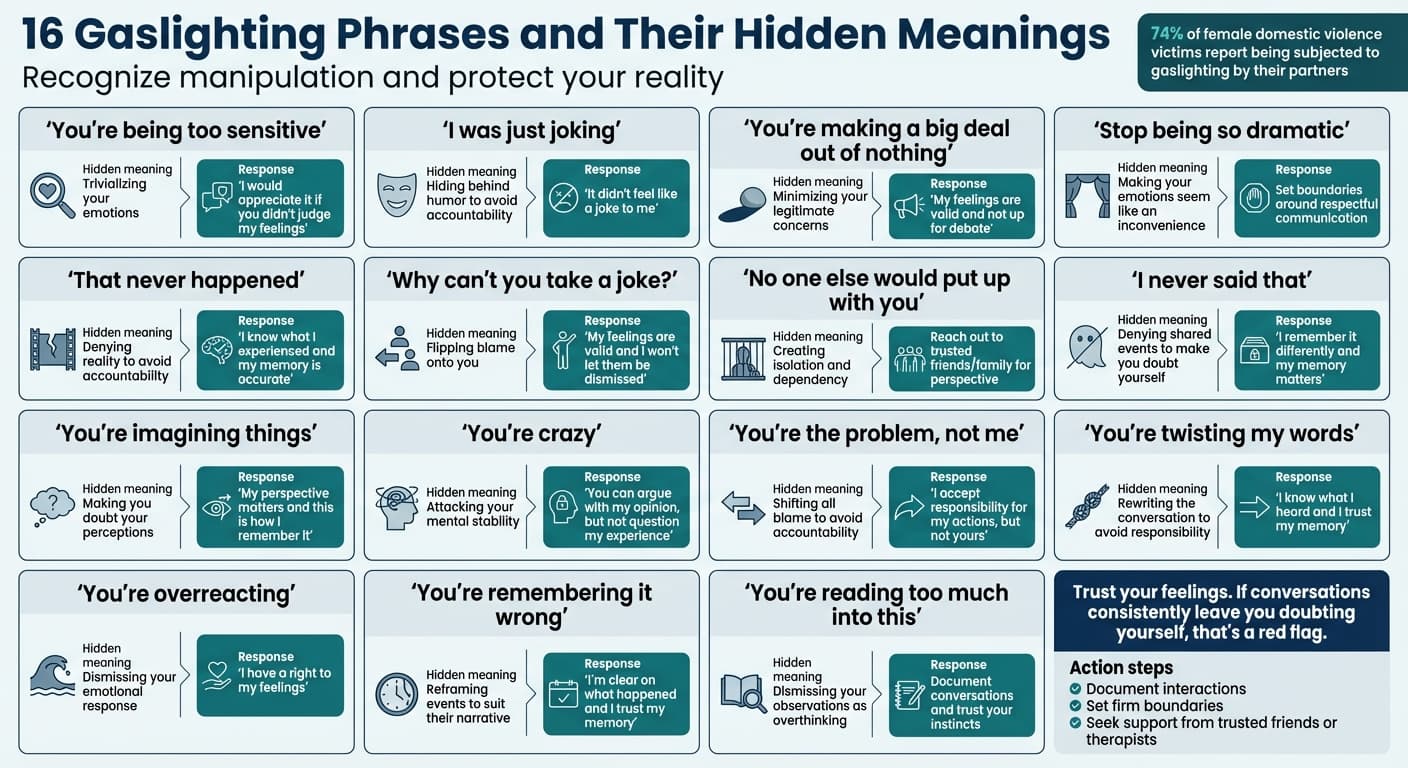
Below is a breakdown of 16 common gaslighting phrases, their hidden meanings, and how to respond effectively.
::: @figure
Recognize the phrase, but not sure what it means in your situation?
Paste a real conversation and see whether these phrases are showing up as manipulation, blame-shifting, or emotional control.
Analyze My Conversation20 Gaslighting Phrases From The Narcissist
1. You're being too sensitive.
When someone says, "You're being too sensitive", they’re using a tactic called trivializing. Instead of addressing your concerns, they shift the focus to how you’re expressing them, effectively dodging accountability. This tactic minimizes your feelings and redirects attention away from their behavior, creating a dynamic where your emotions are invalidated.
By dismissing your feelings as overblown or inappropriate, the gaslighter establishes themselves as the ultimate judge of what’s worth acknowledging. This allows them to control which emotions or reactions are deemed acceptable.
"If you're getting upset, your feelings are valid. Someone who is not gaslighting you should validate what you're saying."
– Amelia Kelley, Ph.D., therapist and author [2]
Over time, such dismissive comments can erode your confidence in your own emotions. Dr. Larissa Redziniak, a licensed clinical psychologist, explains that victims often start suppressing their feelings, hiding emotional responses, or even feeling ashamed for having them. She notes that this is a common reaction to a gaslighter’s manipulative behavior [12]. In fact, research highlights that 74% of female domestic violence victims report being subjected to gaslighting by their partners [6][4].
If you’re confronted with this phrase, it’s important to stand firm. Dr. Cortney S. Warren, a Harvard-trained psychologist, suggests responding with a clear boundary: "I would appreciate it if you didn't judge my feelings. They are mine and not up for debate" [13]. This approach reinforces the idea that your emotions are valid and not subject to someone else’s approval. Recognizing and addressing this tactic is a key step in breaking the cycle of gaslighting.
2. That never happened.
When someone outright denies an event you clearly remember, it’s more than just a disagreement. By rejecting the event entirely, they sidestep accountability and attempt to rewrite the shared reality [14]. This isn’t a case of forgetting or misunderstanding - it’s a deliberate strategy to evade responsibility and position themselves as the ultimate authority on what’s “true.” This kind of denial is a calculated move, setting the stage for further manipulation.
This tactic doesn’t just challenge your memory - it plants seeds of doubt, making you question your ability to trust your own recollection. Unlike normal disagreements, where people acknowledge that memory can be flawed and work together to clarify, gaslighting relies on absolute denial that always benefits the manipulator. As Lisa Ferentz, a Licensed Clinical Social Worker, explains:
"The victim starts questioning her instincts and relies more and more on the 'reality' that gets created and manipulated by the abuser" [10].
Over time, this constant invalidation can take a toll, leading to physical symptoms like chest tightness, headaches, and trouble sleeping.
To combat this, keep detailed records - whether through journaling, saving texts, or emails - to reinforce your own sense of reality. When addressing the gaslighter, use effective communication strategies like grounding statements that don’t depend on their agreement. Ginger Dean, a Licensed Psychotherapist, suggests phrases like:
"Whether or not you believe me doesn't change the truth of what happened. I know what I experienced/saw/heard and my memory is accurate" [7].
Psychologist Deborah Gilman highlights why this approach is effective:
"This approach disrupts the gaslighter's attempt to control the narrative. By calmly stating your experience, you plant a seed of doubt in their manipulation and show you won't be easily swayed" [15].
It’s important to remember that a gaslighter’s goal isn’t resolution - it’s about control and “winning.” Don’t validate their distorted version of events, and if the denial continues, disengage from the conversation altogether.
3. You're imagining things
The phrase "You're imagining things" is another classic example of gaslighting vs manipulation. It undermines your sense of reality, suggesting that you're paranoid or incapable of trusting your own perceptions. This can be especially harmful when you've noticed something troubling - like inconsistent behavior, broken promises, or conflicting stories.
The power of this manipulation lies in its ability to make you doubt your own experiences. As Chivonna Childs, PhD, a psychologist, explains:
"Gaslighting is a form of emotional manipulation to make you feel as if your feelings aren't valid, or that what you think is happening isn't really happening." [3]
This tactic often involves outright dismissals, such as "You're making that up" or "You're being paranoid." These statements are designed to deflect responsibility and keep control of the situation firmly in the hands of the manipulator.
Pay attention to how your body reacts in these moments. Physical cues - like a tight chest, headaches, or a sinking feeling in your stomach - can be signs that your boundaries are being crossed. Robin Stern, PhD, Co-founder of the Yale Center for Emotional Intelligence, explains the psychological toll:
"When a loved one undermines your sense of reality, you become trapped in this never-never land. You feel crazy because there isn't anything concrete to point to as 'bad' so you end up pointing to, and blaming, yourself." [8]
To protect yourself, consider documenting your observations in detail. This can help you stay grounded in your reality without falling into the trap of trying to prove your perspective. Reviewing a gaslighting triggers checklist can also help you identify these patterns early. Grounding statements can also be helpful. For example, you might say, "This is how I remember it, and my perspective matters." Licensed Psychotherapist Ginger Dean offers another effective approach:
"My feelings are valid, and to be clear, I am not asking you to validate them." [7]
If the dismissals persist and your experiences are continually invalidated, it might be best to step away from the conversation altogether. In the next section, we’ll look at another gaslighting tactic that works to undermine your experiences further.
4. You're overreacting.
Hearing "You're overreacting" can feel like a complete dismissal of your emotions. This phrase is often used as a gaslighting tactic to shift attention away from the actual issue and onto your reaction instead. Dr. Cortney S. Warren, PhD, a Harvard-trained psychologist, explains the manipulation behind this:
"By accusing you of being dramatic, the gaslighter is attempting to dismiss your concerns as irrational and unfounded." [13]
This tactic often goes hand in hand with tone policing. Instead of addressing the problem at hand, the focus shifts to how you express your feelings [2]. By labeling you as "hysterical" or "dramatic" (common gaslighting examples), the gaslighter positions themselves as calm and rational while portraying you as unstable [11]. This creates a power imbalance, making it harder for you to trust your own perceptions.
The real harm lies in how this phrase can make you second-guess yourself. Over time, you might start questioning whether your feelings are valid at all, leading to self-doubt about your emotional responses.
If someone uses this phrase, you can respond with statements like, "Whether or not you agree, this is how I feel right now" [13], or "I have a right to my feelings. Just because it didn’t hurt you doesn’t mean it didn’t hurt me" [5]. And if the conversation feels overwhelming, grounding techniques or deep breathing can help you regain focus [16].
Up next, we’ll look at how humor can be used to mask harmful behavior.
5. I was just joking.
When someone says, "I was just joking" after making a hurtful comment, it’s often a way to dodge accountability. By framing the remark as humor, they can hide behind the excuse of "just kidding", all while maintaining control of the situation and dismissing your feelings [17].
Dr. Cortney S. Warren, PhD, a Harvard-trained psychologist, explains this dynamic perfectly:
"That comment might have been funny to you, but it hurt my feelings." [13]
The manipulation becomes even clearer when the conversation shifts from their words to your reaction. Instead of addressing what was said, they might accuse you of being "too sensitive." This tactic minimizes your emotions, making you doubt your feelings and, over time, even your own judgment [18].
Here’s the difference: genuine humor brings people together, while manipulative jokes target your insecurities. A key sign of manipulation is if the humor feels one-sided - if you can’t joke back without facing backlash, it’s likely not harmless banter but a way to undermine you.
Rather than debating their intent, focus on the effect of their words. You can say something like, "It didn’t feel like a joke to me, and I’d prefer respectful communication." If this behavior continues, consider keeping track of these instances to identify recurring patterns and root causes.
This subtle tactic of shifting blame often lays the groundwork for more serious manipulations down the road.
6. Why can't you take a joke?
This tactic takes the manipulation discussed earlier and flips the blame onto you. After delivering a hurtful comment disguised as humor, the gaslighter shifts gears, attacking your reaction instead of taking accountability. They frame your emotional response as a flaw, implying that you're too sensitive or lack a sense of humor.
As the MEND Project aptly states: "A joke is not a joke when it hurts" [19]. Rather than owning up to their actions, the gaslighter dismisses your feelings, making it seem like the problem lies with you.
This behavior can be especially harmful in social settings. By labeling you as overly dramatic or humorless in front of others, the gaslighter isolates you and strengthens their control. You end up defending your reaction instead of addressing the hurtful comment itself. Over time, this can leave you feeling emotionally drained. To avoid conflict, you might start laughing along, even when the remarks sting. This pattern chips away at your confidence, leaving you quieter, more doubtful, and replaying painful interactions in your mind.
When faced with this manipulation, try to reclaim your perspective by saying something like, "My feelings are valid, and I won’t let them be dismissed." Your emotions don’t need to be explained or justified. Knowing how to respond to gaslighting with firm boundaries is essential for protecting your peace. If someone’s jokes repeatedly make you feel small or targeted, listen to that instinct - this isn’t humor; it’s a form of control.
7. You're crazy.
Calling someone "crazy" is a harsh gaslighting tactic designed to attack their character and question their mental stability. Dr. Danielle Hairston, Assistant Professor of Psychiatry at Howard University, sheds light on this behavior:
"This is a common phrase that gaslighters use to avoid taking responsibility or being accountable for their actions" [2].
By labeling you as mentally unstable, a gaslighter shifts focus away from their own actions, undermines your credibility, and fosters dependency on their distorted version of events. Author Cherie White highlights the societal repercussions of such labels:
"The reason is that society believes those with mental illness the least, discredits them the most, and treats them the worst" [22].
Gaslighters often escalate this approach by invoking what psychotherapist Stephanie Sarkis refers to as "invisible armies." She explains:
"I call them invisible armies. They'll use this as a backup of people who aren't there to solidify their point" [2].
This means they'll claim that others - friends, family, or coworkers - also think you're "crazy", isolating you further from your support system. This tactic is not just manipulative; it can have devastating emotional consequences.
Take Catherine’s story from July 2023 as an example. Throughout her five-year marriage, her husband repeatedly dismissed her concerns. When she questioned his late arrivals, he accused her of being "paranoid and dramatic." Even after clear evidence of his affair came to light, he doubled down, insisting she "obviously didn’t listen", leaving her doubting her own judgment [21].
When confronted with this kind of manipulation, it’s important to avoid falling into the trap of proving your sanity. Psychotherapist Diane Young offers a powerful perspective:
"You can argue with my opinion, but not question my experience. That's mine and that is my reality" [21].
To protect yourself, document interactions, and seek support from a trusted friend, therapist, or other third party who can help you navigate the situation and deal with gaslighting in personal relationships with clarity and confidence.
8. You're remembering it wrong.
When someone says, "You're remembering it wrong", they’re doing more than just questioning details - they’re actively reframing events to suit their narrative. This tactic doesn’t deny the event outright but instead targets your memory of it, subtly undermining your confidence in your own recollection.
By casting doubt on your memory, the gaslighter chips away at your self-trust. Over time, this can make you question your own perceptions so deeply that you start relying on them to define reality. This kind of manipulation isn’t just about control - it’s about creating a dependency where you feel like you can’t trust your own mind. And once you’re in that space, it’s easier for them to escalate to outright denial or more aggressive tactics.
What makes this approach so sneaky is how it’s often framed as a misunderstanding. But in reality, the gaslighter always shifts the blame onto you. They might even employ DARVO - Deny, Attack, and Reverse Victim and Offender - to flip the script entirely. In this tactic, they deny your memory, attack your credibility, and then claim they’re the real victim of your "false" accusations [18]. Licensed Psychotherapist Ginger Dean suggests a firm yet empowering response:
"Whether or not you believe me doesn't change the truth of what happened. I know what I experienced/saw/heard and my memory is accurate" [7].
To counter these manipulations, documentation becomes your strongest ally. You can also use tools for detecting gaslighting to help identify these patterns. Keep a private journal, send emails to yourself, or take screenshots - methods that create a record you can rely on to validate your memory. When confronted, use grounding phrases like, "I’m clear on what happened", or, "I hear what you’re saying, but I remember it differently and I trust my memory" [25]. If the conversation spirals into an endless back-and-forth, recognize it for what it is - a power play - and step away before it drains your energy.
9. You're making a big deal out of nothing.
This phrase undermines your concerns by dismissing them as unimportant and labeling your emotions as irrational. When someone calls your legitimate worry "nothing", they sidestep accountability and leave you questioning yourself. Recognizing this tactic is crucial to regaining control over your perspective.
Trauma-informed therapist Amelia Kelley, Ph.D., explains the intent behind this behavior:
"The intention is to make someone feel like natural human experience and needs are over the top, unhealthy, not normal." [2]
This form of manipulation can appear in many situations. For instance, in workplaces, managers might brush off valid complaints as trivial. Similarly, in medical settings, doctors might downplay a patient’s symptoms - a phenomenon referred to as medical gaslighting [20].
Robin Stern, Ph.D., Co-founder of the Yale Center for Emotional Intelligence, highlights the purpose of this tactic:
"The idea is to turn the attention away from their bad behavior by making it about you doing something wrong." [24]
If you encounter this phrase repeatedly, resist the urge to defend your emotions. Licensed Psychotherapist Ginger Dean suggests a firm yet empowering response:
"My feelings are valid, and to be clear, I am not asking you to validate them." [7]
10. No one else would put up with you
This phrase is a classic gaslighting tactic designed to undermine your self-esteem and create a sense of isolation. By suggesting that no one else would tolerate you, the gaslighter plays on insecurities about being flawed or unworthy. It’s not an honest observation - it’s a calculated attempt to make you feel dependent.
Robin Stern, Ph.D., a licensed psychoanalyst and author, highlights the psychological manipulation behind this approach:
"One of our greatest fears is that we are broken or unloveable and a gaslighter will play off that." [8]
The goal here is to make the gaslighter appear as your sole source of support. By claiming that others find you intolerable, they isolate you from friends and family who might otherwise provide a reality check. Relationship expert Zoë O'Connor emphasizes how this tactic fosters a sense of having no alternatives, which deepens dependency [9].
This manipulation also serves another purpose: it shifts the focus away from the gaslighter's behavior. Instead of addressing their own actions, they position themselves as a patient, saint-like figure who graciously "puts up" with your supposed flaws. As Stern explains, even their so-called "forgiveness" is a tool to remind you how lucky you are to have them [8].
Breaking free from this isolating tactic starts with reaching out to someone you trust. A friend or family member can provide the perspective needed to counteract this manipulation. Psychotherapist Stephanie Sarkis, Ph.D., also advises documenting interactions to separate truth from the gaslighter’s distortions [2]. This can help you reclaim a sense of reality and recognize the toxic relationship dynamics at play.
11. You're the problem, not me.
This phrase shifts blame onto you, sidestepping any accountability on the part of the speaker. It's not constructive; it's a tactic designed to avoid self-reflection by painting you as the villain. This behavior aligns with the DARVO pattern - Deny, Attack, and Reverse Victim and Offender. As Robin Stern, PhD, Co-founder of the Yale Center for Emotional Intelligence, explains:
"The idea is to turn the attention away from their bad behavior by making it about you doing something wrong." [8]
Psychotherapist Stephanie Sarkis, PhD, elaborates on this tactic, noting how it serves to distract from the gaslighter's own actions:
"By accusing you, the gaslighter has bought themselves time... The goal is to keep you so busy defending yourself and being emotionally distraught that you don't pay attention to the gaslighter's own behavior." [8]
Hearing "you're the problem" repeatedly can chip away at your self-worth. Over time, it leads to self-doubt, making you question whether you're genuinely difficult or flawed. This erosion of confidence can deepen emotional dependence on the person using the tactic, as you might start seeking their approval to feel validated.
When confronted with this phrase, avoid falling into the trap of defending yourself or arguing. Instead, set firm boundaries with responses like, "I accept responsibility for my actions, but not yours." [13] If the conversation continues, disengage and document the interaction in a private journal. You can also use real-time gaslighting detection tools to help identify these patterns as they happen. Keeping a record helps you maintain perspective and resist attempts to rewrite events. Establishing these boundaries can protect your clarity and protect your mental health from the manipulative cycle.
12. You're reading too much into this
The phrase "You're reading too much into this" is a hallmark of gaslighting. It dismisses your concerns as overthinking, subtly suggesting that the issues you perceive don’t exist. In gaslighting, this tactic is known as "countering" - where the manipulator claims to know your thoughts better than you do, leaving you questioning your own reality [2]. When someone uses this phrase, they minimize your concerns and derail any constructive conversation about genuine problems, such as suspicious behaviors or patterns [23].
This phrase often weaponizes logic. By branding your observations as "irrational" or "paranoid", the gaslighter shifts focus away from their actions, dodging accountability while invalidating your perspective [26][28]. Dr. Danielle Hairston, assistant professor of psychiatry, explains the intent behind this tactic:
"It's trying to distract you or deflect guilt or accountability and responsibility. Sometimes, it's even harsher, like someone is trying to belittle you or damage or chip away at your self-esteem." [2]
Hearing this repeatedly can take a toll. Over time, it undermines your confidence in your own instincts, leading to self-doubt and cognitive dissonance as you wrestle with the mismatch between your observations and the gaslighter’s denials [6][27]. Dr. Amanda L. Chase Avera, assistant professor of psychology, highlights the long-term impact:
"A person who is subjected to repeated attempts of gaslighting can doubt their thoughts, memories, and behaviors which in turn can cause them to become dependent on the abuser and emotionally frazzled." [6]
To protect your mental clarity, it’s essential to recognize these patterns early. Document conversations with specific details to maintain perspective, and seek validation from trusted friends or a therapist to counteract self-doubt. If the manipulation continues, consider using the Grey Rock Method - keeping your responses brief and emotionless - to minimize the gaslighter’s control [23].
13. Stop being so dramatic.
When someone says, "stop being so dramatic", they’re brushing off your emotional reaction as if it’s over-the-top or unwarranted. This phrase is a way of downplaying your feelings, making it seem like you’re the problem, while positioning the person saying it as the only rational one in the conversation. Essentially, it’s a way to make you feel like your emotions are an inconvenience. This tactic is often used when detecting emotional shifts in conversations that favor the manipulator.
Dr. Robin Stern, Co-founder of the Yale Center for Emotional Intelligence, sheds light on this manipulative tactic:
"The idea is to turn the attention away from their bad behavior by making it about you doing something wrong." [8]
In other words, this phrase shifts the spotlight away from their actions and onto your reaction. When this happens repeatedly, it can cause you to second-guess your feelings, leaving you hesitant to express them for fear of being labeled as "too dramatic" or "too sensitive."
True, healthy communication doesn’t dismiss emotions or categorize them as excessive. Gaslighting phrases like this one are designed to deflect blame and make you question the validity of your emotional experience, rather than addressing the actual issue at hand.
14. I never said that.
When someone gaslights you by claiming, "I never said that", they deny a shared event outright. This tactic isn't just about avoiding accountability - it forces you to question your own memory, leaving you second-guessing what actually happened [1]. Over time, this repeated denial chips away at your trust in your own recollections, making you feel uncertain and anxious.
This approach is part of a larger pattern of manipulative behavior where the gaslighter denies, attacks, and reverses roles. They position themselves as the "logical" one while casting you as unreliable. The result? A steady erosion of your confidence and a growing sense of confusion [23][14].
Psychologist Deborah Gilman suggests countering this by calmly asserting your perspective. For example, you might say, "I remember it differently, and my memory matters to me" [9]. If the gaslighter continues to dismiss you, set a boundary by adding, "We clearly remember this differently, and I’m not comfortable continuing this conversation if my experience is disregarded" [9].
"This approach disrupts the gaslighter's attempt to control the narrative." [15]
Another helpful strategy is keeping a private journal or using a secure notes app to document important conversations right after they happen. This can act as a reality check when your memory is questioned. You can also explore apps and tactics to stop gaslighting for more digital tools to protect your reality. Recognizing how this tactic works also sheds light on the broader ways gaslighting distorts your sense of reality.
15. You're twisting my words
When someone says, "You're twisting my words", it’s often a way to dodge responsibility and shift the blame onto you. By accusing you of misinterpreting them, they redirect attention from their behavior to your understanding, leaving you second-guessing your own memory.
The real aim here? To rewrite the conversation entirely. By insisting you’ve distorted their meaning, they erase the original context to fit their version of events. This tactic not only avoids accountability but also reframes the situation, often leaving you apologizing for a conflict they initiated.
"The goal is to keep you so busy defending yourself and being emotionally distraught that you don't pay attention to the gaslighter's own behavior." - Stephanie Sarkis, PhD, Psychotherapist [8]
How do you handle this? If you’re confident in your memory of the exchange, trust yourself. Respond with something like, "I know what I heard, and I trust my memory", or, "Even if your intent was different, the impact still hurt." If they keep pushing, you can calmly assert, "Our memories don’t align, and continuing this conversation isn’t productive."
It’s also helpful to document conversations right after they happen. This not only gives you a clear record but also serves as a reality check when your recollection is questioned. Recognizing this behavior and addressing it directly can help you maintain your sense of reality and protect your emotional well-being. Practicing emotional validation is a key step in this recovery process.
16. You can't take criticism.
When someone says, "You can't take criticism", they often shift the blame onto you, diverting attention away from their behavior or words. This phrase is a way to make the issue about your reaction rather than examining whether their comment was fair or constructive. Instead of reflecting on how they delivered their feedback, they label your response as the problem.
True constructive criticism is very different from gaslighting. Real feedback focuses on specific behaviors, comes from a place of empathy, and encourages collaboration. On the other hand, gaslighting disguised as criticism attacks your character, invalidates your emotions, and shuts down meaningful dialogue. When someone uses this phrase, they may be employing a psychological tactic known as DARVO (Deny, Attack, and Reverse Victim and Offender) [9]. Recognizing this tactic is a key step in identifying and addressing gaslighting in everyday situations.
"The idea is to turn the attention away from their bad behavior by making it about you doing something wrong." - Robin Stern, PhD, Co-founder of the Yale Center for Emotional Intelligence [8]
How can you respond? Start by affirming your perspective with statements like, "My feelings are valid, and I have a right to express them." If the conversation becomes hostile, you might say, "I won't continue this discussion if my feelings are dismissed." Another option is to redirect the focus by saying, "I’m not concerned with who’s right; your tone is aggressive" [8]. These responses help bring the conversation back to the real issue - their delivery - rather than letting it spiral into a critique of your character.
After setting boundaries, it's important to protect yourself by documenting interactions to identify patterns over time. If someone repeatedly uses this phrase to avoid accountability or justify unkind behavior, it’s a strong indicator of manipulation. Trust your instincts, establish firm boundaries around respectful communication, and remind yourself that your emotional responses are valid - they are not a weakness.
How to Spot Gaslighting in Your Conversations
Spotting gaslighting in your interactions is crucial for protecting your sense of reality. Gaslighting isn't a one-off misunderstanding; it's a deliberate and repetitive pattern aimed at undermining your memory, emotions, and perception of events. Recognizing these patterns as they happen is the first step toward safeguarding yourself.
Start by noticing repeated denial of facts. If someone frequently says things like "That never happened" or "I never said that", even when you clearly remember otherwise, it’s a red flag. Similarly, watch for emotional invalidation - statements like "You're overreacting" or "You're too sensitive" that dismiss your feelings outright. These aren't random comments; they're calculated strategies to deflect responsibility and make you doubt yourself.
Another warning sign is shifting blame. If someone consistently turns the tables by saying, "I only acted that way because you..." they're sidestepping accountability and pinning the problem on you. Be alert to triangulation, where they claim that "everyone else" agrees with them or suggest that "no one else would tolerate you." This tactic isolates you and chips away at your confidence, making it harder to trust your own judgment.
Here’s how Robin Stern, Ph.D., Co-founder of the Yale Center for Emotional Intelligence, describes the impact:
"When a loved one undermines your sense of reality, you become trapped in this never-never land. You feel crazy because there isn't anything concrete to point to as 'bad' so you end up pointing to, and blaming, yourself."
- Robin Stern, Ph.D. [8]
To counteract gaslighting, keep a record of events - note dates, times, and details to create an objective account when facts are denied. If you find yourself frequently apologizing or questioning your sanity around someone, trust that as a sign of manipulation. Tools like Gaslighting Check can even analyze texts or recordings for patterns like denial, trivialization, or blame-shifting, offering clarity when your perceptions feel clouded.
Instead of focusing on proving who's right, pay attention to how you feel. If someone avoids engaging, uses silence as a weapon, or abruptly changes the subject, they may be stonewalling - another common gaslighting tactic. Set firm boundaries by stating something like, "My feelings are valid, and dismissing them doesn’t change my experience." Healthy disagreements involve mutual acknowledgment of perspectives, but in gaslighting, the manipulator insists you’re always wrong to maintain control. Recognizing these patterns is key to preserving your emotional well-being.
Conclusion
Understanding gaslighting phrases isn't about winning arguments - it's about safeguarding your mental well-being and holding onto your sense of reality. When phrases like "You're too sensitive" or "That never happened" start to make sense in the context of manipulation, it becomes clear that the problem lies with the manipulator's behavior, not your reactions [14][8]. This awareness can help you avoid reaching the point where your self-confidence is eroded, leaving you dependent on the abuser to define what's "true" [8].
Gaslighting is a common yet damaging form of manipulation that impacts countless individuals in relationships, workplaces, and families. Meaghan Rice, PsyD., LPC, puts it succinctly:
"Gaslighting is the use of a patterned, repetitive set of manipulation tactics that makes someone question reality" [29].
Recognizing these patterns is the first step toward protecting yourself. Whether it's stepping away from toxic conversations, seeking professional guidance, or crafting a plan to exit harmful situations, taking action is key.
Once you've identified these manipulative behaviors, the next step is to reclaim your narrative. Trust how you feel. If a conversation consistently leaves you doubting yourself, that's a red flag. Robin Stern, PhD, Co-founder of the Yale Center for Emotional Intelligence, advises:
"I tell people to focus on how they feel during a conversation rather than what is 'right'" [8].
Your emotions are valid - they're not signs of weakness but indicators of what's happening around you.
Practical tools can also help you counter manipulation. For example, Gaslighting Check offers clarity when your perceptions feel muddled. By analyzing text and voice conversations for patterns like denial, blame-shifting, and trivialization, it provides objective insights into the dynamics at play. Features such as detailed reports, conversation history tracking, and encrypted privacy protections give you a reliable record when facts are distorted or denied.
You deserve relationships that honor your reality. Recognizing gaslighting phrases is the first step toward rebuilding your confidence and fostering connections grounded in respect rather than control. Prioritizing your mental and emotional safety in every interaction isn't just helpful - it’s non-negotiable.
FAQs
How can I recognize if someone is gaslighting me?
Gaslighting is a form of manipulation where someone subtly makes you question your own perceptions, emotions, or memories. It often shows up in phrases like "You're overreacting," "You're too sensitive," or "That never happened." These remarks are meant to dismiss your feelings and create self-doubt.
Gaslighters might also deny events, distort facts, or suggest you're imagining things. Over time, this behavior can leave you feeling uncertain, insecure, or even guilty. If you often find yourself second-guessing your emotions or questioning your memories, it could be a red flag. Trust your gut and consider reaching out for support to validate your experiences and regain confidence.
How can I effectively respond to gaslighting?
Responding to gaslighting starts with calmly affirming your perception of reality and clearly setting boundaries. For instance, you might say something like, “I remember it differently. This is how I recall it,” to assert your perspective without escalating the situation. This kind of response can interrupt the gaslighter’s attempt to distort the narrative.
Simple, confident statements such as “That’s not what happened” or “I know what I experienced” can also help ground you in your reality and minimize confusion. If the gaslighting continues or becomes damaging, reaching out to a mental health professional or using tools designed to identify emotional manipulation can be incredibly helpful. Protecting your mental health means trusting your instincts, maintaining firm boundaries, and seeking support when needed.
What are the long-term effects of gaslighting on mental health?
Gaslighting can have profound effects on mental health, often leaving lasting scars. Over time, it can lead to emotional trauma, persistent self-doubt, and challenges in trusting others. Many who experience gaslighting also grapple with anxiety, depression, and a weakened sense of self-worth.
The harm lies in how gaslighting erodes a person’s confidence in their own perceptions and memories, making them question their reality. Identifying and confronting gaslighting is a critical step toward healing and regaining emotional strength.