
Gaslighting's Impact on Mental Health: Study Insights
Gaslighting is a harmful manipulation tactic that distorts your sense of reality, often leaving long-term mental health effects. It’s commonly used in relationships built on trust - whether personal, professional, or medical - and can lead to anxiety, depression, and even PTSD. Studies show:
- 85.7% of abuse survivors were called "crazy" by their partners.
- Gaslighting correlates with higher depression levels (r = .41) and PTSD symptoms (rs = 0.48).
- Victims often experience self-doubt, chronic stress, and a loss of confidence in their perceptions.
Key signs in everyday conversations include being told you’re overreacting, having your emotions dismissed, or being blamed for events you know occurred differently. Recovery involves recognizing manipulation, setting boundaries, and seeking support from trusted individuals or professionals. Tools like Gaslighting Check can help you identify patterns of abuse and regain control.
::: @figure
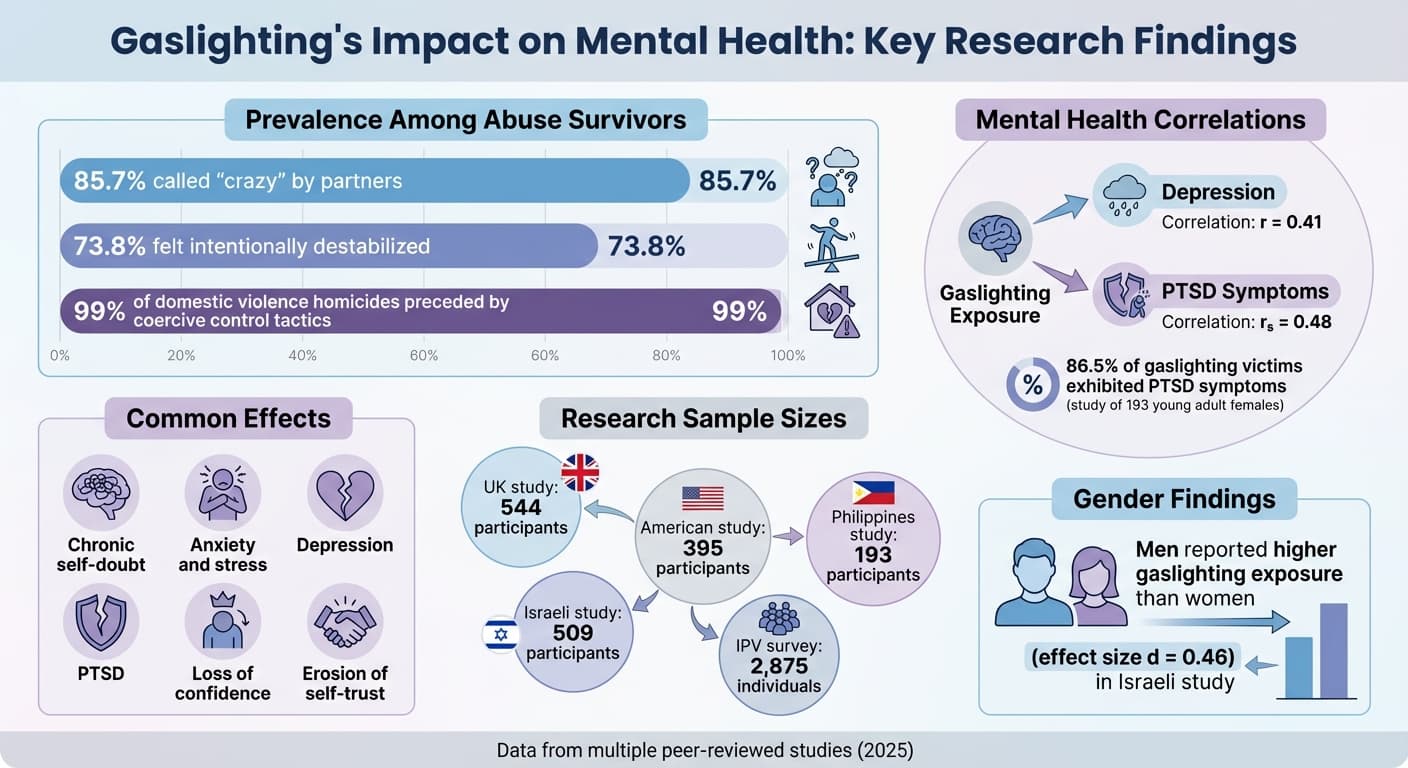
Research Findings on Gaslighting's Psychological Effects
Stress and Anxiety as Main Outcomes
Recent research highlights the profound psychological toll gaslighting takes on mental health. A 2025 study conducted in the United Kingdom with 544 participants quantified these effects, while additional studies involving 509 Israeli and 395 American participants found that gaslighting exposure is uniquely linked to higher depression levels and reduced relationship quality - even when other forms of intimate partner violence are considered [4] [5].
One of the most insidious aspects of gaslighting is how difficult it is for victims to recognize its role in their stress. Unlike overt psychological abuse, such as verbal aggression or threats, gaslighting operates subtly, leaving victims in a constant state of unease without a clear understanding of its source [4]. This often leads to chronic self-doubt and anxiety, with the harm extending beyond mood disturbances to disrupt an individual’s core sense of self.
Effects on Self-Esteem and Emotional Health
Gaslighting deeply undermines a person’s trust in their own judgment. Research has shown that it specifically targets what experts refer to as "knowing abilities" - the confidence in one’s perceptions and understanding of reality [4] [6]. The Journal of Social and Personal Relationships captures this process vividly:
"Individuals who experience gaslighting may... start feeling confused and surreal, that reality is neither clear nor logical, and that they are losing their sense of self and independence." [4]
Using tools like the Gaslighting Relationship Exposure Inventory (GREI), studies have established strong connections between gaslighting and psychological abuse victimization. Interestingly, findings from an Israeli community sample revealed that men reported higher levels of gaslighting exposure than women (effect size d = 0.46), challenging prevailing assumptions about who is most affected by this form of manipulation [4]. The erosion of self-trust caused by gaslighting leaves victims more susceptible to traumatic stress.
Connection to Trauma and PTSD
The damage gaslighting inflicts on self-esteem significantly heightens the risk of trauma. A 2025 study published in the Journal of Interdisciplinary Perspectives examined 193 young adult females in the Philippines using tools like the PTSD Checklist for DSM-5. The study revealed that 86.5% of participants exposed to gaslighting exhibited symptoms of PTSD [7]. Key tactics such as reality manipulation and dominance assertion were identified as drivers of these severe psychological effects.
There is also a moderate positive correlation (rs = 0.48) between exposure to gaslighting and PTSD symptoms [7]. This connection is illuminated by Betrayal Trauma Theory, which explains how victims, relying on their abuser for emotional or physical needs, may suppress awareness of the abuse. This creates cognitive entanglements that mimic trauma responses. In some cases, survivors even internalize the abuser's perspective, engaging in "self-gaslighting" by doubting their own reality long after the abusive relationship has ended [7].
The devastating impact of gaslighting is echoed in survivor testimonies. As noted in an Australian Parliamentary Inquiry:
"Victim-survivors often describe coercive control as 'the worst form of abuse they experience and can have more immediate and ongoing impacts than physical forms of violence.'" [8]
These findings, drawn from populations in the UK, Israel, the United States, and the Philippines, underscore the extensive mental health consequences of gaslighting across diverse cultures and demographics.
Detect Manipulation in Conversations
Use AI-powered tools to analyze text and audio for gaslighting and manipulation patterns. Gain clarity, actionable insights, and support to navigate challenging relationships.
Start Analyzing NowHow to Recognize and Stop Gaslighting
Recognizing Gaslighting Tactics
Gaslighting tends to follow a four-stage pattern: subtle tests, escalating false narratives, reinforcement through insincere apologies or repeated lies, and ultimately, control. Common tactics include reality distortion (denying events ever happened), emotional invalidation (dismissing your feelings as "overreacting"), blame-shifting (making you feel responsible for their actions), and using circular arguments to wear you down.
Dr. Chivonna Childs describes gaslighting as "emotional manipulation that makes you doubt your feelings and perceptions" [1]. Pay attention if you often second-guess yourself, feel anxious around certain people, or find yourself apologizing for things you didn’t do. Recognizing these signs early is key because repeated lies, over time, can start to feel like the truth.
Once you identify these behaviors, seeking validation outside the relationship becomes critical.
Getting Support from Others
Breaking free from gaslighting often requires an outside perspective. Keeping a journal of events - with dates, times, and key details - can help you document what’s happening and counter the distorted reality being imposed on you. Sharing these records with trusted friends, family, or a therapist can provide clarity and reassurance that your concerns are valid.
Dr. Childs highlights the importance of addressing the behavior directly:
"Using expert tactics to respond to gaslighting helps set boundaries and change the power dynamic. It puts the other person on notice that you will no longer accept this type of treatment" [1].
Setting boundaries is crucial. Communicate effectively by calmly stating the facts, such as, "I remember it differently, and I trust my memory", and be prepared to step away from conversations that turn manipulative. Therapists who specialize in emotional abuse can help you process the experience and rebuild your confidence using proven methods.
In addition to personal documentation, technology now offers tools to help identify manipulation more objectively.
Using Gaslighting Check to Detect Manipulation

Technology has stepped in to support those dealing with gaslighting, offering tools that analyze conversations for signs of manipulation. As gaslighting chips away at self-trust, platforms like Gaslighting Check use AI-powered analysis to identify patterns of emotional invalidation, blame-shifting, and reality distortion. This tool works with both text and voice analysis, examining tone, pitch, and speech patterns to catch subtleties that might go unnoticed in written exchanges.
Gaslighting Check also tracks conversation history, mapping how often manipulative tactics occur and how they escalate over time. Tair Tager-Shafrir from The Max Stern Yezreel Valley College underscores the challenge victims face:
"One of the central issues with gaslighting is the difficulty victims face in identifying and recognizing it as a form of abuse. The fact that it's challenging for the victim to define their experience as abusive makes it even more painful and damaging" [9].
The Gaslight Effect: Gaslighting, Anxiety, & Self-Trust with Dr. Robin Stern | Dealing With Feeling
Recovering from Gaslighting
Experiencing prolonged stress and self-doubt due to gaslighting can leave deep emotional scars. The path to recovery centers on rebuilding self-trust and emotional strength.
Rebuilding Confidence and Self-Worth
Gaslighting shakes your ability to trust your own thoughts and memories. A key part of healing is recognizing the experience for what it was - manipulation. Reframing your internal dialogue from "I'm losing it" to "I was manipulated" is a critical step in reclaiming your identity.
Using journaling techniques to track progress can be a powerful tool during this process. It allows you to reconnect with your own perceptions and separate them from the distortions created by the manipulator. This record can serve as a grounding force, helping you counteract confusion and self-doubt.
It's also important to practice self-compassion. Healing isn't a straight line - there will be strong days and more challenging ones. Therapeutic methods like EMDR (Eye Movement Desensitization and Reprocessing), Emotionally Focused Therapy (EFT), and Accelerated Resolution Therapy (ART) can help process trauma and rebuild trust in yourself.
As you start to trust your inner voice again, the next step is establishing firm boundaries.
Setting Healthy Boundaries
Boundaries are essential for protecting your emotional health and shifting control away from the manipulator. The goal isn't to change their behavior but to define what you will and will not tolerate. Use "I" statements to express your feelings about specific actions. For example, instead of saying, "You're invasive", try, "When you read my messages without asking, I felt disrespected."
Decide on clear consequences and stick to them. For instance, you might say, "If you dismiss my feelings again, I will end the conversation." Calmly disengaging from manipulative arguments with phrases like "We remember this differently" can also help. Additionally, set digital boundaries by restricting access to your phone, social media, and location sharing. If you consider recording interactions, check your state’s consent laws first.
Once you've established these limits, seeking professional support can further strengthen your recovery.
Getting Professional Help
Therapeutic support is crucial for addressing symptoms like anxiety, depression, or PTSD. Breaking the isolation by reaching out to trusted friends, family, or a therapist can provide validation and help you process what you've been through. Consider scheduling a consultation to explore the best therapeutic approach for your needs.
As Stefanie Kuhn, LMFT, explains:
"Healing from gaslighting is possible. But it requires time, courage, and support. Recovery means learning to trust your inner voice again, to believe your own memories, and to stand firmly in your reality." [10]
Conclusion
Recent studies have identified gaslighting as a specific and harmful form of psychological abuse with serious mental health effects. Research highlights its strong connection to increased levels of depression, anxiety, and diminished relationship satisfaction. This form of manipulation preys on trust, systematically eroding a person’s sense of reality and self-confidence [3][9].
The numbers are deeply unsettling. In a survey of 2,875 individuals who experienced intimate partner violence, 85.7% reported being called "crazy" by their partner, 73.8% felt intentionally destabilized, and a New South Wales study revealed that 99% of domestic violence homicides were preceded by coercive control tactics [2].
Understanding gaslighting is a critical first step toward breaking its hold. Tair Tager-Shafrir, a researcher at The Max Stern Yezreel Valley College, emphasizes the importance of awareness:
"The fact that it's challenging for the victim to define their experience as abusive makes it even more painful and damaging. We believe it's crucial for people to understand and recognize gaslighting so they can identify it in their own experiences and seek help when needed" [9].
Tools like the GREI and Gaslighting Check are empowering individuals to detect manipulation in real time, offering an objective way to identify these harmful patterns. Recognizing such behaviors is a key step toward intervention and recovery.
Recovery is possible, even after the damage caused by gaslighting. Rebuilding trust in oneself often starts with reaching out to supportive friends, family, or mental health professionals. Keeping detailed records of events, setting clear boundaries, and working toward financial independence can also help counter the effects of manipulation.
Gaslighting’s impact is real, but it’s important to remember that it’s not your fault. Research validates the experiences of survivors: gaslighting can affect anyone who places their trust in the wrong hands [3]. Recognizing the signs, seeking support, and taking steps to reclaim your reality are acts of resilience that pave the way to healing.
FAQs
How is gaslighting different from a normal disagreement?
Gaslighting stands apart from a typical disagreement in both its purpose and its consequences. A disagreement usually involves clashing viewpoints that can often be worked through or resolved. Gaslighting, on the other hand, is a calculated act of manipulation aimed at making someone question their own perception of reality. This tactic can leave the victim feeling confused, ashamed, and unsure of themselves. Unlike disagreements, which are often temporary, gaslighting is about exerting control and can lead to lasting mental health challenges, including stress and anxiety.
Can gaslighting cause PTSD even without physical abuse?
Gaslighting can indeed lead to PTSD, even without physical abuse. The psychological manipulation at its core can trigger trauma symptoms like intense stress, anxiety, and emotional turmoil. Research underscores the profound toll gaslighting takes on mental health, proving that physical harm isn't a prerequisite for significant emotional damage.
How can I document gaslighting without escalating conflict?
To safely document gaslighting, make it a habit to record incidents as soon as they happen. Include the date, time, and a detailed description of what was said or done. If possible, gather supporting evidence such as emails, text messages, or witness statements. Keep your records strictly factual and private to avoid unnecessary confrontation. Accuracy is key when documenting these situations.