
5 Early Signs of Gaslighting Behavior
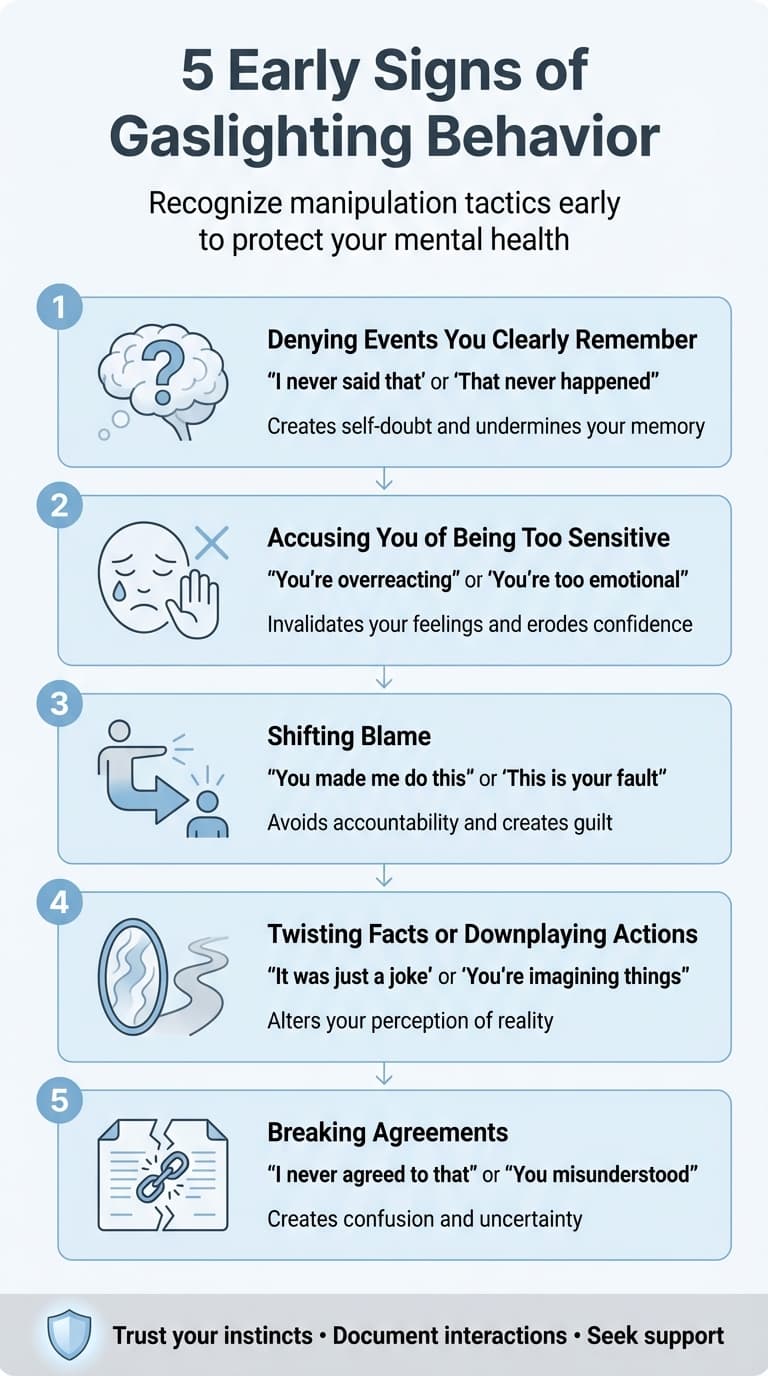
Gaslighting is a subtle and harmful form of psychological manipulation that makes you question your own memory, feelings, or reality. It often starts with small denials or dismissals and can escalate over time, leaving you dependent on someone else's version of events. Recognizing the signs early can help you protect your mental health and regain control. Here are five common tactics gaslighters use:
- Denying Events You Clearly Remember: They insist something didn’t happen, even when you know it did, causing you to doubt your memory.
- Accusing You of Being Too Sensitive: They dismiss your emotions as overreactions, making you question if your feelings are valid.
- Shifting Blame: They avoid accountability by twisting situations to make you feel at fault.
- Twisting Facts or Downplaying Actions: They rewrite events, dismiss concerns as jokes, or accuse you of misinterpreting their behavior.
- Breaking Agreements: They go back on promises or set contradictory rules, leaving you confused and uncertain.
Tools like Gaslighting Check can help you identify these behaviors by analyzing conversations for manipulation patterns. Keeping records of interactions, trusting your instincts, and seeking support from others are key steps to countering gaslighting.
::: @figure
Gaslighting Expert Reveals 10 Early Warning Signs You Shouldn’t Ignore | Dr. Daniel Fox
1. Denying Events You Clearly Remember
One of the first signs of gaslighting is when someone denies events or conversations you distinctly recall. They might say things like, "I never said that" or "That never happened", even when you're certain it did. This strategy is designed to make you doubt your own perception.
Creates Self-Doubt or Confusion
When someone repeatedly denies things you know to be true, it plants seeds of doubt in your mind. Dr. Joel Frank, a licensed psychologist at Duality Psychological Services, explains:
"This tactic disorients the victim, causing them to doubt their recollection and rely more on the manipulator for clarity, gradually undermining their trust in their own memory." [3]
Gaslighters often start small, denying minor details to test how you react. If you accept their version of events, they may escalate to denying more significant occurrences. Over time, this pattern can leave you questioning even the most vivid memories, creating a sense of emotional instability.
Undermines Emotional Confidence
As this self-doubt grows, it can chip away at your emotional confidence. You may begin to feel unsteady or even question your sanity. You might wonder if you're being too sensitive or simply misremembering. This erosion of self-trust is precisely what the manipulator intends - to make you depend on their version of events instead of trusting your instincts.
Avoids Accountability or Responsibility
Denial is also a tool for avoiding blame. By insisting that something never happened, gaslighters sidestep accountability for their own actions. Dr. Brittany McGeehan, a licensed psychologist and executive coach, highlights this behavior:
"Gaslighters consistently deny their actions, words or promises, even with clear evidence. This is harmful because... it teaches you that you cannot trust your senses, which makes it easier to manipulate you later down the line." [3]
In doing so, they often shift the blame onto you, accusing you of being forgetful, overly dramatic, or even fabricating events entirely.
Alters Perception of Reality
Perhaps the most damaging aspect of this tactic is how it warps your sense of reality. Even when you present hard evidence - like a text message or email - they might dismiss it with lines like, "You're imagining things", or "That’s not what it means." This manipulation forces you to choose between trusting your own experiences or accepting their distorted narrative. Often, to avoid conflict, you might start defaulting to their version of events, further eroding your confidence.
To counteract this, tools like Gaslighting Check can help you document these contradictions. By analyzing text messages and voice recordings, the platform identifies denial patterns and provides detailed reports, helping you trust your own recollections and recognize manipulative behaviors.
2. Accusing You of Being Too Sensitive or Overreacting
Gaslighters often dismiss your emotions by calling them "overreactions." This tactic shifts the focus away from their behavior, making you feel like your reactions are the issue. Over time, this undermines your trust in your own feelings and opens the door for further manipulation.
Undermines Emotional Confidence
When someone repeatedly tells you that your feelings are "too much" or "unreasonable", it starts to erode your emotional confidence. This kind of dismissal makes you second-guess whether your reactions are valid. Dr. Chivonna Childs, a psychologist at Cleveland Clinic, explains:
"Gaslighting is a form of emotional manipulation to make you feel as if your feelings aren't valid, or that what you think is happening isn't really happening. Over time, you start to question your self-worth, self-esteem and mental capacity." [2]
You might begin to wonder if you're being overly emotional or if there's something inherently wrong with you.
Avoids Accountability or Responsibility
This tactic doesn't just harm your self-esteem - it also allows the gaslighter to avoid taking responsibility for their actions. Instead of addressing how their behavior affects you, they shift the blame onto you. They may even imply that if you reacted differently, their actions wouldn’t be an issue. This leaves you feeling guilty for expressing emotions that are completely normal.
Creates Self-Doubt or Confusion
Constantly being told you're overreacting can spark a cycle of self-doubt. You start questioning whether your feelings are justified, even when your emotional response is entirely reasonable. As Robin Stern, PhD, explains:
"Over time, you begin to believe that there is something wrong with you because one of the most important people in your life is telling you this." [1]
This confusion can make it hard to trust your instincts, leaving you stuck in a loop of second-guessing yourself.
Alters Perception of Reality
Repeated accusations of being "too sensitive" can distort your sense of reality. The gaslighter essentially sets the standard for what is "acceptable", causing you to doubt your own reactions. You might start apologizing for your feelings or downplaying valid concerns just to avoid being labeled as "dramatic" or "irrational."
Recognizing these behaviors early on is crucial to protecting your emotional independence and breaking free from manipulation.
3. Shifting Blame and Avoiding Responsibility
Gaslighters have a knack for dodging accountability by shifting blame onto others. They rarely admit to their own mistakes. Instead, they twist situations to make you feel at fault. Phrases like "You made me do this" or "If you hadn’t done X, I wouldn’t have had to do Y" are common weapons in their arsenal. This constant redirection keeps you trapped in a cycle of guilt and confusion, all while they avoid facing the consequences of their actions.
Dodging Accountability
By shifting blame, gaslighters effectively sidestep taking responsibility for their behavior. As Dr. Chivonna Childs from Cleveland Clinic explains:
"Gaslighting is a form of projection, particularly when the perpetrator is called out on their actions. This allows them to deflect and blame others." [2]
The result? You end up defending yourself instead of addressing their behavior - exactly what they intend.
Undermining Emotional Confidence
This tactic doesn’t just deflect blame - it also chips away at your confidence and sense of reality. Dr. Daniel Glazer, a clinical psychologist, points out:
"The abuser may accuse you of demonstrating the exact thoughts and behaviors that they themselves are guilty of, leaving you to desperately defend your own sound motivations and grip on reality." [3]
Over time, this relentless blame game creates self-doubt. Even when you know deep down you’re not at fault, you might start questioning yourself. You may find yourself apologizing for things you didn’t do, slowly losing trust in your own judgment. This erosion of self-worth leaves you more vulnerable to further manipulation and hidden psychological effects, making it crucial to recognize these patterns early.
4. Twisting Facts or Downplaying Hurtful Actions
One of the early signs of gaslighting is the deliberate twisting of facts. This tactic not only distorts your sense of reality but also clouds your ability to trust your own judgment. Gaslighters may rewrite events by saying things like, "I never said that", even when you clearly recall the conversation. They might also dismiss your feelings with comments such as, "It was just a joke", or accuse you of being "too sensitive." These behaviors shift responsibility away from them, leaving you doubting your memory and instincts.
Alters Perception of Reality
Dr. Brittany McGeehan, a licensed psychologist, sheds light on how this manipulation works:
"Gaslighters consistently deny their actions, words or promises, even in the face of evidence... It teaches you that you cannot trust your senses, which makes it easier to manipulate you later down the line." [3]
In some cases, gaslighters use what experts call "weaponized compassion." For example, they might say, "I worry about you, you're always getting things mixed up", masking their manipulation under the guise of concern [4]. Keeping a record of these interactions can help you spot patterns and maintain clarity.
Avoids Accountability or Responsibility
Gaslighters often evade responsibility by minimizing their actions. Phrases like, "It was just a joke", or "You can't take a joke", are commonly used to shift blame onto you, framing your hurt as an overreaction [1].
Creates Self-Doubt or Confusion
The constant denial and contradiction can leave you feeling disoriented, a phenomenon often described as mental "whiplash." Dr. Michele Goldman explains:
"The questioning of a memory is a key to gaslighting because it starts to poke questions into your own memories." [4]
This erosion of trust in your recollection can make even basic decisions feel overwhelming [2]. To counteract this, it's essential to document specific incidents with dates, screenshots, or other evidence as part of effective ways to respond to gaslighting. Trust your instincts when something feels off, and lean on friends or family who can provide an objective perspective. These steps can help you stay grounded and recognize manipulation before it takes a deeper toll.
5. Setting Contradictory Rules or Breaking Agreements
Gaslighters often create confusion by setting inconsistent rules or going back on their promises without explanation. You might agree on something - whether it's dividing household chores, gaslighting at work, or establishing relationship boundaries - only to have them later deny the agreement or claim there was a misunderstanding. This keeps you in a constant state of uncertainty, unsure of what’s expected or even what’s real.
Creates Self-Doubt and Confusion
When someone repeatedly breaks promises and then denies they ever made them, it can make you question your own memory. Did that conversation actually happen? Were you imagining things? This isn't accidental - it’s a deliberate strategy. The goal is to make you doubt yourself and hesitate to challenge their behavior. Over time, the constant shifting of expectations clouds your perception of what’s true, leaving you mentally off-balance and vulnerable to further manipulation.
Undermines Emotional Confidence
The damage goes beyond just confusion. When someone close to you insists you’re misremembering or accuses you of being unreasonable for expecting them to follow through, it chips away at your emotional confidence. Over time, these repeated denials can make you question your own worth, judgment, and even your feelings. You might start blaming yourself for their broken promises, which only deepens the emotional impact.
Avoids Accountability and Shifts Blame
Breaking agreements also serves as a way for gaslighters to avoid taking responsibility. When confronted, they might insist you misunderstood, shift the blame, or steer the conversation in unrelated directions. These circular arguments leave you feeling drained and guilty for even addressing the issue, while the original problem remains unresolved.
One way to counter this is by keeping a record of specific agreements, including dates and details. Tools like Gaslighting Check can help validate your memory when someone tries to deny past conversations. Clear, assertive boundaries can also help - statements like, “I remember it differently, and I trust my memory,” can reinforce your confidence. Sharing these experiences with trusted friends or family can provide perspective and help you see the patterns of manipulation more clearly. These tactics are part of a larger strategy gaslighters use to maintain control and keep you questioning your reality.
Using Technology to Detect Early Warning Signs
Technology has stepped in to provide tools that can help identify manipulation tactics and warning signs, offering a way to validate your experiences objectively. One such tool is Gaslighting Check, which uses advanced machine learning and Natural Language Processing (NLP) to analyze conversations for signs of manipulation like reality distortion, emotional invalidation, and blame-shifting.
With this platform, you can either paste text or use real-time audio recordings. Its NLP and voice analysis capabilities examine tone, pitch, and pace to detect coercive behaviors. This is particularly important considering 3 in 5 people have experienced gaslighting but didn’t recognize it at the time, and many endure over 2 years in manipulative relationships before seeking help [5].
For those wanting a deeper analysis, the Premium subscription, priced at $9.99/month, provides detailed reports that highlight specific tactics used in conversations. These reports can help you spot patterns you might not have noticed before. The Premium plan also includes a conversation history feature, which is invaluable for tracking recurring abusive behaviors. This can serve as concrete evidence when someone denies past events. Dr. Stephanie A. Sarkis, author of Healing from Toxic Relationships, emphasizes the importance of this process:
"Identifying gaslighting patterns is crucial for recovery. When you can recognize manipulation tactics in real-time, you regain your power and can begin to trust your own experiences again" [5].
Your privacy is a top priority, with all data encrypted and subject to automatic deletion policies. Whether you opt for the Free plan, which offers basic text analysis, or the Premium plan with advanced features like voice analysis and pattern tracking, your information remains secure.
| Feature | Free Plan | Premium Plan |
|---|---|---|
| Text Analysis | Basic | Advanced (NLP-powered) |
| Voice/Audio Analysis | Not Included | Full Access (Tone & Pace) |
| Real-Time Recording | Not Included | Included |
| Detailed Reports | No | Yes (Actionable Insights) |
| Conversation History | No | Yes (Identify long-term patterns) |
| Privacy Protection | Encrypted | Encrypted + Auto-deletion |
| Monthly Cost | $0 | $9.99 |
If certain interactions leave you feeling uneasy, you can review them daily using this tool. Weekly PDF reports can also be exported for discussions with a therapist or counselor. Armed with concrete evidence of manipulation patterns, it becomes much harder for someone to dismiss your experiences. These tools give you the clarity to recognize manipulation early, helping you regain control and confidence in your own reality.
Conclusion
Dr. Joel Frank, Psy.D., Licensed Psychologist, explains it well: "Early detection allows individuals to take prompt action to protect their psychological well-being. Recognizing gaslighting can help prevent long-term emotional damage" [3]. Manipulation, when left unchecked, erodes your sense of self and independence. Spotting early signs - like signs of manipulation like denial of events or twisting facts - gives you the awareness needed to push back.
Listen to your gut. If something feels off in your interactions, that feeling is worth exploring. Acknowledging it is the first move toward regaining control. Dr. Brittany McGeehan, Ph.D., Licensed Psychologist, reinforces this: "Gaslighters often rely on making you doubt yourself, so recognizing and acknowledging your feelings is the first step in protecting yourself" [3]. Trust those instincts - they’re often your best defense.
To safeguard your perspective, keep a record of interactions. Jot down specific quotes, dates, or even screenshots of texts. Tools like Gaslighting Check can also help. By analyzing text or voice patterns, the platform provides insights you might miss, helping you set boundaries and validate your experiences.
Stay connected with supportive friends and family to counter isolation tactics. Dr. Chivonna Childs, PhD, Psychologist, highlights the importance of addressing these behaviors directly: "Calling out gaslighting behaviors helps set boundaries and change the power dynamic. It puts the other person on notice that you will no longer accept this type of treatment" [2]. Clear, assertive boundaries are essential to protecting your emotional health and regaining control.
Take action today: document your experiences, lean on your support system, and use tools like Gaslighting Check to reclaim your reality and break free from manipulation.
FAQs
How can I tell gaslighting from a normal disagreement?
Gaslighting isn’t just a typical disagreement - it’s a deliberate attempt to distort your sense of reality. In a healthy disagreement, both sides acknowledge each other's perspectives, even if they don’t agree. Gaslighting, however, takes a more manipulative route. It can involve outright denial of events, belittling your emotions, or making you second-guess your own memory. These tactics are designed to confuse you and make you question your sanity. Spotting these behaviors early is key to distinguishing emotional abuse from ordinary conflicts.
What should I do if I think I’m being gaslit?
If you think you might be experiencing gaslighting, it's important to act quickly. Start by trusting your instincts - if something feels off, it probably is. Keep a record of specific incidents, as this can help you recognize patterns and provide clarity. Watch for behaviors like being unfairly blamed or having your perception of reality questioned.
Lean on trusted friends, family members, or a mental health professional to help you process and validate your experiences. Their outside perspective can be invaluable. Finally, establish clear boundaries and take steps to safeguard your mental well-being. Addressing the situation early can make a significant difference in preventing further harm.
Is it safe and private to use Gaslighting Check on my conversations?
Yes, Gaslighting Check prioritizes your privacy. It uses encrypted data to keep your conversations secure and implements automatic deletion policies, ensuring that your interactions aren't stored permanently.