
Future Faking: Patterns in Romantic Manipulation
Future faking is a manipulation tactic where someone makes big promises about the future - like marriage, kids, or moving in together - but has no real intention of following through. This behavior often creates false emotional intimacy early in a relationship, leaving the other person feeling anxious, doubtful, and unable to trust their judgment.
Key Takeaways:
- What it is: Grand promises without follow-through, often used to keep someone emotionally hooked.
- How it works: Promises are exaggerated but lack concrete actions. It’s common during arguments or when the relationship is under strain.
- Emotional impact: Leads to cycles of hope and disappointment, creating anxiety and trauma bonding.
- Spotting it early: Suggest practical next steps (e.g., scheduling apartment viewings) and watch for avoidance or deflection.
- Tools to help: Platforms like Gaslighting Check analyze conversations to detect manipulative patterns. It’s free for the first three conversations, with plans starting at $9.99/month.
To protect yourself, focus on actions over words. If promises don’t align with reality, it might be time to reassess the relationship.
1. Future Faking
Tactic Characteristics
Future faking is all about grand promises with no intention of following through. Think of a partner who starts talking about dream weddings or future family plans way too early in the relationship. Dr. Amelia Kelley, a trauma-informed therapist, describes it perfectly:
It creates false emotional closeness without the intent to follow through. It's a gift with nothing inside. [2]
What sets this apart from genuine planning is the lack of action. If you suggest concrete steps - like researching hotels for that "dream vacation" they keep mentioning - a future faker will dodge the topic, get defensive, or accuse you of being pushy. They’re great at painting vivid pictures of the future but will avoid taking any real steps to make it happen. This tactic often ramps up during arguments or when you're questioning the relationship, as a way to keep you emotionally hooked.
These empty promises don’t just disappoint; they set the stage for deeper emotional harm.
Emotional Impact
The psychological effects of future faking can be intense. It creates a cycle known as trauma bonding, where occasional small efforts to follow through keep you clinging to hope, even when the bigger promises are consistently broken. This pattern can lead to anxiety, a loss of self-confidence, and impaired decision-making.[1]
Detection and Prevention
Spotting future faking early can save you from a lot of heartache.
One way to test the waters is to suggest a practical next step. If your partner talks about moving in together, ask to schedule apartment viewings this weekend. A genuine partner will engage, while a future faker might sidestep the conversation or dismiss your suggestion as unromantic. Pay attention if these grand promises conveniently show up during moments of tension or when you're considering leaving - they’re likely a manipulation tactic.
Keeping a written record of promises and actions can also be eye-opening. This not only helps you counter gaslighting but also gives you a clear picture of the reality versus the fantasy. Ask yourself: "If nothing changed and things stayed as they are today, would I be okay with that?" Making decisions based on what’s happening now, rather than on promises of the future, can help you avoid getting trapped in an illusion.
Detect Manipulation in Conversations
Use AI-powered tools to analyze text and audio for gaslighting and manipulation patterns. Gain clarity, actionable insights, and support to navigate challenging relationships.
Start Analyzing Now2. Gaslighting Check

Detection and Prevention
Gaslighting Check helps uncover manipulation by analyzing conversation patterns to highlight broken promises using tools for detecting gaslighting. It identifies red flags like overly detailed promises with little follow-through, deflective responses when asked for specifics, and heightened commitments that surface during conflicts. By focusing on the gap between words and actions, this tool brings clarity to situations that can feel overwhelming.
The platform takes detection a step further by monitoring consistent behavior over time. Using principles from Cognitive Behavioral Therapy (CBT) and Dialectical Behavior Therapy (DBT), it tracks context across multiple sessions. This allows it to spot recurring patterns, such as repeated broken promises, that might be hard to notice when emotions are involved. This kind of contextual tracking is key to understanding manipulative tendencies.
Gaslighting Check also helps you stay grounded by validating your emotions and guiding you to evaluate broken promises critically. Are the "goalposts" always shifting? Does your partner deflect or assign blame when questioned? The tool encourages you to log promises with dates and outcomes, creating an objective record to counter gaslighting tactics. Having a factual timeline can be especially powerful during emotionally charged discussions.
You can try the service with three free conversations, and monthly plans start at $9.99. All your data is encrypted and automatically deleted for privacy.
Is it REAL or Future Faking? | Sabrina Zohar
Understanding these patterns is the first step in recognizing gaslighting behaviors that often accompany future faking.
Pros and Cons
::: @figure
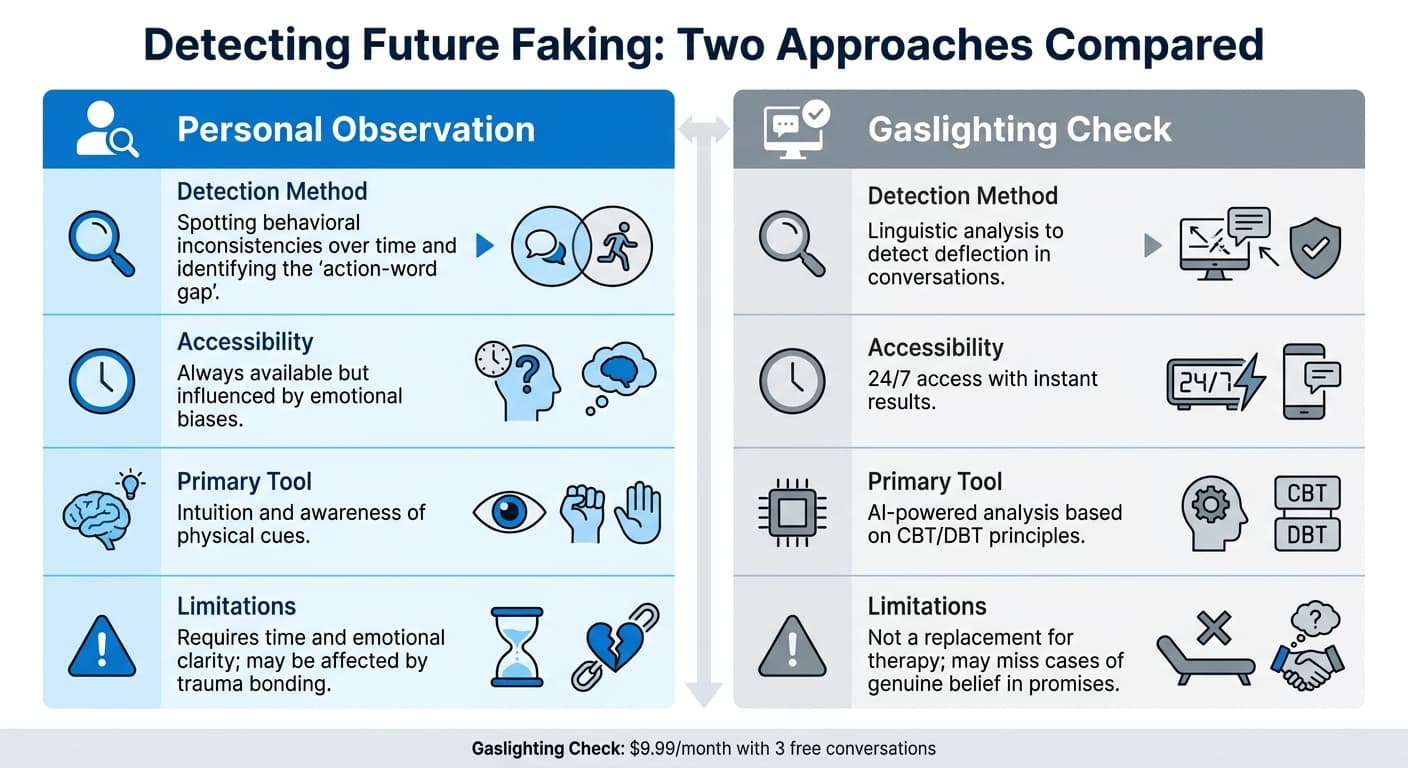
Expanding on earlier discussions about future faking and how to spot it, comparing self-observation to Gaslighting Check reveals distinct advantages and challenges. Personal observation involves keeping track of situations where someone makes promises - like moving in together, marriage, or starting a business - but fails to follow through over many months [2]. Sometimes, even subtle physical cues can alert you to these patterns. Dr. Amelia Kelley, a trauma-informed therapist, describes the emotional toll:
Future faking creates a rollercoaster of highs and lows.
This emotional turbulence highlights the importance of evaluating both methods.
Relying solely on your intuition can be tricky. Early emotional highs might cloud your judgment, and factors like trauma bonding or the sunk cost fallacy can make it even harder to trust your instincts [1]. On the other hand, Gaslighting Check offers a more structured approach. It uses evidence-based frameworks like Cognitive Behavioral Therapy (CBT) and Dialectical Behavior Therapy (DBT) to analyze conversation patterns objectively [1]. Plus, it’s available anytime - no appointments required - and takes just 30 seconds to get started.
Here’s a quick comparison of the two methods:
| Feature | Personal Observation | Gaslighting Check |
|---|---|---|
| Detection Method | Relies on spotting behavioral inconsistencies over time and identifying the "action-word gap" | Uses linguistic analysis to detect deflection in conversations |
| Accessibility | Always available but can be influenced by emotional biases | Accessible 24/7 with instant results |
| Primary Tool | Intuition and awareness of physical cues | AI-powered analysis based on CBT/DBT principles |
| Limitations | Requires time and emotional clarity; may be affected by trauma bonding | Not a replacement for therapy and may miss cases of genuine belief in promises |
Neither approach is perfect. Self-observation requires a high level of self-awareness and patience, while Gaslighting Check might overlook instances where promises are made in good faith. Though Gaslighting Check offers a free trial, it’s important to note that for more serious situations - especially when relationship issues begin to impact daily life - professional therapy remains a critical resource.
Conclusion
Future faking preys on the gap between promises and actions. It often involves elaborate plans or commitments made early in a relationship or conveniently timed to prevent you from walking away. These promises, however, rarely come with tangible steps to back them up, making them a red flag for manipulation rather than genuine intent.
Your emotional well-being relies on staying rooted in the present. Ask yourself: "If nothing changed from how things are today, would I be okay with that?" If the answer is no, it might be time to reevaluate the relationship. As discussed earlier, the key to spotting manipulation lies in recognizing the inconsistency between grand gestures and real, practical efforts.
To help navigate these situations, tools like Gaslighting Check offer support. Using AI grounded in CBT and motivational interviewing principles, this service analyzes your conversations to detect patterns of manipulation. At $9.99/month (with three free conversations to start), it helps you identify when promises clash with reality, giving you clarity when emotions cloud your judgment. While this tool is useful for spotting broken promises, healing and maintaining emotional health often require additional support.
Therapists who specialize in narcissistic abuse and relationship trauma bring the expertise needed for more serious challenges, especially if the relationship is impacting your daily life. Think of Gaslighting Check as a complement to, not a replacement for, professional guidance and personal support systems.
Ultimately, protecting your emotional health means prioritizing actions over empty words. Cultivate independence through hobbies and friendships outside the relationship, and listen to your instincts - if you feel more anxious and uncertain than calm and secure, something may be off. You deserve a partner who actively works toward a shared future, not just talks about one. Stay alert, trust what you see, and verify promises with real, actionable steps.
FAQs
How can I tell future faking from real plans?
Future faking is when someone makes big promises about a future together - like getting married or moving in - early on in a relationship. The problem? These promises rarely come with real action to back them up.
What are the warning signs? Watch out for repeated broken promises, defensiveness when you ask for specifics, or an uptick in grand promises during arguments. Real plans, on the other hand, are built on consistent actions and clear steps, not just empty words meant to keep emotional control.
Why do future fakers make promises during fights?
Future fakers use promises during arguments as a way to manipulate their partner. These promises are designed to heighten emotional investment, give a misleading sense of security, and shift attention away from unresolved problems. This tactic often helps them maintain control while sidestepping responsibility for their behavior.
What should I do when promises keep getting delayed?
If promises keep getting postponed, it might be a warning sign of potential manipulation, as discussed in the article on future faking. When someone frequently breaks commitments after making detailed promises, it could suggest an absence of sincere intent. To safeguard yourself, establish firm boundaries and assess whether their actions match their words. If the delays continue, focus on your emotional health and take time to reevaluate the relationship.