
Common Barriers to Emotional Intimacy
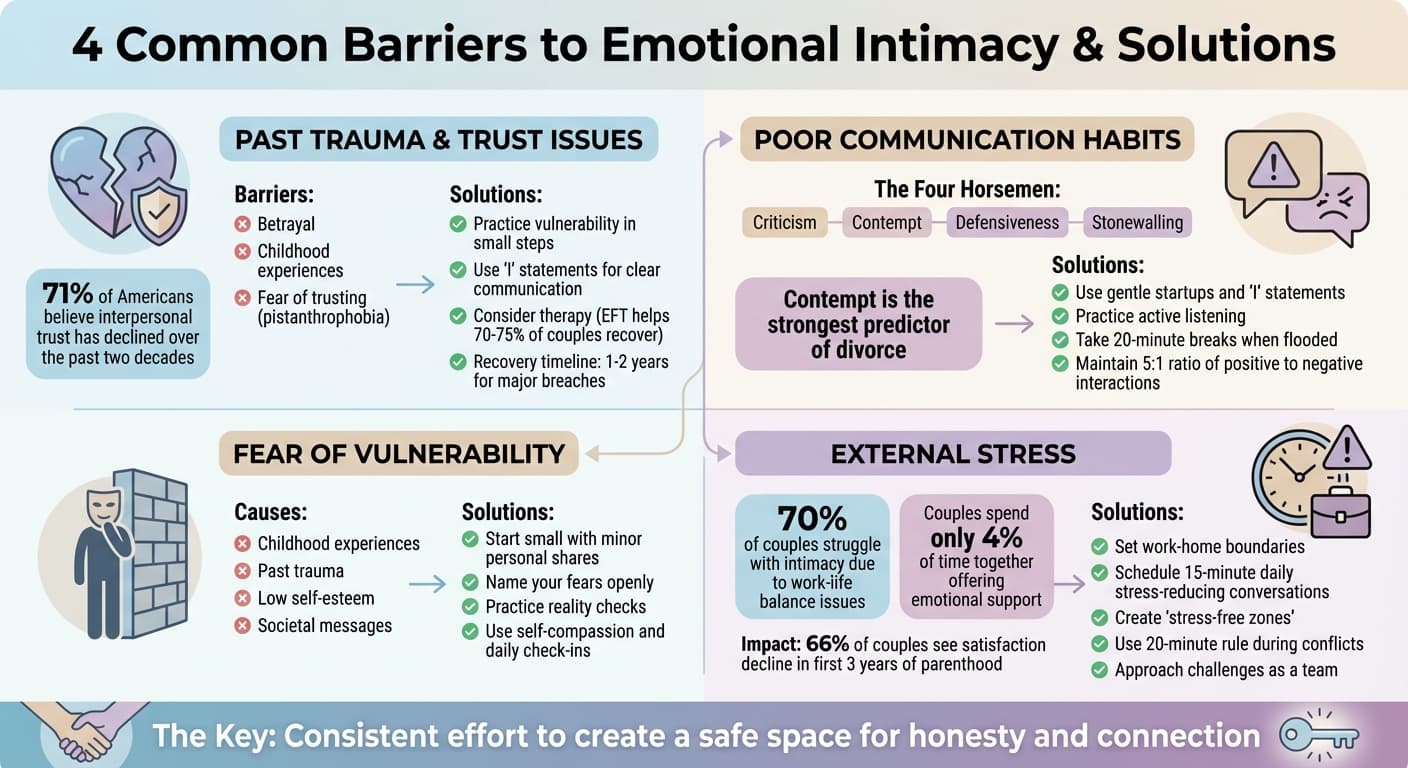
Emotional intimacy is the backbone of healthy relationships, but many struggle to maintain it. Common barriers include unresolved trauma, poor communication habits, fear of vulnerability, and external stressors. These issues can lead to disconnection, mistrust, and frustration. Here's a quick breakdown:
- Past Trauma: Betrayal or childhood experiences can create trust issues, making it hard to open up.
- Communication Problems: Criticism, contempt, defensiveness, and stonewalling often damage relationships.
- Fear of Vulnerability: Worries about rejection or judgment can prevent emotional openness.
- External Stress: Work, financial, or parenting pressures can drain emotional energy.
Practical steps to overcome these include rebuilding trust with small actions, improving communication by learning to be a better partner through "I" statements and active listening, addressing fears gradually, and managing stress through boundaries and regular connection time. Tools like Gaslighting Check ($9.99/month) can also help identify harmful patterns. These AI self-help modules provide personalized support for emotional recovery.
The key is consistent effort to create a safe space for honesty and connection.
::: @figure
The 12 Reasons Why Intimacy Lacks In Your Love Relationship!
Past Trauma and Trust Issues
When someone has experienced betrayal, abandonment, or broken promises, those emotional wounds often linger, shaping how they approach new relationships. These past experiences can create invisible barriers, making it hard to open up - even when there's a deep desire for connection. Let’s dive into how these past traumas influence current bonds.
How Past Trauma Affects Current Relationships
Unresolved trauma has a way of showing up unexpectedly, especially in relationships. For example, childhood trauma can rewire the brain’s threat detection system, making the world feel unpredictable and unsafe [5]. This can lead to disorganized attachment - a pattern where even supportive partners might trigger fear.
Betrayal, on the other hand, can destroy a sense of security and foster a negativity bias, where every action is scrutinized through a lens of doubt [5]. In fact, about 71% of Americans believe that interpersonal trust has declined over the past two decades [5].
Some people develop pistanthrophobia - an intense fear of trusting others - as a way to protect themselves [5]. Others may adopt a self-reliant approach, staying emotionally distant to avoid future pain. While this might feel safer, it also blocks the vulnerability needed for meaningful connections. As Minkyung Chung, MS, LMHC, explains:
"Trust is the belief that someone can be relied on to do or say something that was agreed upon. Trust issues are the inability to believe that one can rely on another person (friend, romantic, family, etc). Without trust, no relationship is sustainable." [5]
When betrayal is paired with gaslighting - where someone denies or shifts blame - it can further damage trust, leaving individuals doubting their own perceptions. This can reinforce harmful beliefs and make it even harder to build intimacy [5].
Recognizing these effects is the first step toward healing and rebuilding trust.
Steps to Rebuild Trust
Restoring trust isn’t quick or easy - it’s a process that requires consistent effort over time. Research suggests that recovering from major breaches, like infidelity, often takes 1–2 years of sustained work [6]. But with patience and small, intentional steps, trust can be rebuilt.
Start by practicing vulnerability in manageable ways. For instance, share a small personal story or trust your partner with a minor responsibility before taking bigger emotional risks. Dr. John Gottman calls these everyday opportunities "sliding door moments", where small acts of reliability strengthen the connection [6].
Trust grows in these small, consistent moments. As Dr. Brené Brown explains:
"Trust is built one marble at a time. It's the little moments of reliability, accountability, and showing up that really matter." [6]
Clear communication also plays a key role. Using "I" statements - like, "I feel anxious when it seems like you’re being distant" - can help express emotions without sounding accusatory. For those dealing with gaslighting, keeping a record of events can help rebuild confidence in personal perceptions.
Therapy can also be a powerful tool. Emotionally Focused Therapy (EFT) has been shown to help 70–75% of couples move from distress to recovery [6]. Cognitive Behavioral Therapy (CBT) is another option, offering strategies to challenge the negative thought patterns that fuel distrust. Nearly 70% of couples who seek therapy report significant improvements in their relationships [6].
Lastly, work on forgiveness - not necessarily for the other person, but for your own peace of mind. Letting go of past hurts can free you from carrying the emotional weight into future relationships. Forgiveness is a personal decision, while reconciliation requires both partners to commit to consistent, trustworthy actions over time [6].
Poor Communication Habits
Good communication is essential for breaking down the barriers that hinder emotional closeness. Even when both partners genuinely want to connect, certain communication habits can unintentionally drive them apart. These patterns often arise from a need for self-preservation rather than a desire to harm. As Reba Machado, M.S., LMFT, explains:
"Destructive communication typically stems from a place of self-protection rather than genuine connection. When we feel threatened, criticized, or misunderstood, our nervous system activates defensive responses that prioritize our emotional safety over the health of the relationship." [7]
Ironically, these self-protective behaviors often create the very distance people are trying to avoid. Here are some common ways these behaviors can damage relationships.
Common Harmful Communication Patterns
Relationship experts have identified "The Four Horsemen" - four destructive communication habits that can predict the breakdown of a relationship: criticism, contempt, defensiveness, and stonewalling [7][10].
- Criticism targets a partner's character rather than addressing specific actions. For example, saying "You're so lazy" instead of "I was upset that the dishes weren't done."
- Contempt escalates criticism by adding mockery, sarcasm, or a sense of superiority. It’s the most damaging of the four and a strong predictor of divorce, as it undermines both connection and emotional well-being [7][10].
- Defensiveness involves shifting blame or dismissing accountability, signaling that a partner’s concerns don’t matter.
- Stonewalling occurs when one partner shuts down entirely, withdrawing from the conversation. While it may resemble the silent treatment, stonewalling is often an involuntary reaction to feeling emotionally overwhelmed or "flooded" [7].
Other damaging habits include revisiting past grievances during current arguments, which prevents resolution and adds to resentment. Similarly, invalidating communication - dismissing feelings with phrases like "it's not a big deal" or "just relax" - can leave a partner feeling unheard and unimportant [12].
How to Improve Communication
Recognizing these harmful patterns is the first step toward healthier communication. One effective approach is to use gentle start-ups when discussing concerns. Instead of jumping into criticism, focus on your feelings and needs. For example, use "I" statements like "I felt hurt when..." to express emotions without placing blame [7][9][11].
Another key strategy is active listening - fully concentrating on your partner’s perspective and reflecting back what they’ve said to ensure understanding [7][9]. If a conversation becomes too heated, take a 20-minute break to calm down. During this time, engage in soothing activities like walking or reading before returning to the discussion [11].
Taking responsibility for even a small part of a conflict can quickly reduce tension [11]. Additionally, setting up regular check-ins - dedicated times to discuss the relationship and external stressors - can prevent minor issues from escalating into major problems [8][9].
Healthy communication not only resolves conflicts but also strengthens emotional bonds. Researchers emphasize maintaining a "magic ratio" of at least five positive interactions for every negative one [11]. Building this positive buffer through consistent, constructive communication helps relationships stay strong, even during challenging times.
Fear of Vulnerability
Even with better communication, the fear of being judged, rejected, or hurt often lingers, stopping people from showing their authentic selves. Shari Foos, a Marriage and Family Therapist, captures this well:
"Vulnerability is when a person willingly takes the risk to reveal their emotions and weaknesses." [13]
Many shy away from vulnerability because it feels risky. Sharing insecurities might lead to rejection or criticism. Others worry about losing independence, fearing that getting too close could mean being overwhelmed by their partner's needs [16][18]. These fears can create emotional barriers that block the connection people deeply desire. Understanding what drives this fear is the first step toward overcoming it.
What Causes Fear of Vulnerability
The fear of vulnerability often has its roots in early childhood experiences. If caregivers were critical, inconsistent, or rejecting, children may learn to associate openness with pain. These early lessons shape how they approach intimacy as adults [15][16].
Past trauma is another major factor. Those who experienced childhood neglect, abuse, or had narcissistic parents may develop a deep-seated distrust of others [14][19].
Low self-esteem also plays a role. People who feel fundamentally unworthy of love or believe their true selves are flawed often avoid emotional exposure [14][15]. Additionally, societal messages that glorify extreme independence and emotional toughness can frame vulnerability as a weakness instead of a strength [15].
Recognizing these underlying causes can help you address barriers like mistrust and poor communication. Vulnerability is essential for building emotional intimacy.
How to Become More Vulnerable
Once you've improved communication, embracing vulnerability can take your connections even deeper. You don’t need to dive into intense confessions right away. Start small by sharing minor personal experiences or daily feelings before moving on to more sensitive topics. This allows you to test your partner's response without feeling too exposed [17][4].
Acknowledge your fear openly and use "I" statements to share your emotions. Research suggests that naming your fear can make it feel less overwhelming [13]. For example, telling your partner, "I find it hard to be vulnerable because I'm afraid of being judged", can create an immediate sense of closeness. Similarly, reframe blame into personal feelings, like saying, "I felt dismissed when you made that joke", instead of accusing [17][18].
Reality checks can help separate old fears from the present moment. If you worry your partner is pulling away because of a short text, talk to a trusted friend or ask your partner directly to see if your concern matches reality [18]. Finally, practice self-compassion by checking in with yourself daily. Notice physical signs of anxiety before they escalate into defensive reactions like withdrawal or sarcasm [19][4].
External Stress and Its Impact on Intimacy
Even after addressing past trauma and improving communication, external pressures can still sap the emotional energy needed to maintain intimacy. Work deadlines, financial concerns, parenting responsibilities, and health issues don’t stop at the office door - they follow you home, often creating distance in your relationship. Just like rebuilding trust or opening up emotionally takes effort, managing external stress requires consistent boundaries and intentional interaction.
Here’s a striking statistic: 70% of couples struggle with intimacy due to challenges in maintaining a healthy work-life balance [21]. This imbalance doesn’t just affect individual well-being; it ripples through the relationship. Dr. Padma Srivastava, Consultant Obstetrician & Gynecologist at Motherhood Hospitals, highlights the issue:
"Long working hours, high stress, and lifestyle imbalances take a toll on couples' well-being, making it difficult for them to engage in meaningful interactions, including intimacy" [21].
Stress doesn’t stay contained - it spreads. Psychologist and author Dr. Alexandra Solomon explains it succinctly:
"Stress is highly contagious. When you live with someone and build a life with someone and they are struggling with work, it affects you, not because you are codependent but because you are coregulated" [22].
Our nervous systems are like mirrors; when one partner feels overwhelmed, the other often feels it too.
Signs That Stress Is Affecting Your Connection
Spotting the signs of stress-induced disconnection early can help you address it before it deepens. One common red flag is irritability - you might catch yourself snapping over trivial things that wouldn’t normally bother you. Stress can also lead to "flooding", a state where your heart rate exceeds 100 beats per minute [24]. This physical response releases stress hormones, making it harder to express affection or think creatively during conflicts.
Another sign is a shift in communication. Conversations may stop being about emotions and instead focus on logistics - schedules, bills, or errands. Research shows that couples spend only 4% of their time together offering emotional support [28]. You might also notice withdrawal, such as less eye contact, fewer hugs, or one partner seeking comfort from friends rather than their significant other [25][9].
Exhaustion can become the norm, especially for parents. Studies reveal that 66% of couples experience a decline in relationship satisfaction during the first three years of parenthood [27]. Over time, the relationship may feel more like a functional partnership - focused on tasks - than an emotionally fulfilling connection.
Managing Stress to Protect Intimacy
Once you recognize how stress is affecting your relationship, taking proactive steps can help rebuild intimacy. Start by setting clear boundaries between work and home. Dedicate intentional time each day - like a 15-minute stress-reducing conversation - to reconnect [23][27]. Small rituals, such as changing out of work clothes, taking a short decompression break, or setting a "digital sunset" to put away devices, can make a big difference. During these moments, give each other undivided attention - no phones, no distractions. You might also create "stress-free zones", like taking a quiet walk or cooking together, where work talk is off-limits.
When arguments escalate, try the 20-minute rule. It takes about 20 minutes for stress hormones to subside [24]. If things get heated, pause the conversation and use that time to walk, journal, or practice deep breathing (inhale for 5 seconds, hold for 5 seconds, exhale for 10 seconds). Then, return to the discussion with a clearer mind.
Be direct about your needs instead of expecting your partner to read your mind. For example, if financial worries or parenting duties feel overwhelming, say something like, "I need to vent for 10 minutes", or "Can you handle the dishes tonight so I can take a break?" [28]. Avoid jumping into "fix-it" mode when your partner shares their struggles; instead, ask, "How can I support you right now?" This approach can feel far more validating [23].
Lastly, approach challenges as a team. Viewing problems like financial stress or work demands as shared issues fosters collaboration. Couples who tackle these difficulties together are more likely to have the tough conversations that ultimately strengthen their bond [26].
Using Communication Tools to Build Intimacy
Once you've managed stress and carved out time for connection, the next step is ensuring that your conversations strengthen trust rather than undermine it. Effective communication is at the heart of resolving issues tied to emotional intimacy, whether those stem from past trauma or fears of vulnerability. Interestingly, research indicates that 21% of people cite intimacy concerns as a major source of conflict in their relationships [29]. Many of these challenges can stem from miscommunication or subtle emotional manipulation. Building on earlier strategies, incorporating digital tools can add another layer of trust and clarity to your interactions.
Technology, while not a substitute for genuine connection, can provide an objective lens to identify patterns you might miss otherwise. For example, platforms like Gaslighting Check analyze text or voice interactions to detect emotional manipulation. This includes distinguishing between intentional gaslighting - when someone deliberately distorts your reality - and unintentional invalidation, where feelings are dismissed without harmful intent [12]. These tools also highlight harmful communication patterns, creating opportunities for accountability and fostering a safer space for vulnerability.
How Technology Can Support Healthy Communication
Tools like Gaslighting Check act as neutral observers, tracking and analyzing communication patterns in real time. For instance, if phrases like "You're too sensitive" or "That never happened" frequently come up, the platform can document these trends, offering tangible insights during difficult conversations [12].
One major advantage of using such tools is transparency. When both partners are aware that their interactions are being analyzed, it encourages honesty and discourages manipulative behavior. Psychologist Cara Gardenswartz highlights the importance of this dynamic:
"Emotional intimacy is the cornerstone of a strong, lasting relationship. It fosters a deep connection that transcends physical attraction" [1].
Additionally, these tools can help manage "flooding", a state of emotional overwhelm during conflicts, by offering neutral, grounded feedback [9]. With these insights, you can explore practical ways to incorporate these tools into your everyday communication.
Practical Ways to Use Communication Tools
Integrating technology into your relationship can address communication challenges and emotional barriers, helping you work toward greater intimacy.
Start by using platforms to monitor your communication habits. Over time, you can identify whether you're responding with empathy (turning toward each other) or avoiding concerns (turning away) [9]. If you notice recurring issues, review the reports together and schedule a calm conversation to address them. For instance, you could say, "I've noticed we've been interrupting each other a lot this week. Can we set aside some time tonight to talk about it?"
Another useful strategy is triangulation - introducing external content, like articles or podcasts, as a neutral way to approach tough topics [20]. For example, you might share a report from Gaslighting Check with your partner and say, "This tool flagged some patterns I hadn’t noticed. Can we go over this together?" This approach reduces the tension of direct confrontation and encourages teamwork.
As licensed sex therapist Vanessa Marin explains:
"Once you've gotten to a dark place in your relationship, it's hard to work your way out of it on your own. Being able to ask for help is a huge sign of strength" [29].
Conclusion
Building emotional intimacy involves tackling the barriers that prevent a deep connection. Unresolved trauma can lead to self-protective behaviors that make vulnerability - and therefore trust - hard to maintain [30][31]. Studies show that couples who share a strong emotional bond report higher satisfaction, better communication skills, and fewer conflicts [2].
How you communicate plays a major role in shaping your relationship. The "Four Horsemen" - criticism, defensiveness, contempt, and stonewalling - are known to damage trust and connection over time [9]. Replacing these patterns with strategies like softened startups, active listening, and using "I" statements fosters a space where real understanding can grow. As Cara Gardenswartz, Ph.D., puts it:
"Emotional intimacy is the foundation of a deep, fulfilling connection between partners" [2].
External stressors, if left unchecked, can also chip away at your bond. Setting aside 20 minutes daily to talk about outside pressures - not relationship issues - can help partners support each other without adding strain [9]. Simple rituals, like sharing daily highs and lows or asking three thoughtful questions, can keep you emotionally in sync [3].
Technology can also lend a hand. Tools like Gaslighting Check are designed to identify harmful communication patterns, distinguishing between intentional manipulation and accidental missteps [12]. For $9.99/month, this tool provides text and voice analysis with detailed reports, complementing your efforts to improve communication and address past challenges.
Take a step today: carve out time for a stress-relief conversation, share a personal thought, or try a communication tool to gain clarity. As Gillian Florence Sanger writes:
"To be intimate with someone is to allow ourselves to be seen and to see openly in return" [4].
The goal is simple: create honest, meaningful exchanges that deepen your connection.
FAQs
How do I know if my trust issues are from past trauma?
Trust issues rooted in past trauma often arise from early experiences of betrayal, neglect, or abuse. These experiences can shape behaviors like avoiding vulnerability, relying heavily on oneself, or constantly questioning others' intentions. Understanding how these patterns connect to unresolved emotional pain is crucial. Recognizing trauma as the source can open the door to healing, whether through therapy or other supportive approaches that help rebuild trust over time.
What should I do if we keep falling into criticism or stonewalling?
Repeated cycles of criticism or emotional withdrawal can seriously damage trust and communication in relationships. Criticism often feels like a personal attack because it targets someone's character rather than addressing specific actions. Instead, focus on discussing behaviors without making it personal. On the other hand, stonewalling - when someone shuts down or withdraws emotionally - can leave the other person feeling ignored or dismissed. To address this, try to recognize what triggers this response, create an environment where open dialogue feels safe, and take short breaks when emotions run high to prevent escalation. Building empathy and, when necessary, seeking guidance from a professional can pave the way for healthier communication and deeper emotional connection.
Can Gaslighting Check help me spot manipulation in our conversations?
Gaslighting Check is a tool designed to help spot emotional manipulation by analyzing conversations for signs of gaslighting and similar tactics. It generates detailed reports and keeps a history of conversations, offering insights that can help improve communication and understanding.