
AI Text Analysis for Emotional Manipulation
AI can help you spot manipulation in texts, emails, and DMs by finding repeat patterns that are hard to see in the moment. The main point is simple: one message can be misleading, but a thread over time can show gaslighting, guilt-tripping, blame shifting, pressure, and threats.
Here’s the short version:
- AI looks for patterns, not just rude words
- Conversation context matters more than single lines
- Layered systems do better than keyword-only tools
- One cited framework reached 94.1% F1, vs. 87.9% for sentiment-only and 83.4% for keyword filtering
- Adding thread context improved recall by about 0.12 and F1 by up to 0.10
- AI output is a signal, not proof
- If messages include threats or control, save records first and put safety first
In plain English: if you feel like “something is off,” AI can help turn that feeling into a dated record of repeated tactics. That can help you think more clearly, respond with care, and decide whether to bring in a therapist, advocate, or lawyer.
A few points matter most:
- Gaslighting often looks like denial, minimization, and “you’re remembering it wrong”
- Guilt-tripping often uses debt language like “after all I’ve done for you”
- Coercion often follows an “if you don’t do X, I’ll do Y” pattern
- False urgency uses deadlines to force a fast reply
- Sudden tone swings - from praise to contempt - can be a warning sign
What I’d take from this article: use AI as a second opinion for written conversations, keep raw logs plus short notes, and do not rely on a tool alone for legal, mental health, or safety decisions.
| What AI helps with | What AI can miss |
|---|---|
| Repeated language patterns | Tone, history, body language |
| Contradictions across threads | Sarcasm and private context |
| Escalation over time | Dialect and dataset bias |
| Pressure, denial, and blame patterns | The full meaning of a relationship |
Bottom line: AI text analysis is most useful for documentation, pattern spotting, and risk awareness. It helps most when you compare the report with your own experience and, if needed, get outside support.
Can AI Detect Emotional Manipulation? | AI + Psychology
Detect Manipulation in Conversations
Use AI-powered tools to analyze text and audio for gaslighting and manipulation patterns. Gain clarity, actionable insights, and support to navigate challenging relationships.
Start Analyzing NowHow AI Text Analysis Detects Manipulation
::: @figure
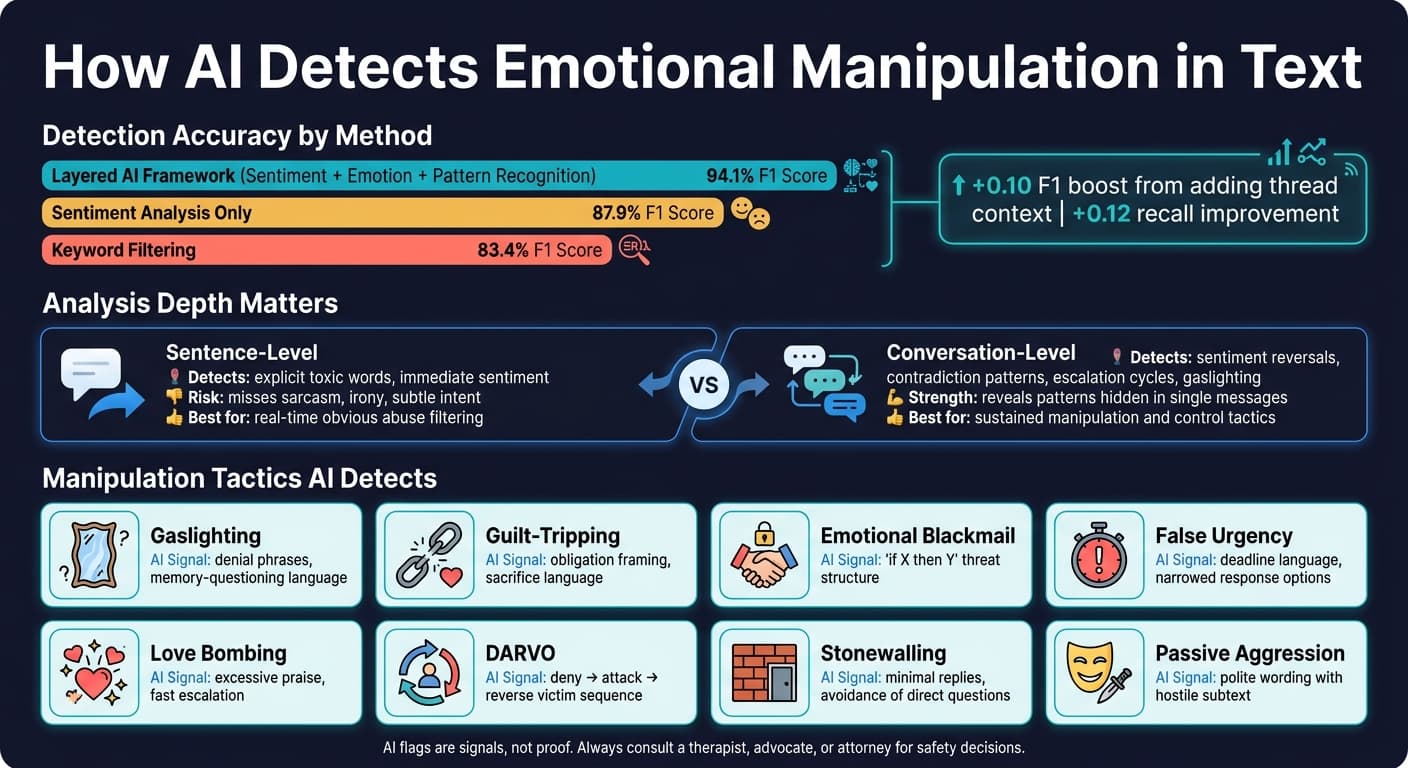
AI looks at messages as a set of signals it can measure: word choice, emotional tone, sentence structure, and how those things change over time. Most systems mix sentiment analysis, emotion classification, toxic language detection, and intent analysis. Put those layers together, and they spot manipulation much better than plain keyword filtering.
One study found that a layered framework using sentiment, emotion detection, plus recognition of repetition, contradiction, and deflection reached an F1 score of 94.1% for manipulation detection. By comparison, sentiment analysis alone reached 87.9%, and keyword filtering reached 83.4%.[3] So the next step is pretty clear: look at the signals AI tracks.
The Core Signals AI Looks For
Direct threats are the easy part. The harder cases involve pressure language, contradiction patterns, and repeated attempts to dodge accountability.
AI also watches for emotional intensity shifts. A message can jump from warm to hostile or suddenly sound urgent out of nowhere. Those swings often tell you more than one phrase ever could. Gaslighting is a good example. It often slips past toxicity filters because it leans on denial, minimization, and distortion instead of open abuse.[7]
Sentence-Level vs. Conversation-Level Analysis
A single message on its own can seem harmless. “I'm just trying to help” sounds supportive in isolation. But after several messages that dismiss your concerns, that same line lands in a very different way. Context changes everything.
| Analysis Type | What It Detects | Strengths | Risks of Misinterpretation | Best Use Case |
|---|---|---|---|---|
| Sentence-Level | Explicit toxic words, immediate sentiment, profanity | Fast, low computational cost, easy to automate | High - misses sarcasm, irony, and subtle intent | Filtering obvious abuse in real time |
| Conversation-Level | Sentiment polarity reversals, contradiction patterns, sudden deviations from a communication baseline, escalation cycles | Spots patterns hidden in single messages | Needs enough message history to establish a baseline | Detecting gaslighting and sustained control tactics |
Research on toxic email detection backs this up. Including the previous message in a thread improves detection, especially for categories like gossip, where context matters a lot.[8] Adding a short contextual snippet has been shown to boost recall by roughly 0.12 and F1 scores by up to 0.10.[9] That extra context is often what reveals manipulation spread across a thread.
Rule-Based Systems, ML Models, and LLM Prompting
These methods are most useful when the goal is to catch repeated manipulation, not just bad words.
| Technique | Strengths | Weaknesses | Best Suited For | Common Pitfalls |
|---|---|---|---|---|
| Rule-Based Systems | Transparent, fast, easy to audit | Rigid - misses anything not in the ruleset | Flagging known phrases, keyword patterns, explicit threats | Heavy reliance on exact wording; manipulators adjust fast |
| ML Models (e.g., fine-tuned BERT, RoBERTa) | Learns subtle patterns from labeled data; goes beyond fixed rules | Needs high-quality annotated data; can reflect dataset biases | Detecting subtle abuse, dialogue-level manipulation, tone shifts | Biased training data; low explainability can weaken user trust[4][5][6] |
| LLM Prompting | Understands context and intent; flexible for multi-turn conversations | High computational cost; outputs can vary | Intent-aware analysis, complex conversational dynamics | Uneven results without structured prompting; not always easy to audit |
LLM prompting helps most when intent matters more than keyword matching.
Text Patterns AI Can Flag in Manipulative Relationships
Once AI has enough conversation context, it can start spotting gaslighting and other tactics. That matters because manipulation usually doesn't show up in one line. It builds over time through repeated wording, changes in tone, and patterns that keep coming back.
AI can label those patterns as gaslighting, guilt-tripping, blame shifting, or DARVO, then sort them by how often they appear and how intense they are.
Gaslighting, Blame Shifting, and Reality Distortion
Gaslighting can make a person doubt their own memory and judgment. In text, it often shows up as denial ("That never happened; you're imagining things."), attacks on recall ("You're remembering it wrong"), and emotional dismissal ("You're too sensitive", "You're overreacting.").[2][1] The point is to create self-doubt, so the target starts second-guessing what they saw or felt.
Blame shifting works a little differently. Instead of denying what happened, it moves responsibility somewhere else. AI can spot this by tracking language that pushes fault onto the other person, especially when repeated "you" statements replace accountability words like "I" or "we."
Guilt, Fear, and Control Tactics in Messages
Guilt-tripping leans on obligation and emotional debt. Common examples include "After everything I've done for you…" and "No one else would put up with what I do."[2][10][1] These lines turn the relationship into a kind of scoreboard where one person is always supposed to owe the other. AI looks for signals like obligation framing, sacrifice language, and conditional statements such as "If you cared about me, you would do this."[10][1][13] A single heated message may not mean much. But when the same pattern keeps showing up across many texts, severity scores go up.
Fear-based control is more direct. Emotional blackmail phrases like "If you don't change, I don't see how we can stay together" or "If you tell anyone, you'll regret it" follow an "if you don't do X, I will do Y" threat structure, where Y is punitive.[10][1][12] AI separates this from healthy boundary-setting by checking the purpose of the consequence. Is it there to protect a limit, or to punish and scare?
Coercive urgency adds another layer. A message like "You have until tonight to decide, or I'm done" creates a false deadline, shrinks the other person's options, and pressures them to comply on the spot.[11]
Common Tactics and Their AI-Detectable Features
The table below shows how AI turns a vague sense that "something feels off" into text signals it can track.
| Manipulation Tactic | Typical Text Example | Emotional Impact | AI-Detectable Features | Potential Misinterpretation Risks |
|---|---|---|---|---|
| Gaslighting | "That never happened; you're imagining things." | Self-doubt, confusion, loss of trust in memory | Denial phrase matching, frequency tracking of memory-questioning language | Genuine memory disagreement if isolated |
| Guilt-Tripping | "After all I've done for you, this is how you treat me?" | Obligation, emotional debt, inadequacy | Obligation framing, sacrifice language, "if you cared" conditionals | Genuine expression of hurt or disappointment |
| Emotional Blackmail | "If you don't change, I don't see how we can stay together." | Fear, helplessness, forced compliance | Threat structure detection ("if X, then Y"), coercive pressure patterns | Firm but fair ultimatum in a genuine crisis |
| False Urgency | "If you don't answer immediately, I'll know you don't care." | Panic, pressure to comply without thinking | Deadline language, narrowing of acceptable responses | Legitimate time-sensitive request |
| Love Bombing | "You're perfect, I've never felt this way." | Intense attachment, fast trust, emotional dependence | Excessive praise, fast escalation, and future-faking | Sincere early-stage affection |
| DARVO (deny, attack, reverse victim and offender) | "You're the abusive one; I did nothing wrong." | Confusion, guilt, reversal of accountability | Deny → attack → reverse victim/offender sequence within a single reply or thread | Defensive but non-abusive reaction to a false accusation |
| Stonewalling | Minimal replies, repeated avoidance, or extended silence after direct questions | Isolation, anxiety, feeling punished | Minimal response detection, response latency tracking, avoidance of direct questions | Needing space to cool down after conflict |
| Passive Aggression | Polite-sounding language with hostile subtext or a backhanded compliment | Confusion, irritation, feeling undermined | Sarcasm detection, polite wording with hostile subtext, backhanded compliments | Dry humor or casual indifference |
These flags should be treated as signs of a pattern, not proof by themselves. Their main use is practical: they help document the thread before you decide what to do next. That documentation sets up the next step - responding to gaslighting and recordkeeping.
Using AI Insights Safely: Documentation, Responses, and Gaslighting Check

Spotting a pattern is only the first step. After that, you need to save evidence and decide on a safe response.
How AI Reports Can Support Safer Next Steps
AI findings work best as a structured second opinion, not a verdict. If an AI report flags repeated gaslighting or guilt-tripping across several weeks of messages, it gives you something solid to work with: a timeline you didn't have to piece together from memory alone.
Keep three records:
- raw logs
- the AI report
- a short journal note about what happened and how you felt
For example:
July 24, 2026 – he denied making that promise, and I felt confused and started doubting myself.
Over weeks or months, those three layers can build a timeline you can bring to a therapist, a domestic violence advocate, or an attorney.
Date-stamped records also make it easier to show that the behavior isn't a one-time event. Severity indicators - low, medium, or high concern ratings - can help shape your next move. A low-severity finding may point to a boundary-setting conversation. A high-severity flag, especially one involving threats or controlling language, is a sign to put your safety first and talk to outside support before confronting anyone.[14][15][16]
U.S. domestic violence safety plans put personal safety first: do not alert the other person to your plan, secure your devices and accounts, prepare emergency exits, and coordinate with trusted friends, shelters, and legal help before taking action.[14][15][16]
Store records somewhere the other person can't access, such as password-protected cloud storage, an encrypted notes app, or a secure external drive.
Response Strategies Based on What the Analysis Finds
The right response depends on what the analysis shows and how much risk is involved. Trauma-informed practitioners and abuse experts usually match strategies to the situation and risk level.
| Response Strategy | When It's Typically Advised | Potential Benefits | Important Cautions |
|---|---|---|---|
| Boundary-Setting | Lower-risk relationships where you have some ability to say no - coworkers, extended family, or partners who are defensive but not dangerous | Adds clarity and self-respect; can sometimes improve communication | Manipulators may test or punish new limits; safety planning still matters |
| Evidence Preservation | Broadly advised across all risk levels when emotional manipulation, gaslighting, or coercion shows up again and again | Keeps records clear and usable | Must be stored securely; avoid shared devices or accounts |
| Grey Rock | When the other person feeds on emotional reactions and can't be fully avoided - co-parenting or workplace situations | Cuts down engagement and emotional drain by making interactions unrewarding | Can be tiring to keep up; avoid if compliance might increase danger |
| Disengagement | Severe or high-risk situations, especially when manipulation includes threats, stalking, or other abuse | Supports long-term safety and emotional recovery | Needs a safety plan, legal advice, and support networks before a sudden break |
AI analysis can help sort a situation into one of these categories, but the final call is still yours - and, when possible, yours with professional support beside you.
A tool that saves records and points out repeated patterns can help with that process.
How Gaslighting Check Fits This Workflow
Paste a text thread into the text analysis tool. It flags gaslighting, blame shifting, guilt-tripping, and control tactics, then returns a clear report showing which tactics appeared, how often, and in what context.
From there, conversation history tracking helps you see whether the same patterns repeat over weeks or months. That's often more telling than any single message. If calls are involved, use real-time recording and voice analysis to document tone and escalation. U.S. users should check their state's consent laws before recording calls, especially in two-party consent states.[17]
The feature set is built to work as one system instead of a pile of separate tools:
| Feature | Primary Purpose in Manipulation Detection | Data Required | Privacy Safeguards |
|---|---|---|---|
| Text Analysis | Flags manipulative language in written conversations | Pasted text, emails, or chat logs | End-to-end encryption; automatic data deletion |
| Voice Analysis | Detects pressure and escalation in tone | Audio recordings or live speech | Encrypted processing; anonymized data |
| Real-Time Audio Recording | Captures live interactions for documentation | Live audio stream | Real-time encryption; user-controlled logs |
| Detailed Reports | Summarizes tactics and severity | Analyzed text or audio data | Password-protected access; exportable and deletable |
| Conversation History Tracking | Shows recurring patterns over time | Archived conversation threads | Anonymized storage; manual deletion options |
Limits, Privacy, and Conclusion
AI text analysis is a good place to start, but it doesn't give you the whole story of a relationship. Text leaves out tone, history, body language, and the private context two people share. And those details matter a lot when you're trying to figure out what's actually going on. So the next step is pretty simple: understand where AI helps, and where it falls short.
Important Limits and Ethical Concerns
One pattern shows up again and again in the research: gaslighting and subtle manipulation often slip past keyword-based systems. Why? Because this kind of behavior usually doesn't rely on obvious insults or slurs. It tends to show up through denial, minimization, and distortion instead. Even stronger models can miss it when sarcasm, ambiguity, or domain mismatch gets in the way.[20][24][25][27][28][29]
Bias is another problem. Models trained on older or narrow datasets can carry over gaps from that data. That means AI may label ordinary language as manipulative text when the speaker uses a different dialect or comes from a different background than the training data reflects.[23][26][29]
So it's smart to treat AI output as a signal, not a ruling. If the situation is emotionally messy, legally sensitive, or feels unsafe, bring in a therapist, advocate, or attorney.[19][21][22][30]
Privacy matters just as much as accuracy. If you're using these tools, use encrypted services with automatic deletion. And if you're dealing with voice or audio, check consent laws before you record anything. Most states allow one-party consent, but some require all-party consent. Interstate calls may follow the stricter rule.[18]
Key Takeaways
AI can spot patterns that are hard to notice when you're inside the relationship, especially across messages sent over weeks or months. But one flagged line, by itself, doesn't mean much. The surrounding conversation is what tells you whether you're looking at a real pattern or a false alarm.
Used with care, AI analysis can help with clarity and documentation. It should not make the decision for you. A grounded way to use it looks like this:
- AI flags a pattern
- You compare it with your own experience
- A trusted professional helps you decide what to do next
Gaslighting Check fits that role by surfacing repeated tactics while leaving the final judgment to you.
FAQs
How accurate is AI at spotting manipulation?
AI accuracy depends on the system behind it and the data it learns from. Early text-only models often missed context and sometimes misread normal human communication. Newer systems do a much better job. They can look at word choice, sentence structure, and shifts in tone to spot patterns that older models would miss.
Gaslighting Check improves reliability by looking at both text and voice, reaching 95% accuracy in identifying emotional manipulation. When text, speech, and behavioral trends are analyzed together, accuracy can climb to 97.4%.
Can AI tell the difference between manipulation and normal conflict?
Yes. AI can help tell the difference between normal conflict and emotional manipulation by looking at patterns in conversations over time.
Gaslighting Check looks for repeat tactics like blame-shifting, reality distortion, and memory questioning. It reviews communication history to spot inconsistencies and shifts in tone that may point to control, not honest emotion.
What should I save if messages feel manipulative?
Save text messages, emails, and transcripts so you have something concrete to look back on instead of leaning on memory alone.
It also helps to write down the context around each moment: how you felt before and after, what was going on at the time, any promises that were made or later broken, and when past events were denied or rewritten. Gaslighting Check can review these records and help spot patterns that keep showing up.