AI for Gaslighting: Spotting Contradictions in Manipulation

AI for Gaslighting: Spotting Contradictions in Manipulation
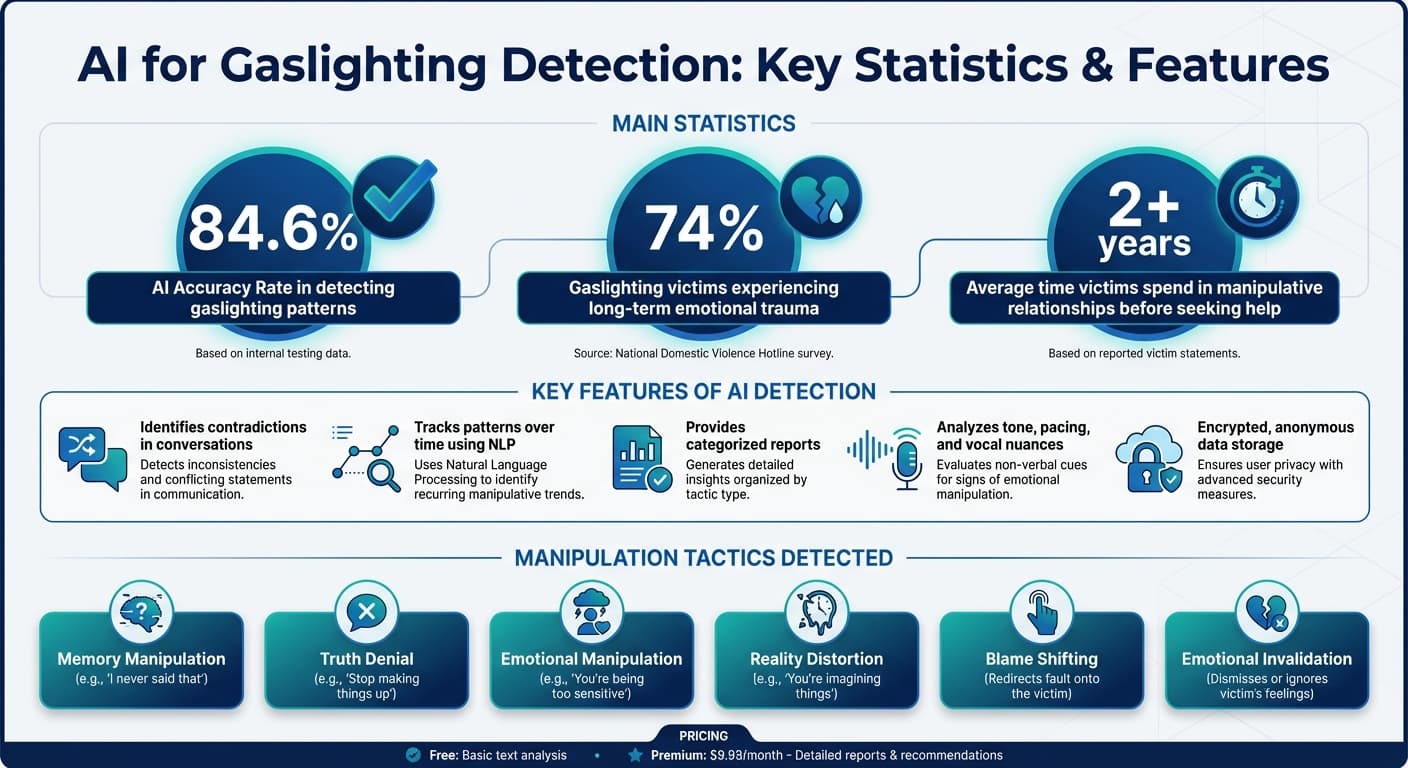
Gaslighting is a manipulative tactic that uses contradictions to make you question your reality. AI tools, like Gaslighting Check, analyze conversations to detect these patterns, providing clarity and helping you identify manipulation. By processing text and voice data with an 84.6% accuracy rate, these tools flag tactics such as denial, blame-shifting, and emotional invalidation. Unlike human memory, AI tracks precise details over time, offering insights into recurring behaviors.
Key Features of AI for Gaslighting Detection:
- Identifies contradictions in conversations (e.g., "I never said that" vs. "You misunderstood").
- Tracks patterns over time using natural language processing (NLP).
- Provides categorized reports highlighting manipulation tactics.
- Analyzes tone, pacing, and vocal nuances in audio files.
- Ensures privacy with encrypted, anonymous data storage.
Gaslighting Check offers free basic text analysis, with premium plans starting at $9.99/month for detailed reports and recommendations. While not a replacement for human judgment, these tools help you regain confidence by highlighting manipulation patterns objectively. Always ensure compliance with local recording consent laws when using such tools.
::: @figure
AI Detects Covert Manipulation (You Won't Believe)
How Contradictions Work in Gaslighting
Gaslighters use contradictory statements as a tool to distort your sense of reality. They push their version of events as the only truth while conveniently denying or revising what they previously said or did. This constant back-and-forth creates confusion, making you question your own memories and perceptions. Over time, this tactic erodes your confidence in your ability to discern what’s real, leaving the gaslighter in control. Let’s look at how these contradictions show up in everyday situations.
Common Forms of Contradictory Statements
Contradictions in gaslighting often follow specific patterns, making them easier to spot once you know what to look for. One common approach is outright denial of past statements. For instance, a gaslighter might claim, "You must be imagining things," when confronted with something they said earlier [1]. Another tactic is flipping their position entirely. A manager, for example, might praise your work one week, only to criticize the same approach the next, all while insisting they’ve always had concerns.
Another method involves presenting two opposing ideas as if both are true. In a family context, a parent might say, "I only want what’s best for you," while simultaneously sabotaging your ability to make independent decisions. Phrases like "You’re being too sensitive" or "Stop making things up" are also frequently used to dismiss and invalidate your reality [1].
Emotional Effects of Contradictory Manipulation
The emotional toll of these tactics can be devastating. When someone repeatedly denies your reality, it chips away at your confidence in your memory and judgment. This confusion often leads to self-doubt and an increasing dependence on the gaslighter to define what’s "real." Studies indicate that 74% of gaslighting victims experience long-term emotional trauma, and many endure over two years in manipulative relationships before seeking help [1].
As your trust in yourself diminishes, it becomes harder to objectively evaluate conversations or rely on your instincts. What starts as fleeting confusion can grow into a constant state of second-guessing, making it even more challenging to break free from the manipulative cycle. The emotional effects aren’t just temporary - they can linger, deeply affecting your ability to trust yourself and others.
Why Humans Struggle to Spot Contradictions
Our brains are incredible, but they have limits - especially when it comes to memory. Working memory, for instance, can only juggle a small amount of information at a time. Imagine trying to recall what someone said last Tuesday, compare it to what they're saying now, and connect it to a conversation from three weeks ago. It’s a lot to handle, and when you’re stressed or scared, it gets even harder. In those moments, your brain prioritizes emotional safety over keeping track of every detail. This natural limitation in memory helps explain why catching gaslighting in the moment can feel almost impossible.
On top of that, human memory doesn’t work like a video recording. Instead, it reconstructs events using fragments and emotions, which means exact recall is out of reach. Gaslighters take advantage of this by pushing their version of events, which can overwrite your already hazy recollections. This is where AI systems stand out - they can process and retain information with far greater precision than human memory [2].
Barriers to Detecting Manipulation Patterns
Modern communication makes spotting manipulation even trickier. Conversations are scattered across texts, phone calls, emails, social media messages, and face-to-face interactions. Each platform feels like its own little bubble, so it’s tough to connect the dots. For instance, you might get a friendly text in the morning, a contradictory phone call at lunch, and a confrontational conversation in the evening. With everything so fragmented, tracking inconsistencies becomes a daunting task.
The sheer volume of digital communication doesn’t help either. In the U.S., it’s common to receive hundreds of messages a day - texts, long threads, voice notes, follow-ups. It’s overwhelming. Add features like message editing or deletion, and you’re left with a nagging feeling that something doesn’t add up but no concrete evidence. Gaslighters also rarely repeat themselves word for word. Instead, they tweak their language and tone just enough to keep you off balance. One moment it’s “I never said that,” then “You misunderstood me,” and later, “That’s not what I meant.” These subtle shifts make it exhausting to pin down the truth.
Cognitive biases further complicate things. For example, confirmation bias might lead you to ignore red flags, while cognitive dissonance pushes you to rationalize contradictions. Social norms in the U.S. that emphasize being "reasonable" or avoiding drama make it even harder to call out manipulative behavior, especially when it involves someone close to you, like a partner, family member, or boss. These mental and social barriers show why an unbiased system is so valuable in exposing manipulation.
AI's Advantage in Pattern Recognition
Unlike humans, AI doesn’t get tired or emotional. It processes data consistently and can handle massive amounts of information across multiple platforms - texts, emails, calls - without missing a beat. AI can sift through weeks or even months of conversations, identifying patterns and contradictions that would take a person hours or days to uncover. Where your memory might blur similar conversations into one vague recollection, AI can pinpoint exact timestamps, compare specific phrases, and track subtle shifts in narrative. Without the interference of stress, fear, or emotional ties, AI’s ability to spot manipulation is a game-changer. It excels where human memory and perception naturally fall short.
Detect Manipulation in Conversations
Use AI-powered tools to analyze text and audio for gaslighting and manipulation patterns. Gain clarity, actionable insights, and support to navigate challenging relationships.
Start Analyzing NowHow AI Detects Contradictory Statements
AI Technologies for Detecting Contradictions
AI uses advanced tools to spot contradictions that might easily escape human notice. Through natural language processing (NLP), conversations are broken down into words, phrases, and sentence structures, allowing the system to understand meaning beyond just the surface. For example, semantic analysis digs deeper to compare the meanings of statements across conversations. If someone says, "I always support your career", but later claims, "I never encouraged you to take that job", AI can highlight the contradiction, even if the phrasing is different.
Another key feature is conversation history tracking, which organizes statements in chronological order. This creates a timeline that makes shifts in narrative much more obvious. Unlike human memory, which can fade or distort over time, AI keeps precise records and can compare statements made weeks or even months apart. These technologies form the backbone of tools like Gaslighting Check, enabling them to evaluate text and audio in real-time for manipulative contradictions.
How Gaslighting Check Works

Gaslighting Check builds on these AI capabilities to systematically identify statements that distort reality. Using machine learning algorithms, it analyzes conversation patterns to detect manipulation tactics. Users can upload text conversations or audio files for instant analysis. The tool doesn't just evaluate the words - it also considers tone, pacing, and vocal nuances to flag problematic tactics. For example, it highlights phrases like "I never said that, you must be confused" (Memory Manipulation) or "Stop making things up" (Truth Denial).
Premium users benefit from conversation history tracking, which identifies contradictions over time, offering a perspective that human memory often struggles to maintain. Privacy is a major focus: all data is encrypted, stored anonymously, and automatically deleted after a set period. Gaslighting Check offers a free plan for basic text analysis, while premium plans start at $9.99 per month, including detailed reports with actionable recommendations.
What AI Detection Results Look Like
When you analyze a conversation, Gaslighting Check provides a detailed breakdown of manipulation tactics, categorizing them into groups like Emotional Manipulation, Reality Distortion, Blame Shifting, Memory Manipulation, Emotional Invalidation, and Truth Denial. For instance, it might flag statements like "You're being too sensitive" as Emotional Manipulation, or "You're imagining things again" as Reality Distortion.
Users also receive comprehensive reports that go beyond identifying tactics - they offer insights into the patterns detected within the conversation. These reports help users understand the manipulation they’re experiencing and suggest practical next steps. One user, Michael K., shared, "The detailed analysis helped me understand the manipulation tactics being used against me. It was eye-opening." Premium reports provide even deeper insights, along with concrete recommendations for moving forward.
"Identifying gaslighting patterns is crucial for recovery. When you can recognize manipulation tactics in real-time, you regain your power and can begin to trust your own experiences again."
- Stephanie A. Sarkis, Ph.D., Leading expert on gaslighting and psychological manipulation, Author of "Healing from Toxic Relationships"
Ethical and Legal Considerations for AI Detection Tools
When it comes to leveraging AI for detecting contradictions, it's just as important to think about the ethical and legal frameworks that govern its use. Once the detection methods are in place, ensuring these tools operate responsibly and within boundaries is crucial.
Using AI as a Support Tool, Not a Replacement
AI tools like Gaslighting Check are designed to assist in identifying manipulation patterns, not to make decisions for you. These tools analyze conversation patterns and flag contradictions objectively, but they don’t have the capacity to fully understand the emotional dynamics of your relationships. Think of them as a flashlight - they shine a light on what’s happening, but it’s up to you to interpret what you see and decide how to act.
The best results come when you combine the insights from AI with your own judgment. In cases where things feel especially complex, consulting with a therapist or counselor can provide additional clarity. While AI can pinpoint shifts - like going from praise to criticism - your personal understanding of the situation is essential for interpreting these findings. Experts agree that AI insights are most effective when paired with human judgment to provide a fuller picture of the context.
Privacy and Recording Consent Laws
Recording conversations for AI analysis brings up some important legal considerations, particularly in the United States. Consent laws vary depending on the state - some allow one-party consent, while others require the agreement of all parties involved in the recording.
Gaslighting Check addresses these concerns by prioritizing privacy. The platform uses end-to-end encryption, anonymizes all data, and automatically deletes it after a set period. It also does not sell, share, or commercialize user data. However, it’s up to users to ensure they comply with local recording laws. These safeguards are designed to protect privacy while enabling users to analyze conversations responsibly.
Limitations and Potential Errors in AI Detection
As advanced as AI detection tools are, they aren’t perfect. Sometimes, they may flag statements as manipulative when they’re actually just miscommunications or natural shifts in opinion. Not every change in tone or perspective is a sign of manipulation. Additionally, AI can struggle with linguistic and cultural nuances, occasionally misinterpreting phrases or communication styles that depend heavily on context.
While Gaslighting Check is effective at identifying patterns over time, it might miss isolated incidents or fail to pick up on emotional subtleties that humans instinctively notice. Its reports are meant to offer insights and recommendations, not definitive proof of manipulation. For this reason, users should treat AI findings as one piece of the puzzle - an additional resource to supplement their intuition and, when needed, professional advice - before making any personal or legal decisions.
Conclusion: Using AI to Recognize Manipulation
Gaslighting thrives on creating confusion and self-doubt, making it incredibly difficult to identify contradictions when you're caught in the middle of it. Unlike relying on memory or subjective recall, which gaslighting often undermines, AI steps in with objective, time-stamped insights. These tools cut through the fog by providing clear, unbiased analysis that doesn’t depend on human memory.
Gaslighting Check stands out for its accuracy, offering a way to detect manipulation in both personal relationships and workplace dynamics. It’s not about making decisions for you - it’s about highlighting the reality of a situation so you can rebuild trust in your own judgment. By uncovering hidden patterns of manipulation, it helps restore your confidence and sense of independence.
With its Premium Plan, Gaslighting Check goes a step further by analyzing text and voice data while ensuring privacy through secure tracking. This level of clarity can help you regain control and trust in your own perceptions.
FAQs
How does AI detect contradictions in communication?
AI identifies contradictions by examining the structure and patterns of language in conversations. It spots inconsistencies, conflicting statements, and tactics like denial, distortion, or invalidation, whether found in text or audio.
This process can reveal behaviors commonly linked to gaslighting, offering clarity and emotional understanding for those experiencing such interactions.
How does Gaslighting Check protect my privacy?
Gaslighting Check takes your privacy seriously. It employs end-to-end encryption to safeguard all your conversations and recordings, ensuring your data stays secure whether it's being transmitted or stored. To add another layer of protection, your data is automatically deleted after analysis - unless you decide to save it. Plus, Gaslighting Check guarantees that your information is never shared with third parties, giving you peace of mind while using the platform.
Can AI help identify gaslighting, or does it still require human judgment?
AI can assist in spotting gaslighting by analyzing patterns, contradictions, and manipulative tactics in conversations. However, it’s not a substitute for human judgment. Grasping emotional context and subtle nuances still relies heavily on human interpretation.
These tools are most effective when used to support human awareness and intuition, offering insights and evidence to enhance understanding rather than serving as a standalone solution.